
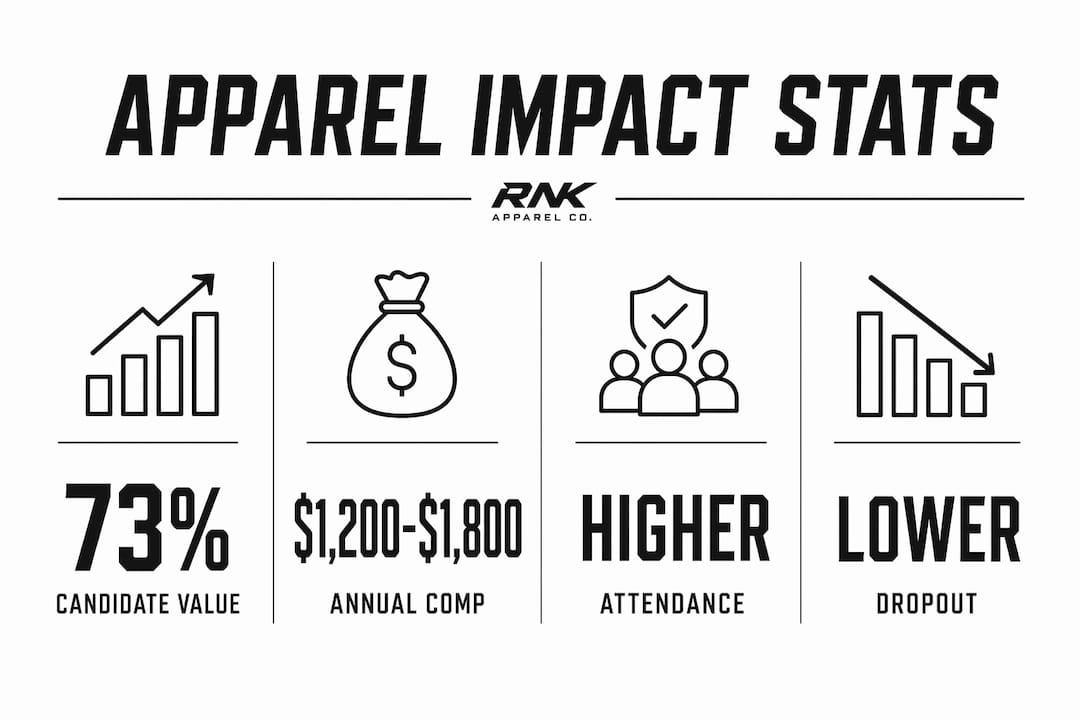
High-quality, personalized team apparel raises a program’s perceived professionalism and speeds recruit decisions faster than most coaches expect. The role of apparel in team recruitment is not a soft, feel-good concept Research from UNIFORMS.COM.AU shows that 73% of candidates value quality uniforms as a $1,200–$1,800 annual compensation equivalent. That figure alone reframes what a welcome kit costs.
The single most effective first step: build a 10–15 item welcome kit (jersey, hoodie, hat) and hand it to every recruit at first contact. Rnkapparel makes this straightforward with custom hockey apparel, small-batch fulfillment, and no-minimum order options that fit programs of any size.
What apparel does for recruitment, at a glance:
- Signals program investment and professionalism before a coach says a word
- Creates an immediate sense of belonging through personalization (name, number, logo)
- Functions as a tangible compensation equivalent recruits and parents notice
- Reduces perceived status gaps between veterans and newcomers
- Generates shareable social content that extends your program’s reach organically
Table of Contents
- How does apparel affect recruitment psychology?
- Seven tactics that put apparel to work in your recruitment cycle
- What should you prioritize when ordering team apparel?
- How do you measure apparel’s impact on recruitment?
- How RNK Apparel Co. supports recruitment-focused teams
- Key Takeaways
- Why coaches underestimate what a jersey actually does
- Your next recruitment kit is one order away
How does apparel affect recruitment psychology?
Matching gear works on recruits through three overlapping mechanisms: group-identity activation, enclothed cognition, and social signaling. When a recruit puts on a jersey with their name on it, the psychological shift is immediate. Research on group dynamics and enclothed cognition shows that matching apparel reduces the salience of individual differences and moves thinking toward cooperation and collective identity. That is not a slow process. It happens in the first wearing.
Field research on youth and amateur teams links consistent uniforms to higher attendance, lower dropout rates, and stronger cohesion across a season. For a coach trying to convert a tryout attendee into a signed player, that early cohesion signal matters.
The compensation-equivalent effect is real. When 73% of candidates mentally assign $1,200–$1,800 in annual value to a quality uniform program, apparel stops being a line item and starts being part of your player value proposition. Coaches who frame it that way in recruitment conversations close faster.
Seven tactics that put apparel to work in your recruitment cycle
Apparel’s impact on team selection depends entirely on how and when you deploy it. Here are seven tactics coaches can implement now, ordered from highest psychological impact to lowest cost:
-
Welcome kits at first contact. A personalized jersey, team hoodie, and hat handed to a recruit on their first visit signals commitment before any contract is signed. Budget tier: medium ($60–$120 per kit). Timing: recruit visit or tryout day one.
-
Personalized jerseys with name and number. A recruit’s name on the back of a jersey is the fastest psychological shortcut to belonging. It communicates “you already have a spot here.” Order through Rnkapparel’s customization flow: upload logo, add name/number, select colors. Timing: offer day or signing.
-
Event-exclusive apparel. Create a limited run of gear tied to a showcase, tournament, or open tryout. Small-batch DTF printing removes the old minimum-order barrier, so a 15-piece exclusive drop is now economical. Scarcity creates urgency in recruitment campaigns without large capital outlay.
-
Travel and practice kits. Programs that extend consistent apparel across practice and travel reinforce identity beyond game day. A recruit who sees your team arrive at a tournament in matching gear reads that as organizational discipline. Consistent program gear from practice to travel strengthens recognition and signals a well-run operation.
-
Social-ready photo kits. Design one clean, high-contrast kit specifically for signing-day photos and social posts. Recruits share these. Parents share these. Each post extends your program’s reach to the recruit’s entire network. Include custom hats for added visual variety.
-
Limited-edition seasonal drops. A “founding class” hoodie or a season-specific colorway creates collector appeal. Offer it only to players who commit before a deadline. Budget tier: low per unit when ordered in small batches.
-
Inclusive sizing across the full roster. Recruits who cannot find their size in your gear feel excluded before they play a game. Order across the full size range and confirm fit with a sample run before committing to a full roster order.
Pro Tip: Design for contrast first. High-contrast color combinations read better in photos, on video, and on the ice. A recruit’s signing-day photo shared on social media is free advertising. Make sure your colors are distinct and bold enough to pop in a phone camera shot.
What should you prioritize when ordering team apparel?
Procurement mistakes cost programs time and money. Order the wrong sizes, pick a low-quality fabric, or miss a lead-time window, and your recruitment kit arrives after the player has already committed elsewhere. Here is the priority order that prevents those mistakes:
- Material quality and durability. Recruits and parents touch the garment. A flimsy hoodie undercuts the professionalism signal you are trying to send. Prioritize performance fabrics that hold shape after washing.
- Correct fit and inclusive sizing. Confirm sizing with a 5–10 piece sample order before a full run. This prevents costly returns and lets staff validate appearance before committing.
- Color contrast for gameplay and visibility. Visual contrast is an operational priority. FIFA’s kit assignments treat contrast as the top criterion because it affects officiating and player decision-making. Apply the same logic to your practice and game kits.
- Clear branding and personalization options. Logo placement, name/number legibility, and color consistency across garment types all affect perceived quality. Review Rnkapparel’s logo placement guide before finalizing artwork.
- Lead times and production minimums. Plan for a 2–4 week quick-kit workflow for sample orders. Full roster runs may need 4–6 weeks depending on customization complexity.
- Budget justification. The perceived compensation equivalent from UNIFORMS.COM.AU research — $1,200–$1,800 valued by 73% of candidates — gives you a concrete figure to present to administrators when requesting apparel budget.
| Priority | What to check | Why it matters |
|---|---|---|
| Material quality | Fabric weight, wash durability | Signals program investment |
| Fit and sizing | Full size range, sample run first | Prevents exclusion and returns |
| Color contrast | Distinct colors, bold combinations | Gameplay clarity and photo impact |
| Branding clarity | Logo size, placement, legibility | Perceived professionalism |
| Lead time | 2–4 weeks sample, 4–6 weeks full | Hits recruitment calendar windows |
How do you measure apparel’s impact on recruitment?
Tracking results turns a gut feeling into a repeatable program. Run a baseline period of 4–8 weeks before introducing your apparel campaign, then measure the same metrics for 4–8 weeks after. The gap tells you what moved.
Primary metrics to track:
- Inquiry volume (calls, emails, social DMs asking about tryouts)
- Trial and tryout attendance numbers
- Offer acceptance rate
- Signed commitments per recruitment cycle
- First-season retention rate
- Social engagement: photo shares, mentions, and tags featuring your gear
For recruit and parent feedback, use three to five short survey questions after the first contact or tryout:
- “How professional did the program appear when you first visited?”
- “Did receiving team gear influence your impression of the program?”
- “How comfortable did the apparel feel compared to what you expected?”
- “Did you share any photos of the team gear on social media?”
A simple Google Sheet tracking these metrics monthly is enough for most programs. If you want to go further, clubs struggling to fill team rosters often find that perceived professionalism is the gap, and apparel data makes that visible.
How RNK Apparel Co. supports recruitment-focused teams
Rnkapparel provides custom hockey apparel and small-batch fulfillment built for exactly this kind of recruitment workflow. The product range covers everything a welcome kit needs: hoodies, graphic tees, joggers, hats, and accessories, all with full customization for team logos, player names, and numbers.
The ordering flow is straightforward:
- Design: Upload your logo and select colors, garment types, and personalization options
- Sample order: Start with 5–10 pieces to validate fit, sizing, and print quality
- Approval: Confirm the sample before committing to a full roster run
- Full order: Place the bulk order with confirmed specs
- Delivery: Typical lead times run 2–4 weeks for sample kits; full orders vary by complexity
Rnkapparel’s custom apparel guide and youth hockey design guide walk coaches through design decisions that affect both perceived quality and on-ice performance. For programs new to the process, the logo upload guide covers file requirements and artwork approval steps.
Key Takeaways
Apparel is a recruitment lever when coaches treat it as part of the player value proposition, not just a uniform expense.
| Point | Details |
|---|---|
| Perceived compensation value | 73% of candidates value quality uniforms as $1,200–$1,800 in annual compensation equivalent. |
| Welcome kit timing | Hand a personalized jersey, hoodie, and hat to every recruit at first contact for maximum psychological impact. |
| Sample order first | Order 5–10 pieces before a full run to validate fit, sizing, and print quality and avoid costly returns. |
| Measure what moves | Track inquiry volume, offer acceptance, and social engagement before and after your apparel campaign. |
| Rnkapparel fulfillment | Rnkapparel offers small-batch custom hockey apparel with no-minimum options, supporting quick welcome kits and full roster orders. |
Why coaches underestimate what a jersey actually does
The conventional wisdom treats apparel as a finishing touch, something you sort out after you have already recruited the player. That framing gets it backwards. A personalized jersey handed to a recruit on day one does something a coach’s speech cannot: it makes the recruit feel like they already belong before they have earned a spot. That psychological shortcut, the immediate legitimacy a named jersey creates, collapses weeks of relationship-building into a single moment.
What coaches often miss is that the parents in the room are watching too. A parent who sees their kid hold up a jersey with their name on it reads that as organizational seriousness. They are not evaluating the stitching. They are deciding whether this program takes care of its players. Apparel answers that question without a word.
The ESPN data is worth keeping in perspective: uniforms tend to function as a tiebreaker rather than a primary decision factor for elite recruits. But most programs are not competing for elite recruits. They are competing for the committed, coachable player who has two or three reasonable options. At that level, the program that looks and feels more professional, that hands over gear on day one, wins that decision more often than not.
Your next recruitment kit is one order away
Rnkapparel gives coaches a direct path from this article to a working welcome kit. Custom hockey hoodies, graphic tees, and accessories ship to teams across the United States and Canada, with full personalization for logos, names, and numbers. No large minimum orders required for sample runs, so you can validate fit and design before committing to a full roster.
Start with a custom hockey hoodie or a graphic tee for your first welcome kit. Add accessories like hats to round out the package. Once your sample order arrives, confirm sizing across your roster and place the full run. After your first recruitment cycle with the new kits, run the four-week measurement window from the metrics section above and track what changed in inquiry volume and offer acceptance. The data will tell you whether to scale up next season.
Recommended
- Why Youth Teams Use Matching Apparel for Team Unity – RNK Apparel Co.
- Design Youth Hockey Team Gear: A Coach’s Guide – RNK Apparel Co.
- Personalized Hockey Coach Gift Guide: Performance Gear They’ll Actually Wear (2026) – RNK Apparel Co.
- What Does Custom Apparel Mean for Sports Teams? – RNK Apparel Co.
