

Yes, in most cases, if you act now: rush printing paired with local pickup is the fastest reliable way to get custom jerseys before a tournament, with stocked or semi-custom garments as a close second. The catch is shipping. Rush production can turn a design around in hours, but once a package enters the carrier’s network, transit time still counts against your deadline. RNK Apparel can quote a realistic path once it knows your date, roster, and artwork.
TL;DR:
- Rush printing combined with local pickup can deliver jerseys within 10 days, minimizing transit time delays but requiring quick supplier response.
- Custom jersey production ranges from 2 to 6 weeks depending on the complexity, with full custom orders needing at least 10 to 14 weeks if schedule permits.
- Payment and proof approval timing, not order placement, start the production clock, so finalizing roster and artwork early prevents delays.
- Giving suppliers an arrival-by date and building in a two-day buffer significantly reduces the risk of late delivery due to shipping or transit issues.
- Simplified designs or reorders of existing templates are the fastest options for last-minute tournament preparations.
Table of Contents
- How Long Does It Actually Take to Order Custom Jerseys?
- What’s the Fastest Way to Meet a Tournament Deadline?
- How Do You Prep a Jersey Order to Avoid Delays?
- Rush Printing vs. Shipping: What Actually Controls Your Deadline
- A Manager’s Take on Rush Jersey Orders
- Get Your Tournament Jerseys Ordered With RNK Apparel
- Sources
- FAQ
How Long Does It Actually Take to Order Custom Jerseys?
Basic customization, meaning names and numbers on a stock jersey, typically ships in 2 to 3 weeks. Semi-custom work, where you’re adding sublimated panels or partial logo builds, runs 3 to 4 weeks. Full custom jerseys with original sublimated designs, unique cuts, or complex team branding usually take 4 to 6 weeks, according to ordering guidance from French Press Custom.
These are ranges, not guarantees. A supplier backed up with tournament season orders can push toward the longer end even for a basic job.
Here’s the part managers miss most: the production clock doesn’t start when you place the order. It starts when you approve the proof and the payment clears. If your team spends five days debating jersey colors after the quote comes in, that’s five days gone before the supplier even begins cutting fabric.
For anything approaching full custom, French Press Custom’s planning research recommends starting 10 to 14 weeks out whenever the schedule allows it. That sounds excessive for a tournament three weeks away, but it’s the number that keeps a program from scrambling every single season. If you’re already inside that window, don’t panic. It just means your options narrow toward the faster paths below rather than closing off entirely.
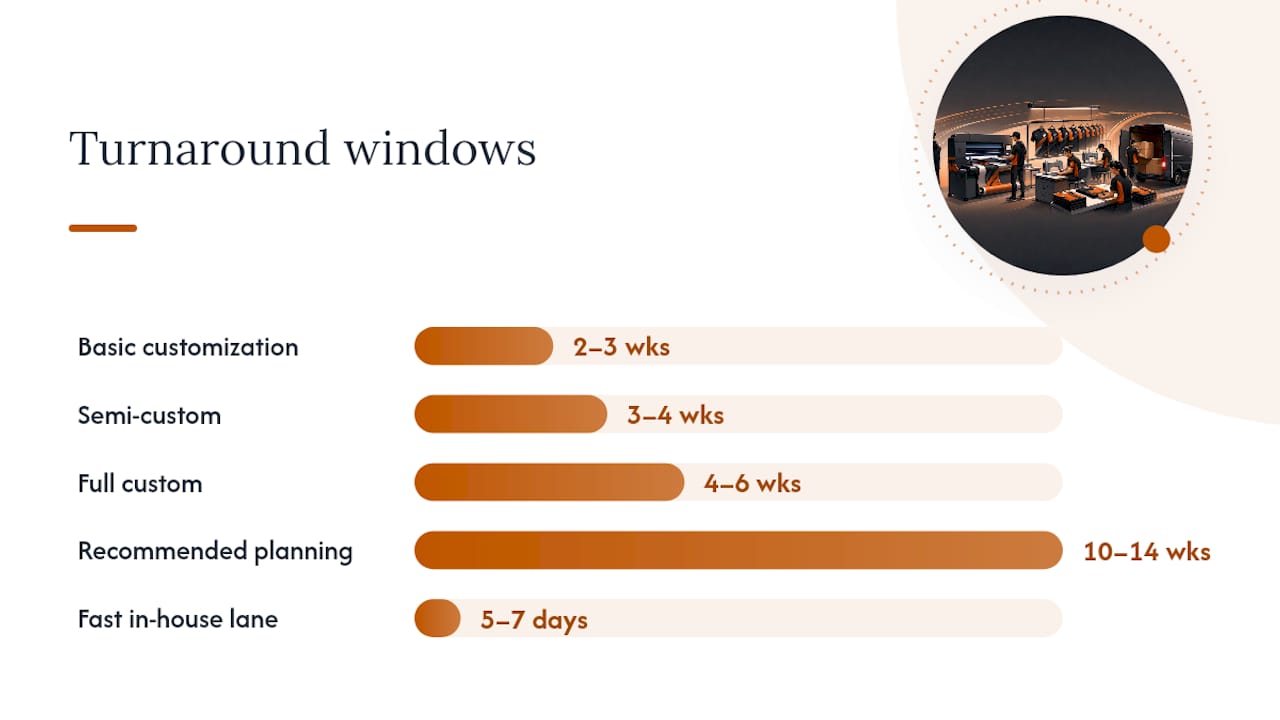
Some suppliers also run one-week in-house sublimated hockey jersey programs, where a U.S. warehouse handles design and production start to finish. HockeyTron’s turnaround program offers design contact within one business day and production in 5 to 7 days after approval, though these fast lanes usually apply to specific garment types and come with minimum order requirements.
What’s the Fastest Way to Meet a Tournament Deadline?
Rank your options by how much control you have over the last mile, not just the print time.
- Rush print plus local pickup. This is the fastest combination available because it removes the one variable nobody can fully control: carrier transit. If your supplier has a pickup counter within driving distance, this is almost always your best move under 10 days.
- Rush print plus expedited shipping. Faster than standard shipping, but you’re still at the mercy of the carrier network. A rush print completed in hours can still sit in a truck for two days before it reaches you.
- Stocked or semi-custom garments. When a full custom build isn’t realistic, jerseys built on pre-stocked blanks with heat-pressed names and numbers are often the fastest reliable route, since the base garment is already sitting in inventory.
- Reorders or partial kits. If you already have a jersey template on file with a supplier, reordering additional units or a partial run for late roster additions moves faster than starting from scratch.
Rush printing itself can be completed in 1 to 3 hours once a supplier accepts the order before their cutoff, but that speed only applies to the print job, according to DTF Jersey’s turnaround documentation. Shipping is a separate clock entirely.
If none of these paths get you there in time, your remaining option is a simplified design, names and numbers only, on whatever base garment can move fastest, or splitting the order so the starting lineup gets outfitted first.
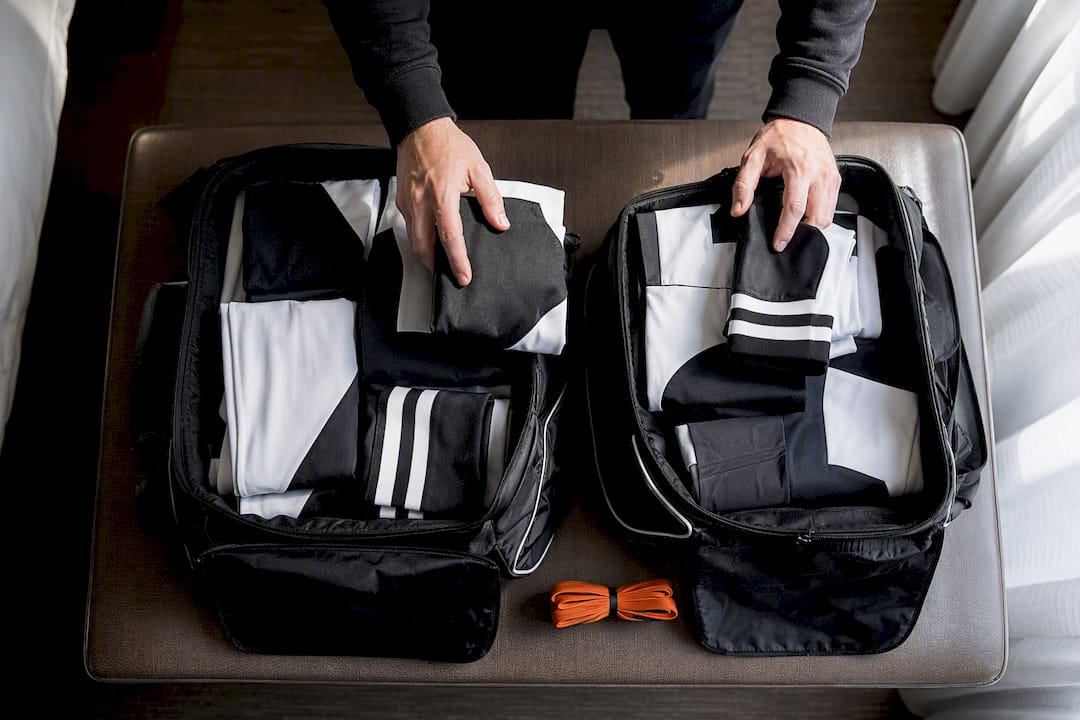
Pro Tip: Call your supplier before you design anything. Ask what’s realistic for your date first, then build the design around that answer instead of the other way around.
How Do You Prep a Jersey Order to Avoid Delays?
Most tournament deadline problems aren’t printing problems. They’re paperwork problems that stall an order before it ever reaches the production floor.
- Lock the roster and sizes first. Names, numbers, and sizes need to be final before you request a proof. Every roster change after that point restarts part of the review.
- Send print-ready artwork. Vector files or high-resolution logos, plus a clear note on sponsor placement, prevent a back-and-forth that eats days. Fuzzy screenshots get bounced back for revisions.
- Pick one approver. Committees don’t approve jerseys fast. Name a single person, coach, manager, or team parent, and give them a firm internal cutoff for sign-off.
- Pay or submit your purchase order immediately after approval. Production doesn’t begin on approval alone. Payment is usually the actual trigger.
- Order 2 to 3 spare jerseys in common sizes. A late roster addition or a lost jersey mid-season shouldn’t force a slower, pricier reorder later.
Managers who treat the order checklist as a formality, rather than a gate, are the ones calling suppliers in a panic a week before the tournament.
Rush Printing vs. Shipping: What Actually Controls Your Deadline
Suppliers run on cutoffs, not vague promises. A common pattern is a same-day processing cutoff around 3:00 PM and a rush or pickup cutoff around 4:00 PM on business days, per DTF Jersey’s documented workflow. Miss the cutoff, and your order rolls to the next business day, no exceptions.
Rush print can be done in 1 to 3 hours. Shipping is still a separate, additive block of time unless you pick up in person.
Skip telling your supplier the tournament date. Instead, give them an arrival-by date, something like “must arrive by September 10,” which is the approach recommended in Kiteflag’s promotional buyer lead-time guide. That framing removes ambiguity and lets them pick the fastest routing that actually works.
Pro Tip: Build in a two-day buffer between “arrive by” and the tournament date itself. Gear bags get lost, box trucks run late, and a buffer is cheaper than a bench full of players in mismatched jerseys.
A Manager’s Take on Rush Jersey Orders
Here’s the rule of thumb worth memorizing: under 72 hours, plan for pickup with a simplified name-and-number design. Inside two weeks, semi-custom with rush processing is your realistic ceiling. Past four weeks, full custom is back on the table. The pitfall RNK sees most is teams treating the deadline as the ordering date instead of the arrival date, which quietly erases a week nobody accounted for.
— Eric
Get Your Tournament Jerseys Ordered With RNK Apparel
A custom hockey apparel provider builds gear specifically for teams working against a clock, with online design tools that let you upload a logo, set colors, and enter your roster without waiting on back-and-forth email threads. When you reach out, have five things ready: the date your jerseys need to arrive, your finalized roster with sizes, print-ready artwork, your total quantity including spares, and whether you’re picking up locally or need shipping.
That upfront information is the difference between a quote that’s accurate and one that gets revised twice before production even starts. Start your custom order on the Customized Hockey Apparel page, and if your tournament kit needs more than jerseys, extras like hoodies or warmup shorts can be quoted alongside your main order rather than as a second scramble later. For a detailed work-back schedule before you commit to a date, RNK’s own turnaround planning guide walks through the math week by week.
Sources
Cross-check any rush promise against a supplier’s own documentation before you commit a deposit. RNK’s tournament pack guide and extras ordering guide cover common scenarios, while DTF Jersey’s rush cutoff breakdown documents the industry-standard cutoff windows referenced above.
- DTFJersey: Rush, same-day, or standard DTF turnaround
- French Press Custom: Custom team jerseys and uniforms ordering guide
- Kiteflag: 2026 promo buyers calendar and lead times
FAQ
How Long Does It Take to Make a Custom Jersey?
Basic customization usually takes 2 to 3 weeks, semi-custom runs 3 to 4 weeks, and full custom builds take 4 to 6 weeks, per French Press Custom’s ordering guide. Rush production can shrink the print step to 1 to 3 hours, but shipping still adds time unless you arrange local pickup.
How Much Does It Cost to Get a Custom Jersey?
Pricing depends on garment type, decoration method, and order quantity, and rush orders typically carry a premium over standard processing. RNK Apparel’s current pricing for custom hockey apparel is listed on the site, since jersey builds vary too much by design to quote a single flat number.
Can I Create My Own Custom Jersey?
Yes. Online configurators let you choose a template, pick colors, upload your logo, and enter roster names and numbers before approving a final proof. RNK’s online jersey customizer walks through that exact process step by step.
What Are the Rules for Customizing Professional League Jerseys?
Officially licensed league jerseys carry trademark restrictions on logos, team marks, and league branding that limit how much a third party can customize them. For team and recreational hockey apparel that isn’t tied to licensed professional league merchandise, those restrictions don’t apply, which is why most tournament and club orders use original or licensed-blank designs instead.
