

Adult back numbers typically run 8 to 12 inches tall, while youth back numbers sit closer to 6 to 8 inches. Front numbers are smaller across every sport, usually 3 to 6 inches for youth and 4 to 10 inches for adults, with sleeve and shoulder numbers landing around 2 to 4 inches. Those ranges cover most recreational and scholastic orders, but check the sport-specific table below and confirm your league’s written minimums before you send anything to production.
TL;DR:
- League rules, especially NFHS football requirements, enforce minimum number heights of at least 8 inches for front and 10 inches for back numbers, while other sports have industry recommendations.
- Jersey numbers should be measured starting from the collar seam and centered on the spine, with size confirmed on a flat template and then on a live player to prevent shifts.
- Fabric type and printing method, such as mesh or twill, require adjustments in numeral size and outline to maintain readability and correct appearance from a distance.
- Full-team jersey orders should include sample proofing for size, placement, and color contrast, with sign-off from coaches before production begins.
- Accurate, consistent placement and accounting for fabric stretch are more critical to a professional look than precise adherence to size charts.
Table of Contents
- Jersey Number Size Chart by Sport
- How Do You Measure and Center Jersey Numbers?
- What League Rules Govern Jersey Number Sizes?
- Does Fabric or Printing Method Change the Number Size You Need?
- How Full-Team Jersey Number Orders Are Typically Handled
- Where to Verify Official Jersey Sizing Rules
- Why Most Sizing Charts Undersell What Actually Matters
- Sources
Jersey Number Size Chart by Sport
Every sport treats numbers a little differently, and the gap between “looks right” and “meets the rule book” trips up a lot of first-time team managers. The table below gives you a working starting point for a full jersey size chart across the sports Rnkapparel customers order most, plus a few adjacent ones you’ll likely run into as a decorator.
A few things to flag before you build artwork from this table:
- Football minimums are league-enforced, not optional. NFHS specifications commonly set front numbers at a minimum of 8 inches and back numbers at a minimum of 10 inches for high school play, according to a breakdown of jersey numbering rules. Everything else in the chart is a common industry recommendation rather than a hard rule.
- Basketball has a numbering restriction most people never notice. Scholastic basketball limits legal jersey digits to combinations using only 0 through 5, a rule that exists because officials signal fouls with hand gestures, per Stahls’ team decorator reference. A player wearing 74 or 89 is fine at the pro level but won’t pass inspection in most high school gyms.
- Soccer rarely carries a front number at all. Most club and school kits put the number on the back only, occasionally adding a small shorts number instead.
- Hockey back numbers run larger than almost any other sport because they need to stay legible from the far blue line, and the long-sleeve jersey gives decorators more vertical real estate to work with.
- Front numbers are consistently smaller than back numbers across every sport, mainly because officials and scorekeepers rely on the back number for identification during live play, a pattern confirmed across team decorator placement checklists.
Hockey jersey templates are often built against the higher end of these ranges, since rink lighting and distance from the stands both push toward bigger, bolder numerals than a gym or field sport needs.
How Do You Measure and Center Jersey Numbers?
Getting the size right on paper doesn’t help if the number ends up crooked or floating too high on the back panel. Here’s the process decorators use to keep a full team consistent, garment to garment:
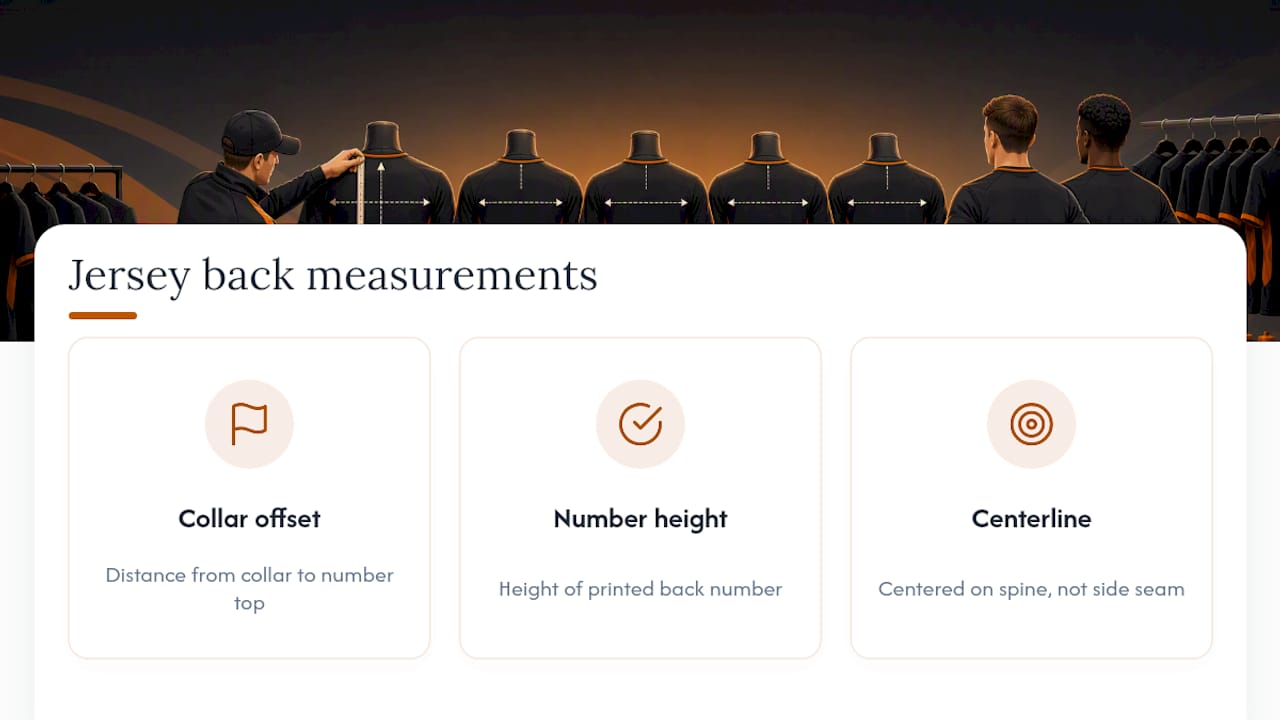
- Start at the collar seam, not the shoulder or hem. Measure straight down 2 to 4 inches from the base of the collar to set the top edge of the number. Anchoring to the collar, rather than a percentage of jersey length, keeps the number sitting at the same visual height across a youth small and an adult XXL, according to Stahls’ placement guidance.
- Center the number horizontally between the shoulder blades, not between the side seams. Fold the garment flat and match the centerline to the spine, since side-seam centering drifts on jerseys with curved side panels.
- Check the number height while the player is bent forward, not just standing straight. Football and hockey numbers need to stay visible when the athlete is crouched or skating in a low stance.
- Set front numbers with at least 1 to 2 inches of clearance from the collar and any chest logo so the number doesn’t crowd the neckline or crest.
- Place sleeve or shoulder numbers centered on the outer sleeve panel, roughly 1 to 2 inches below the shoulder seam, keeping them small enough that they don’t wrap into the underarm curve.
- Proof on a flat template first, then confirm on a body form or a live player before cutting a full run. Numbers that look centered flat sometimes shift once the fabric stretches over shoulders.
- Build a checklist for sign-off: roster spelling and numbers confirmed, size chart matched to actual garment measurements, one sample printed per size class, and a written approval from the coach or team manager before bulk production starts.
Pro Tip: Print one full sample jersey in your smallest and largest ordered size before running the whole roster. A number that’s perfectly centered on a medium can drift noticeably on an XXL cut from a different pattern block.
What League Rules Govern Jersey Number Sizes?
League specifications exist for a reason beyond tradition. Referees need to read numbers at a glance, and scorekeepers need consistency across every roster in the league. A few rules come up constantly:
- NFHS football sets minimum number heights (commonly 8 inches front, 10 inches back) and assigns numbers by position group in many state associations, meaning offensive linemen, receivers, and quarterbacks each fall into a required numbering range.
- NFHS basketball restricts legal digits to combinations of 0 through 5, a detail that catches teams off guard when they order numbers online without checking the rule first, per Stahls’ team decorator PDF.
- NCAA and professional leagues (NBA, NHL) publish their own uniform specification sheets, and these often diverge from scholastic rules, particularly around number placement, patch clearance, and sponsor logo zones.
- Recreational and travel leagues generally use open numbering, meaning any player can wear any available number regardless of position, unlike the position-restricted system in scholastic football.
- Always request the current written spec sheet from your specific league before finalizing artwork. Rules change by state association and by season, and a number size that passed inspection last year isn’t guaranteed to pass this year.
Skipping this step is the single most common reason teams get artwork rejected at check-in, right before a game, when there’s no time left to fix it.
Does Fabric or Printing Method Change the Number Size You Need?
The number on your spec sheet and the number that actually reads clearly from the stands aren’t always the same thing, and the gap comes down to material.
- Sublimation prints edge-to-edge with no texture buildup, giving the crispest edges and the most accurate match between your intended size and the printed result.
- Tackle twill looks sharp and durable but needs a seam allowance. Stahls recommends an edge buffer of roughly 0.125 to 0.25 inches per edge to prevent fraying, which slightly reduces the visible numeral area compared with a flat heat-transfer number cut to the same nominal size.
- Heat transfer vinyl holds crisp edges similar to sublimation but can crack or peel faster under heavy wash cycles, which matters for numbers players wear every practice for a full season.
- Open-mesh or heavily textured fabrics swallow fine detail, so add roughly 0.5 to 1 inch to your planned height on mesh jerseys to preserve the same perceived size you’d get on a smooth knit, a practical adjustment Stahls recommends for exactly this reason.
- Low-contrast color combinations (navy on black, white on light gray) need a thin outline or drop shadow, since the raw numeral size on paper doesn’t guarantee readability once it’s on fabric under stadium or rink lighting.
Pro Tip: If you’re printing on a mesh basketball or lacrosse jersey, bump your number height up half an inch beyond what the size chart says and outline it. What reads clean on a flat proof sheet often looks smaller once it’s stretched over open weave.
How Full-Team Jersey Number Orders Are Typically Handled
Team orders generally start with roster collection: names, numbers, and garment sizes confirmed in writing before any template gets built. From there, numbers get placed on a standard template, a sample gets produced, and the team manager signs off before the full run goes into production, a workflow that mirrors the proofing checklist practitioners rely on industry-wide.
Hockey orders often get an extra layer of attention. Long sleeves and shoulder pads change how a number sits and reads compared with a short-sleeve baseball or basketball jersey, so sample adjustments are common before a size run gets locked. The most frequent fixes on incoming rosters include names submitted without matching numbers, numbers centered to the side seam instead of the spine, and low-contrast color pairings that need an outline added before printing. Catching these on a sample proof, rather than after 20 jerseys are printed, is key to keeping a team set looking uniform from the front row to the top of the bleachers.
[Image placeholder: sample team jersey proof showing measurement callouts for collar offset, number height, and centerline]
Where to Verify Official Jersey Sizing Rules
Before locking artwork, confirm the numbers against a primary source rather than a blog post. Useful references include:
- NFHS rule books for scholastic sport-specific number and placement requirements
- Stahls Team Decorator PDF for sizing tables and basketball digit rules
- Nike NBA & WNBA jersey size chart when matching a specific brand’s body measurements to your placement template, since numeric sizes vary between manufacturers even at the same label size, an issue also covered in this designer size conversion guide
- Your printable measurement template, saved and reused for every proofing cycle so placement stays identical season to season
Why Most Sizing Charts Undersell What Actually Matters
The size chart gets all the attention, but it’s the least likely thing to actually go wrong on a team order. Numbers that are half an inch off from some published standard almost never cause complaints. Numbers that are inconsistently placed jersey to jersey, or unreadable because nobody accounted for fabric texture, cause complaints every single time.
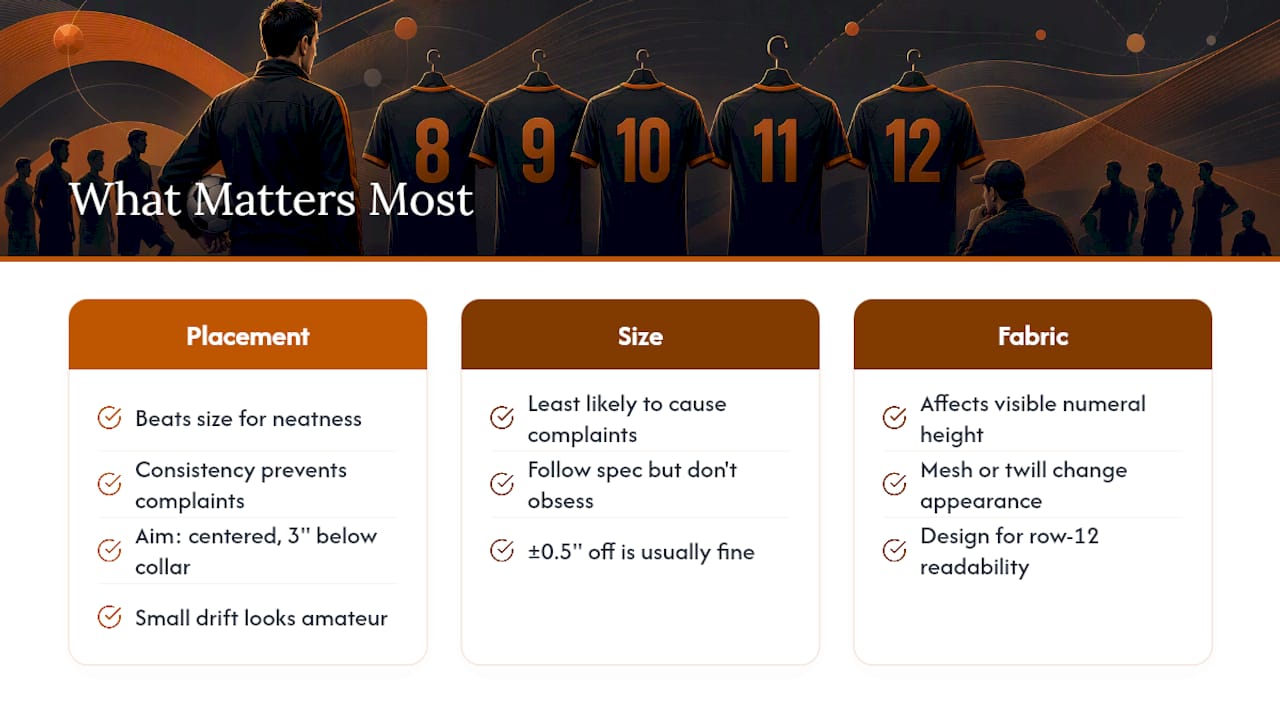
If I had to rank what actually separates a clean team set from a sloppy one, consistency of placement beats precision of size almost every time. A team where every back number sits exactly 3 inches below the collar and centered on the spine looks sharp even if that measurement is a half inch outside some guide’s recommendation. A team where the numbers are technically “correct” size but drift half an inch left on some jerseys and right on others looks amateur regardless of what the tape measure says.
The other overlooked piece is fabric. Decorators obsess over the numeral height on the spec sheet and forget that mesh, twill seam allowance, and low-contrast colors all quietly shrink the number you actually see from the stands. Measure for what a parent in row twelve can read, not just what fits the template.
— Eric
Ready to build a full team set instead of guessing garment by garment? Browse custom hockey shirts built around consistent number placement, or check the long sleeve tees if you need sleeve number space that a short-sleeve cut can’t give you.
Sources
- Stahls Team Decorator (sizing and numbering reference)
- Recommended Jersey Letter and Number Sizes for Sports Garments
