
A tournament apparel pack should cover five bases: a tournament tee for identity, a warm hoodie for downtime between games, warmup joggers for travel comfort, spare base layers and socks for the grind of back-to-back games, and a small accessories kit for the moments gear fails. Get those five right and everything else, from color matching to fundraising, is detail work. The rest of this guide walks through ordering, sizing, pricing, and packing so that detail work goes smoothly.
TL;DR:
- Prioritize durable fabrics, double-stitched seams, and reinforced zippers to ensure apparel withstands multiple wash cycles and rough tournament conditions.
- Order at least three to four weeks in advance, collecting accurate sizes through a structured process to avoid last-minute errors and delays.
- Focus on core items like hoodies and tournament tees for maximum wear and team spirit, reducing costs on personalization if budget constraints exist.
- Confirm artwork in vector format, request physical samples for complex designs, and verify lead times to prevent costly mistakes or missed deadlines.
- Pack extras of fast-wearing items, establish a drying plan, and label gear to avoid missing or mishandling equipment during the tournament.
Table of Contents
- What Should Be in a Hockey Tournament Apparel Pack?
- Choosing Fabrics, Fits, and Construction That Survive a Tournament Weekend
- How to Order a Custom Tournament Apparel Pack Without Missing Deadlines
- What Does a Tournament Apparel Pack Actually Cost?
- Packing and Tournament-Day Logistics That Keep a Team Ready
- RNK Apparel Co.: Where the Recommended Pack Actually Lives
- How Should Apparel Handle Different Tournament Weather?
- What Makes a Hockey Apparel Supplier Trustworthy?
- What Ordering Mistakes Cost Teams the Most Time?
- A Coach’s Take: Prioritize Function Over Flash
- Get Your Team’s Tournament Pack Ordered Through RNK Apparel Co.
- Primary Sources for Packing and Tournament-Prep Guidance
- Sources
- FAQ
What Should Be in a Hockey Tournament Apparel Pack?
Ask ten hockey parents what to pack for a hockey tournament and you will get ten slightly different answers, but the core list barely changes. A well-built pack is built around function, not just team spirit. Each piece earns its spot because it solves a specific problem that shows up during a three-day tournament weekend: cold rinks, wet gear, long drives, and downtime between games that stretches on for hours.
Here is the shortlist that shows up in nearly every credible team apparel bundle:
- Tournament tee — the identity piece. Worn on travel days, warmups, and team photos, it is usually the item players wear the most outside the rink.
- Hoodie or crew — the warmth layer for cold arenas and outdoor rink walks between periods, especially at tournaments held in unheated buildings.
- Warmup joggers — comfortable enough for a four-hour car ride, presentable enough for the hotel lobby and team dinner.
- Travel tee or long sleeve — a second identity layer so players are not wearing the same shirt for three straight days.
- Socks — often overlooked in apparel packs, but tournament play means multiple games without laundry access.
- Hat or beanie — a low-cost, high-visibility accessory that rounds out a pack without adding much per-player cost.
Youth packs and adult packs diverge mostly on sizing and fabric weight. Youth players run through sizes fast, so many teams order slightly loose to extend a garment’s useful life across a season instead of ordering exact-fit. Adult league packs tend to lean into heavier fleece and fitted joggers since players are less likely to grow out of them mid-season. Single-player orders and full team bulk orders also differ: individual buyers can pick exactly what they want, while team orders need a size matrix and a single point of contact to keep the process from turning into forty separate emails.
Pro Tip: If your budget only covers three items per player, skip the accessories and put the money into the hoodie and the tournament tee. Those two get worn the most and photographed the most, so they carry the biggest return on team spirit per dollar spent.
Choosing Fabrics, Fits, and Construction That Survive a Tournament Weekend
The fabric you pick decides whether the pack looks good on day one or still looks good on day three. Tournament apparel takes more abuse in seventy-two hours than most everyday clothing takes in a month: sweat, hotel dryers, rink floors, and the inside of a hockey bag that smells like a locker room by Saturday.
Base layers should be moisture-wicking synthetic blends, not cotton. Cotton holds sweat against skin and takes far longer to dry between games, which matters when a player has back-to-back games with only ninety minutes in between.
Hoodies and crews work best in a midweight cotton-poly blend. Too light and they lose their shape after two washes. Too heavy and they become unwearable once tournament weekends run into warmer spring rinks. A fleece-lined hood is worth the small upcharge for outdoor rink walks between periods.
Warmup joggers need to stretch. A tapered cotton-spandex or poly-spandex blend moves with a player getting in and out of a car seat all weekend and still looks clean walking into the tournament banquet.
A few construction details separate apparel that survives a season from apparel that falls apart after one tournament:
- Double-stitched seams at the shoulder and side seam, not single-stitch construction.
- Reinforced pocket zippers on joggers, since zipper failure is one of the most common warranty complaints on athletic wear.
- Ribbed cuffs on hoodies that hold their shape after multiple washes instead of stretching out and staying loose.
- Screen print or vinyl transfers rated for repeated washing, not a basic heat press that cracks within a season.
Heavier fabric generally signals more durability, though the relationship is not perfectly linear. What matters more in practice is stitching density and how the garment holds up after ten or more wash cycles, which is a better predictor of season-long durability than fabric weight alone. RNK Apparel Co.'s durability checklist for coaches breaks down the specific construction cues worth checking before a bulk order goes in.
Sizing is where most team orders go wrong, not fabric choice. The fix is a size sheet with a hard cutoff date, distributed at least three weeks before you need to place the order. Collect sizes with a simple spreadsheet or form, include a sizing chart with actual body measurements rather than just “S/M/L,” and confirm returns and exchange policy with your supplier before, not after, the order ships. A buying checklist built for parents helps standardize how a team collects that information so nobody is guessing at a nine-year-old’s hoodie size from memory.
Care instructions matter more for custom prints than for the garment itself. Skip the dryer’s high-heat setting on anything with a printed logo or number, since heat is what cracks vinyl transfers and fades screen prints fastest. Wash inside-out in cold water when possible, and the print will outlast at least one extra season compared to garments dried on high heat every week.
How to Order a Custom Tournament Apparel Pack Without Missing Deadlines
Ordering team apparel feels complicated the first time and completely routine by the second season. The process breaks down into a short sequence, and teams that skip steps are the ones scrambling the week before a tournament.
- Pick your core items first. Decide on the four to six pieces that make up the pack before you look at colors or logos. Budget constraints get easier once the item list is locked.
- Collect sizes and confirm the order date. Send out a size sheet with a firm deadline. Build in at least a week of buffer between the size cutoff and the date you actually need to submit the order.
- Submit artwork in the right format. Vector files (AI, EPS, or high-resolution PDF) print cleaner than a logo pulled off a team website or a phone screenshot. A blurry raster logo will look blurry on the finished hoodie too, just bigger.
- Confirm color matching. Ask your supplier whether they match to Pantone codes or standard stock colors. This matters most for team colors that fall between shades, like a navy that is not quite royal and not quite black.
- Approve a digital proof. Check placement, spelling on every name and number, and spacing before signing off. This is the step most teams rush through and most reprints trace back to.
- Request a physical sample for complex prints. A digital proof shows layout, but it cannot show you how a five-color print actually sits on fabric or how a metallic ink catches light. Ordering one sample before a 25-piece run is cheap insurance against a bulk mistake.
- Confirm the lead time and delivery date against your tournament schedule. Standard production runs typically take longer than most teams expect, so build in slack rather than ordering the week before you leave.
Pro Tip: Never rely on a digital-only proof for a multi-color logo or a design with metallic or glitter ink. Screen colors and fabric colors do not always match, and the only way to know for certain is to hold the actual garment in your hand before forty of them get printed the same way.
Rush production exists at most suppliers, but it usually comes with a smaller item selection and a real cost premium. If your tournament date is locked and immovable, ask about rush options at the very start of the conversation rather than after a standard order has already been placed, since some rush slots fill up on a first-come basis during peak tournament season in the winter and early spring.
One deadline trap worth flagging separately: some tournaments or leagues run their own official apparel windows through a host-managed order portal, and those windows close on a fixed date regardless of when your team gets organized. Teams that miss a host cutoff and only find out afterward are stuck buying at the merchandise table for full retail. If your tournament runs an official apparel sale, mark that closing date on the team calendar the same day you mark the tournament itself.
What Does a Tournament Apparel Pack Actually Cost?
Per-item pricing on custom hockey apparel typically follows a predictable shape: hoodies run in the mid-range for a pack, tees sit lower, and joggers land somewhere in between depending on fabric weight and customization level. A pack built around a hoodie, a tournament tee, a travel tee, and a sock set will generally cost less per player than a pack that also adds joggers and multiple accessory items, which is the trade-off most teams are actually weighing when they build a budget.
For a team of 15 to 25 players, the total pack cost scales with two variables: how many items are in the pack, and how much customization goes on each one. A four-item pack with names and numbers on two pieces costs meaningfully more per player than the same four items with a single team logo and no personalization, simply because individual name and number printing adds a setup step for every unique garment.
- Bulk discounts typically kick in at set order thresholds, so a 20-player order often prices lower per item than two separate 10-player orders placed weeks apart.
- Minimum order quantities (MOQs) exist for a reason: setup costs for screen printing or embroidery get spread across the run, so a small order pays a higher effective setup fee per piece.
- Consolidating shipping into one team-wide order instead of individual player orders cuts a real cost that often goes unnoticed until the invoice arrives.
If the budget is tight, a few adjustments make a real dent without cutting the pack down to nothing. Simpler print methods, like a single-color logo instead of a full-color design, cost less to set up and less to reproduce across dozens of garments. Limiting personalization to one or two items, like the tournament tee, while keeping the hoodie and joggers as a plain team logo, keeps identity intact without paying for name-and-number printing on every single piece. Team fundraisers, sponsor logos placed on a sleeve in exchange for a contribution toward the order, or a simple per-player payment window collected in advance all help spread the cost without cutting quality on the pieces that matter most.
Packing and Tournament-Day Logistics That Keep a Team Ready
A great apparel pack does nothing if it is soaked, missing, or buried at the bottom of a duffel bag when a player needs it between periods. Packing strategy matters as much as what you bought in the first place.
Pack extras of the things that get worn out fastest. Base layers and socks should be packed in multiples of two or three, not one, because tournaments run multiple games in a short window and damp gear rarely dries completely between them. A single base layer worn twice in one day is uncomfortable by game two and unsanitary by game three.
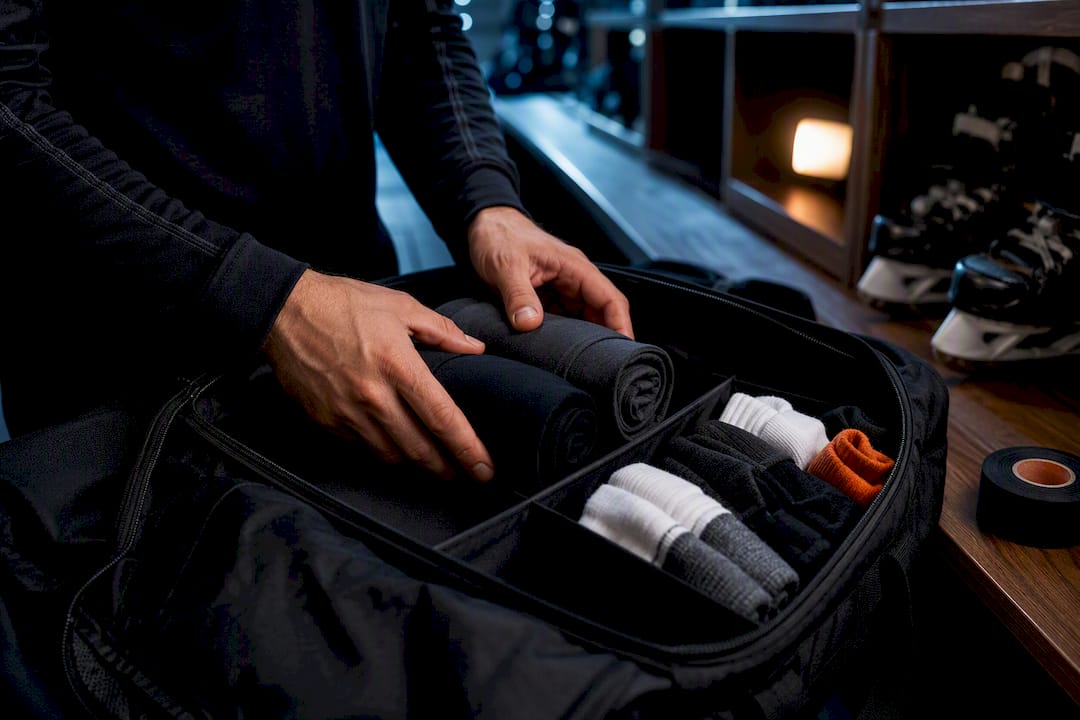
Have an actual drying plan, not a hope. Hotel rooms are not built for drying hockey gear, which is exactly why a plan matters. Opening the bag fully, draping padding over chairs, and running a portable fan or the room’s air conditioning speeds up drying considerably compared to leaving everything zipped inside a closed bag overnight, according to travel hockey packing guidance from RinkHive. Skipping this step does more than create a smell problem: heat and prolonged dampness can degrade foam and protective padding over time, which shortens the useful life of equipment that is far more expensive to replace than a tee shirt.
Build a permanent side-pocket kit and never remove it from the bag. This is one of the simplest habits that separates prepared teams from teams having a bad weekend. A fixed kit that lives in the bag’s side pocket year-round should include:
- Extra skate laces and a spare mouthguard
- Clear tape, cloth tape, and stick tape
- A multi-bit screwdriver for loose blade holders
- A skate stone for nicked edges between periods
- A small first-aid kit and zip ties for quick fixes
Recommended tournament checklists consistently point to this exact combination, and packing gear in the same order every single time speeds up dressing and cuts down on the frantic “where is my other glove” moment that eats into warmup minutes. It also means the team is not scrambling to find an open pro shop on a Sunday morning, since many local shops are closed during tournament weekends precisely when teams need them most.
Pro Tip: Sharpen skates and restock stick tape before you leave town, not when you arrive. Tournament host cities are frequently short on pro shop availability during peak weekends, and the shop that is open may have a line out the door by Saturday morning.
A last piece of coordination that has nothing to do with fabric: label every item with a player’s name or number before the tournament, hand packs out during a team meeting rather than mailing them individually, and keep a simple inventory sheet of who received what. It sounds like overkill until a hoodie goes missing in a hotel hallway and nobody can say for certain whose it was.
RNK Apparel Co.: Where the Recommended Pack Actually Lives
Every item in the pack outlined above maps directly to a real collection. Some hockey apparel suppliers build team hockey apparel around exactly this structure: hoodies, tournament tees, warmup joggers, and small accessories that round out a bag.
- The hockey hoodie collection covers the warmth layer with team logo, name, and number customization options.
- The hockey t-shirt collection handles the tournament tee and travel tee pieces, in youth and adult sizing.
- The youth hockey jogger collection covers the warmup layer for younger players specifically, where fit and growing room matter more than in adult sizing.
- The accessories collection rounds out hats and small add-ons that finish a pack without adding much per-player cost.
Ordering a bulk team apparel order typically involves uploading artwork, selecting a garment and color, choosing name and number printing where wanted, and submitting a size matrix for the full roster. Bulk orders often scale down in per-item cost as quantity goes up, standard production timelines apply to most orders, and rush options may be available for teams working against a tighter tournament date. Ordering a sample ahead of a large or multi-color run is a smart move for any team that wants to see the actual print before committing to a large quantity.
How Should Apparel Handle Different Tournament Weather?
Tournament weather rarely cooperates with a single packing strategy. A weekend tournament in February might mean an unheated rink lobby and a parking lot walk in freezing temperatures, while the same tournament in April could swing toward a warm afternoon outside the arena between games.
Layering solves this better than buying separate cold-weather and warm-weather packs. A midweight hoodie over a moisture-wicking base layer handles a cold rink walk, and the hoodie comes off easily once the team is inside a heated hotel or car. Warmup joggers in a poly-spandex blend breathe better than heavier fleece pants, which matters on a tournament weekend that starts cold in the morning and warms up by afternoon.
Fabric choice affects this more than most teams realize going in. A hoodie built from a thin, cheap blend either fails to keep a player warm in a cold arena or turns uncomfortably hot the moment the team steps into a heated lobby, with no middle ground. A midweight blend with some structure handles both environments reasonably well without needing a second jacket in the bag.
Regional tournaments add their own quirks. Outdoor rinks and older arenas in colder states often run noticeably colder in the stands and hallways than newer facilities, so teams traveling to those venues should lean toward the heavier end of the hoodie weight range rather than the lightest option available.
What Makes a Hockey Apparel Supplier Trustworthy?
A supplier’s reputation shows up in three concrete places: how they handle production timelines, how they communicate about sizing and proofs, and what happens when an order goes wrong.
Lead time transparency is the first signal worth checking. A supplier who gives a specific production window and sticks to it is more valuable to a tournament-bound team than one who promises the fastest turnaround in vague marketing language. Ask directly what the standard timeline looks like and what a rush order actually costs before you commit.
Sample and proof policies tell you how much the supplier trusts their own printing process. A supplier willing to send a physical sample before a large run, or at minimum a detailed digital proof with clear sign-off steps, is signaling confidence in their own quality control. One that pushes straight to production without a proof step is a warning sign, especially for complex multi-color designs.
Minimum order quantities and return policies round out the picture. Fair MOQs that scale sensibly with team size, combined with a clear returns and exchange policy for sizing mistakes, separate a supplier built for teams from one built for one-off novelty orders. Collection and product descriptions that clearly state fabric composition, sizing details, and customization limits, rather than vague marketing copy, are usually a sign of a supplier who has done this at scale before.
What Ordering Mistakes Cost Teams the Most Time?
The single most common mistake is starting the order too close to the tournament date. Standard production takes real time, and teams that wait until three weeks out are the ones paying rush fees or missing the tournament entirely.
Sizing mistakes rank second. A size sheet sent out with no deadline, or collected through a group text instead of a structured form, produces confusion that shows up as wrong-size garments arriving the week of the event. Build the cutoff date into the request itself, not as a follow-up afterthought.
Skipping the proof step is the third major trap, particularly for teams excited to place an order fast. A rushed sign-off on a digital proof misses spelling errors on player names, wrong jersey numbers, or a logo placed slightly off-center, and none of those mistakes are cheap or fast to fix once forty garments are already printed.
Finally, teams underestimate how firm host-run apparel deadlines can be. If a tournament or league runs its own official merchandise window through a separate order portal, that cutoff is usually final, and missing it means paying full retail at the venue instead of ordering ahead at a better price. Treat that date with the same seriousness as the roster deadline.
A Coach’s Take: Prioritize Function Over Flash
Novelty items lose their charm by the second tournament. A funny slogan on a tee gets a laugh once; a hoodie that survives eight tournaments and three seasons of washing keeps paying off long after the joke fades. If forced to choose between a flashier design and a heavier, better-constructed garment, take the construction every time.
Before placing a bulk order, run a short sanity check: are sizes collected and confirmed against actual measurements, not guesses? Is the logo file a clean vector, not a stretched screenshot? Is the order date locked with enough buffer for standard production, plus a few extra days for the inevitable delay? Has someone actually approved the proof, not just glanced at it on a phone screen while distracted?
The trade-off that trips up most teams is spending the whole budget on customization and running short on quantity. A pack with fewer print colors but two full base layers per player beats a heavily personalized pack that leaves players wearing the same damp shirt on day two.
— Eric
Get Your Team’s Tournament Pack Ordered Through RNK Apparel Co.
Some suppliers offer the core items in the apparel pack—warmth layers, travel joggers, and small accessories—from one source with one size matrix and one delivery date to track.
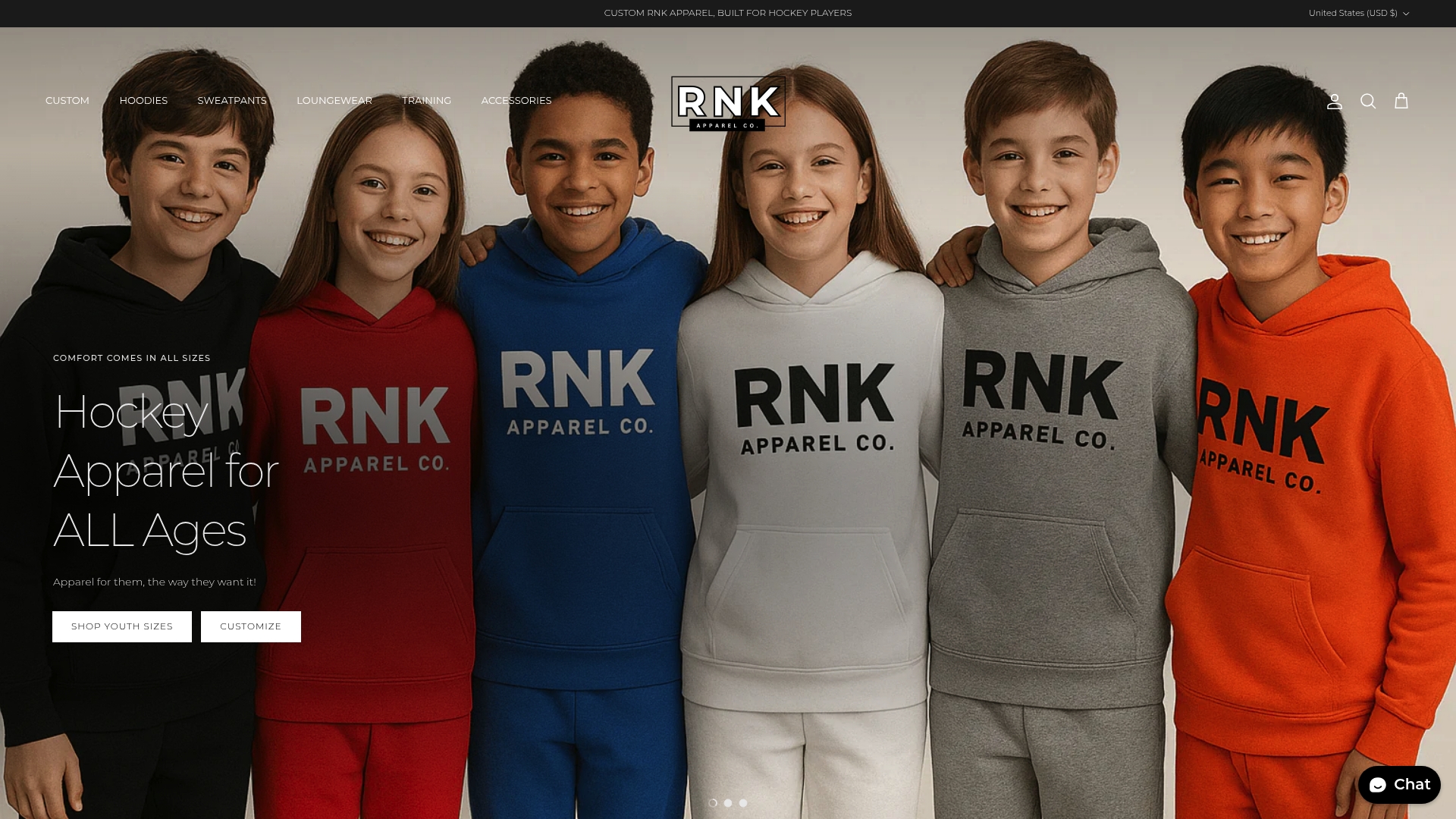
Start with the hockey hoodie collection for the warmth piece your team will wear the most, then move to the hockey t-shirt collection for the tournament tee. Round out training and travel comfort with the performance training gear collection for base layers built to handle multiple games without falling apart on the second wash.
To get a quote moving, put together three things before reaching out: a size sheet with confirmed player measurements, a clean vector logo file, and the delivery date you actually need the pack in hand. That short list is usually all it takes to get an accurate turnaround estimate and lock in a bulk order before the next tournament weekend arrives.
Primary Sources for Packing and Tournament-Prep Guidance
- Hockey Bag Packing Checklist – Better Hockey
- How to Prepare for a Hockey Tournament – Better Hockey
- Tournament Family Checklist – The Hockey Tournament Resource
- Travel Hockey Parent Equipment System – RinkHive Gear
- Packing Tips and Tournament Logistics – Omaha Hockey
Sources
- Hockey Bag Packing Checklist | Better Hockey – Better Hockey US
- How to Prepare for a Hockey Tournament | Better Hockey – Better Hockey US
- TOURNAMENT BRAIN – Family Checklist | Hockey Resource
- Travel hockey parent equipment system | RinkHive Gear
- Packing tips and tournament logistics | Omaha hockey article
FAQ
What Should Be in a Basic Tournament Apparel Pack?
A core pack covers a tournament tee, a hoodie, warmup joggers, spare base layers and socks, and a small accessories kit like a hat. RNK Apparel Co. builds team collections around this exact structure, so the four to six core pieces can typically be ordered from one supplier.
How Many Base Layers Should a Player Pack for a Tournament?
Pack two to three base layers and two pairs of socks per player, since damp gear often does not fully dry between back-to-back tournament games.
When Should a Team Place Its Apparel Order Before a Tournament?
Order at least three to four weeks ahead of the tournament date to account for size collection, artwork proofing, and standard production time, plus extra buffer if a rush option is not available.
Is a Digital Proof Enough Before a Bulk Order Ships?
A digital proof confirms layout and spelling, but a physical sample is worth the extra step for multi-color or metallic prints since screen colors do not always match the finished fabric.
What Belongs in a Permanent Side-Pocket Emergency Kit?
A fixed kit should include spare skate laces, a mouthguard, cloth and stick tape, a multi-bit screwdriver, a skate stone, and a small first-aid kit, kept in the bag year-round rather than packed separately each trip.
