

Rush custom jerseys are realistic in most cases, with fastest practical turnarounds typically running anywhere from about five business days to two weeks depending on production method and shipping. Some providers offer rush production for teams needing hockey apparel fast. Expect trade-offs: a rush surcharge, minimums that vary by production method, and a hard requirement for print-ready artwork and a locked roster before anyone can promise you a date.
TL;DR:
- Rush jersey production typically takes five business days to two weeks, depending on the provider’s schedule, artwork readiness, and chosen shipping method.
- Guarantee a specific ship date in writing and match your production method to the order size and deadline to avoid delays or unmet delivery expectations.
- Prepare finished logos in vector format, a final roster spreadsheet, and designate an approver before ordering to streamline approval and avoid added wait time.
- Rush fees can be a flat per-item charge, an overall surcharge, or a percentage for expedited processing, and minimum order quantities significantly impact cost and timing.
- The actual speed of meeting deadlines depends on internal decision-making and approval speed, not just the provider’s advertised rush window.
Table of Contents
- How Fast Can You Actually Get Rush Custom Jerseys?
- What Should Decide Your Rush Jersey Provider?
- What Do You Need Ready Before Placing a Rush Order?
- How Much Does Rushing a Jersey Order Actually Cost?
- Getting Shipping Right When Production Is Already Tight
- What RNK’s Own Process Says About Rushing a Jersey Order
- Ready to Place Your Rush Order With RNK?
- What the Rush Process Actually Rewards
- Sources
- FAQ
How Fast Can You Actually Get Rush Custom Jerseys?
Every rush-capable provider works from the same basic equation: standard production time minus a paid acceleration, plus shipping. The gap between “we can do it” and “we can do it by Saturday” usually comes down to whether your files are ready and whether the provider actually publishes a rush window instead of just promising to “try.”
RNK Apparel Co. runs an online customizer built specifically for hockey teams, supporting logo upload, player names and numbers, and sublimated or heat-applied designs. RNK documents its minimum order rules and turnaround planning directly on its site, which is worth reading before you contact anyone, since it tells you what information to have ready. To start a rush order, you typically upload your logo and roster through a customizer, flag the order as rush, and confirm final art before it enters production.
Beyond RNK, teams typically have three other categories to consider:
- Large national custom apparel shops tend to have the widest size runs and lowest per-unit minimums, but rush slots fill up fast during fall and spring team season.
- Regional quick-turn print shops often beat national players on speed for small orders because your job doesn’t sit in a national queue.
- Small-batch sublimation specialists handle full-coverage designs well but usually carry higher minimums, since sublimation runs are less efficient at very low volumes.
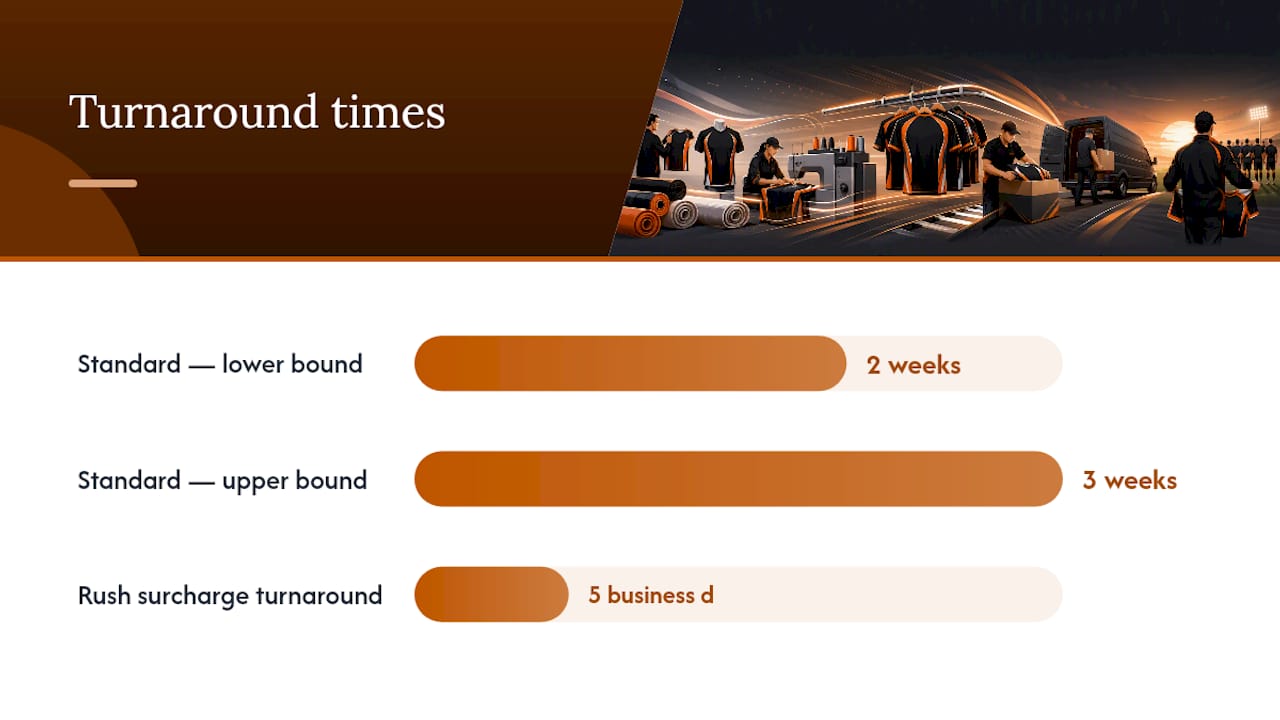
Across all four categories, expect standard production of 2 to 3 weeks, a rush turnaround of roughly 5 business days for a surcharge, minimums ranging from single units to a dozen or more pieces for sublimation runs, and a proof step before anything gets printed. Shipping choices generally range from ground to overnight, and that choice can matter as much as the production window itself.
What Should Decide Your Rush Jersey Provider?
Speed claims are easy to advertise and hard to verify. Base your decision on these four factors instead:
- Guaranteed ship date, not advertised production window. A vendor that says “3 to 5 days” without committing to a ship date is giving you a hope, not a plan. Ask for a date in writing.
- Production method matched to quantity and deadline. Sublimation handles full-coverage graphics well and can move faster once a run is scheduled, but minimums (often 5 to 12 pieces) may not fit a tiny roster. Print or heat-apply methods scale down more easily for small orders.
- Proof turnaround and revision limits. Ask exactly how many rounds of changes you get during a rush cycle. Some vendors cap it at one round to protect the schedule.
- A named contact and a stated cutoff time. Email threads die in inboxes. Get a phone number and a specific cutoff for file changes before you commit.
Pro Tip: Call the vendor before you upload anything and ask them to say your ship date out loud. If they hedge, that hesitation is your answer about how “rush” their rush service really is.
What Do You Need Ready Before Placing a Rush Order?
Every hour spent hunting for a missing logo file or confirming a spelling is an hour subtracted from your production window. Build a preflight checklist before you contact any vendor:
- Vector logo files (not a phone photo of a jersey), plus either a confirmed Pantone code or acceptance that screen colors won’t perfectly match fabric.
- A finished roster spreadsheet with sizes, player names, and numbers, checked twice for typos.
- One named final approver for the design, with a strict internal deadline, plus a backup approver in case the first one is unreachable.
A 3D mockup or a full-color PDF flat catches alignment and color problems that flat previews miss, and it’s worth the extra hour it takes to review one. Minor text edits, like a corrected jersey number, rarely add production time. Full artwork rework, like a redesigned crest or a new color scheme, almost always does, so lock that decision early using RNK’s own jersey name placement checklist.
How Much Does Rushing a Jersey Order Actually Cost?
Rush pricing generally follows one of three models: a flat per-item rush fee, a single flat surcharge for the whole order, or a percentage added to expedite production. Custom Ink and similar apparel platforms commonly structure rush as a fixed reduction in production days for a per-item fee, which is a useful benchmark when you’re comparing quotes.
Standard production typically runs 2 to 3 weeks. A 5-business-day rush usually carries a moderate per-item surcharge. A 48 to 72 hour express order costs more still, since it often requires pushing other customers’ jobs aside.
Minimums complicate the math. If sublimation requires 8 pieces minimum and your roster only has 6 confirmed, you’re either paying for 8 or splitting the order, which is sometimes the faster path anyway.
Getting Shipping Right When Production Is Already Tight
A jersey finished on time but shipped ground is still late. Confirm the carrier’s same-day pickup cutoff at the supplier’s facility, not just the carrier’s general cutoff, since suppliers often need product boxed hours before a driver arrives.
- Choose overnight or two-day shipping whenever your production window leaves no shipping buffer.
- Ask about split-shipping: sending the goalie’s jersey and captain’s gear overnight while the rest ships standard can save a season opener.
- If a delay happens anyway, ask the vendor directly about partial shipments, expedited reprint policy, and documentation you’ll need for any shipping claim.
RNK’s guidance on ordering extras and coordinating shipments covers how teams handle exactly this kind of last-minute split.
What RNK’s Own Process Says About Rushing a Jersey Order
Some providers have customizers designed around the reality that hockey managers usually don’t have six weeks. The online design flow lets you upload a logo, add names and numbers, and see production timeline information before you commit to an order.
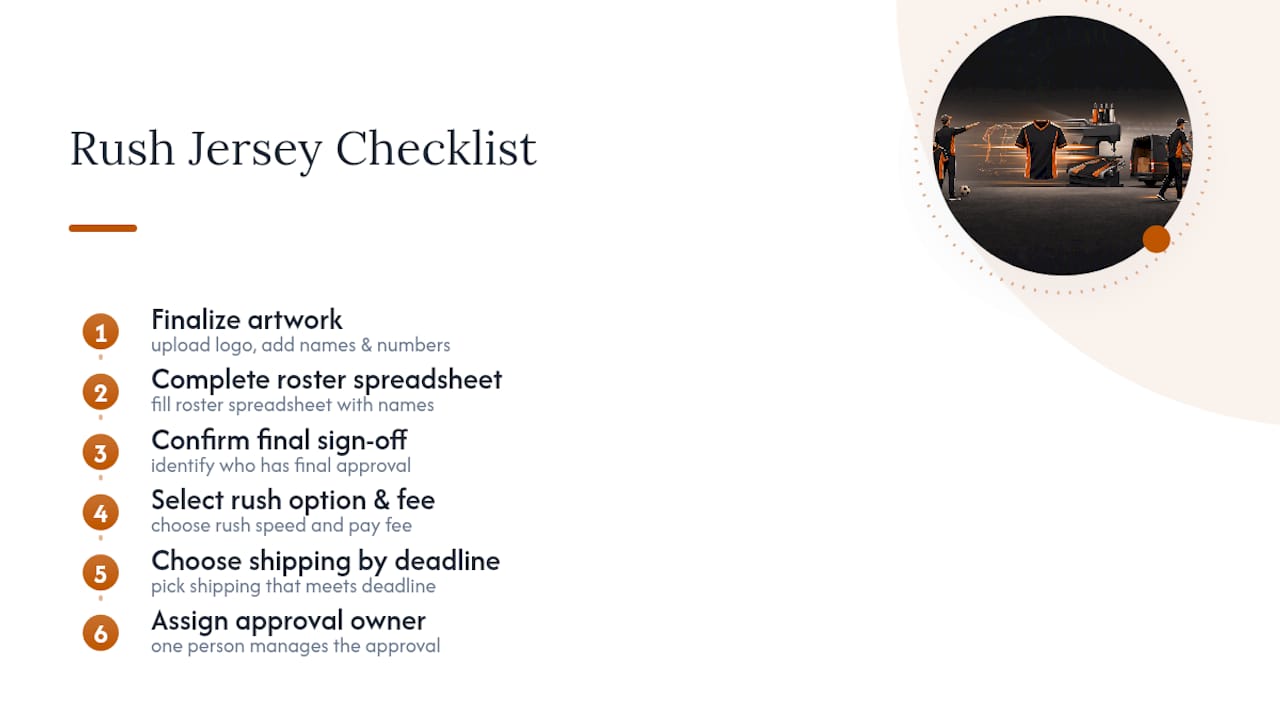
A practical six-step rush checklist looks like this: finalize your artwork, complete the roster spreadsheet, confirm who has final sign-off, select the rush option and fee, choose a shipping method that matches your deadline, and assign one person to the whole approval process.
Pro Tip: Ask for a digital preflight and nail down exact color expectations up front. It’s the single fastest way to avoid a reprint request three days before your first game.
Ready to Place Your Rush Order With RNK?
There are specialized options as alternatives to hunting through generic print shops for hockey-specific rush jerseys. Instead of explaining sleeve cuts and collar styles to a vendor who mostly prints softball uniforms, you’re working with a platform built around hockey apparel from the start.
Starting a rush order is straightforward: head to the Customized Hockey Apparel landing page, upload your team logo, and enter your roster with names and numbers directly in the customizer. Flagging your order for rush production during checkout helps ensure it is routed correctly. Once you place the order, keep an eye on your email and phone for proof approval, since that’s the step that determines whether your rush timeline holds. If your team also needs matching hoodies or joggers for the bench, browse the hoodie collection while you’re finalizing jersey art, since bundling reduces the number of separate approval cycles you’re managing.
What the Rush Process Actually Rewards
Most teams treat rush ordering as a shipping problem. It isn’t. The bottleneck almost never sits with the carrier. It sits with the roster spreadsheet that has three players still listed as “TBD” and the parent group chat still arguing about jersey color on day four of a seven-day window.
Here’s the uncomfortable truth: a vendor’s advertised rush speed is only ever as fast as your slowest internal decision. A provider that promises 48-hour production can’t do anything with that promise if your artwork isn’t finalized until hour 40. The teams that actually hit rush deadlines aren’t the ones who found the fastest printer. They’re the ones who assigned one approver, gave that person real authority, and refused to reopen the color debate after the file was submitted.
That’s also why minimums matter more than people expect. A coach fixated on getting the absolute lowest per-unit price will sometimes choose a sublimation run with a higher minimum, not realizing that decision alone can push the whole order past game day. Speed and unit cost pull in opposite directions under a rush deadline, and pretending otherwise is how good teams end up in bad print shop reviews. Pick the method that fits your actual roster size first. Argue about the price per jersey second.
— Eric
FAQ
How fast can rush custom jerseys realistically ship?
Most rush programs promise 5 business days once art is approved, with some express options reaching 48 to 72 hours for an added fee. The actual date depends on how quickly your roster and artwork are finalized, since approval delays eat directly into the production window.
Does RNK Apparel Co. offer rush production?
Yes. RNK Apparel Co. supports rush orders through its online customizer, which lets teams upload logos, add names and numbers, and flag production speed during checkout. Current rush pricing and options are listed directly on the site.
What’s the minimum order for custom hockey jerseys?
Minimums vary by production method, with some providers accepting single-unit orders and sublimation runs sometimes requiring 5 to 12 or more pieces. RNK’s minimum order guide breaks down specifics by quantity tier.
What raises the price of a rush jersey order?
Rush pricing typically adds either a per-item fee, a flat order surcharge, or a percentage tied to expedited production, a model common across apparel platforms. Splitting an order to hit a minimum, or choosing overnight shipping instead of ground, both add cost on top of the base rush fee.
How many design revisions do I get on a rush order?
Most vendors limit rush revisions to one round to protect the production schedule, though this varies by provider. Confirm the exact revision limit and file change cutoff time before submitting your final artwork.
