

Standard custom hockey jersey production runs 2 to 4 weeks from final art approval, with most established vendors landing closer to 3 to 4 weeks including sewing and quality checks. If you need jerseys faster, rush programs can cut that to one week or less, but expect a surcharge and a shorter list of eligible styles. Start by locking your roster and artwork now, then call your vendor to confirm current windows before you commit to a date.
TL;DR:
- Rush programs can produce hockey jerseys in one week for eligible styles, but at a higher surcharge of around 15 to 30 percent.
- The standard turnaround for most orders ranges from two to four weeks, depending on order volume and peak season delays.
- Design mockups, missing roster details, and peak season timing are the main factors that cause production delays, not manufacturing capacity.
- Starting the order at least eight weeks before the first game ensures enough time for design, approval, and shipping.
- Simplifying design complexity and having artwork ready in advance can save several days on delivery.
Table of Contents
- How long does hockey jersey turnaround actually take?
- What do rush and express hockey jersey orders cost?
- What slows down hockey jersey production the most?
- When should you start ordering hockey jerseys?
- How can you shorten hockey jersey turnaround?
- Does jersey customization complexity change your delivery date?
- RNK Apparel Co.'s take on realistic hockey jersey timelines
- Getting your team’s order started with RNK Apparel Co.
- Where to verify current hockey jersey turnaround windows
- Sources
How long does hockey jersey turnaround actually take?
Vendor timelines cluster into three brackets, and knowing which one applies to your order keeps you from getting blindsided two weeks before your season opener.
The fastest tier is the made-in-USA rush model. Some vendors advertise a 1-week turnaround on eligible sublimated styles, with production starting the moment you approve the final proof and shipping out of a domestic warehouse within 5 to 7 days. That’s the outlier, not the baseline, and it usually applies to a limited set of cuts and print methods.
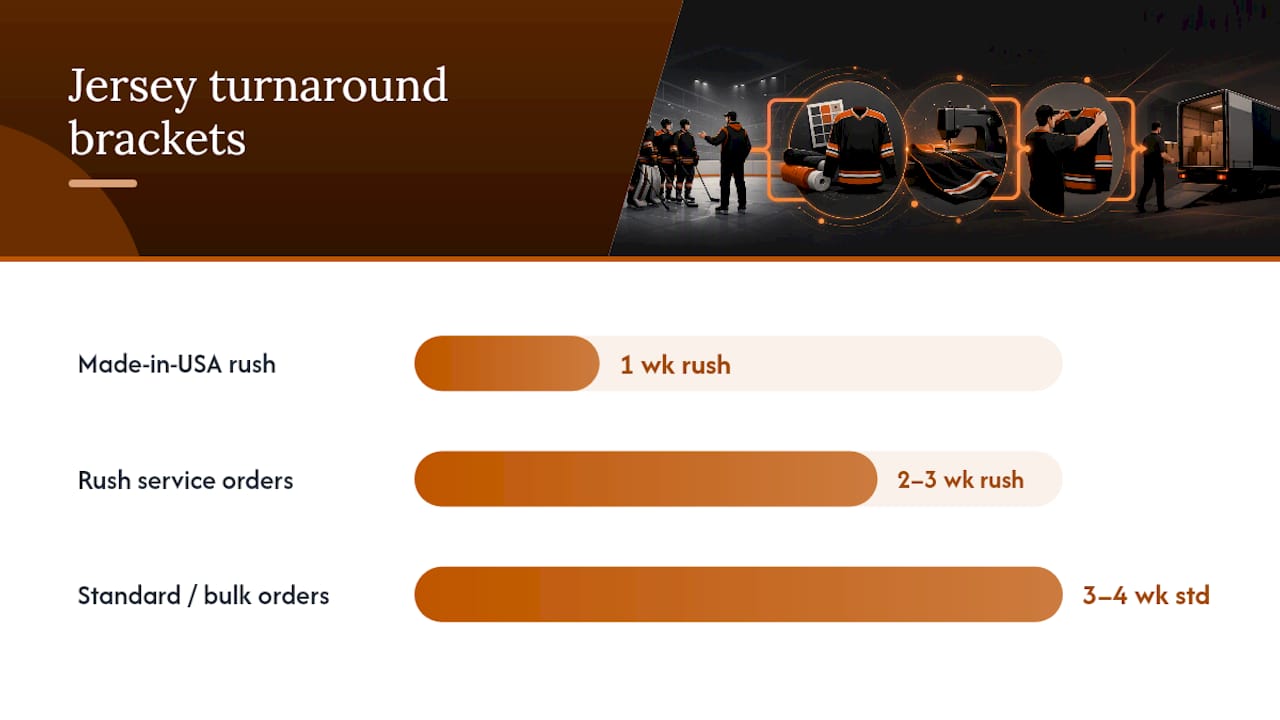
The middle bracket, where most team orders live, runs 2 to 3 weeks when you pay for rush service or 3 to 4 weeks standard. This range typically covers design finalization, printing or sewing, and a quality pass before the box ships.
The longest bracket shows up around bulk orders and peak season. Some manufacturers count in business days rather than calendar days, and a “30 business day” standard window can stretch to 6 weeks or more once weekends and holidays are factored in.
What’s usually baked into these windows:
- Design mockup creation and revision rounds
- Proof approval (the clock often doesn’t start until you sign off)
- Printing or sublimation, then sewing and finishing
- Quality control and packaging
What’s often NOT included: shipping transit. A vendor’s “2-week turnaround” almost always means production time only. Add 2 to 5 business days for ground shipping, longer if you’re shipping to a rural rink or during a winter storm delay.
What do rush and express hockey jersey orders cost?
Rush pricing follows a predictable pattern across the industry: the faster you need it, the steeper the percentage tacked onto your invoice.
Published examples show roughly a 15% surcharge for one-week rush service and closer to 30% for a three-business-day super-rush. On a $60 jersey, that’s the difference between paying $9 extra per piece and $18 extra per piece, which adds up fast across a 20-player roster.
Before you request a rush order, ask your vendor:
- Which styles and print methods qualify for expedited production (not every sewn-number or twill option does)
- Whether there’s a minimum or maximum quantity for rush pricing
- If there are blackout dates around holidays or the start of hockey season
- Whether the rush fee is a flat percentage or a per-piece charge
Pro Tip: Ask for the rush quote in writing before you approve anything. Verbal turnaround promises from a sales rep have a way of slipping once your order hits the actual production queue.
What slows down hockey jersey production the most?
Delays rarely come from the factory floor. They come from the steps before production even starts.
- Design and proof rounds. Every revision cycle adds a day or two. Vendors typically turn around an initial mockup in 1 to 3 business days, but three rounds of “can we try a different orange” easily costs a week.
- Missing roster information. Incomplete sizing charts or last-minute number changes push your order to the back of the queue while the vendor waits on you.
- Factory volume and peak season. August through October and December through February are crunch times for youth and travel hockey orders alike.
- Shipping and carrier delays. Ground shipping during winter weather is unpredictable, especially for teams in northern states.
When should you start ordering hockey jerseys?
Work backward from your first game, not forward from when you feel like dealing with it.
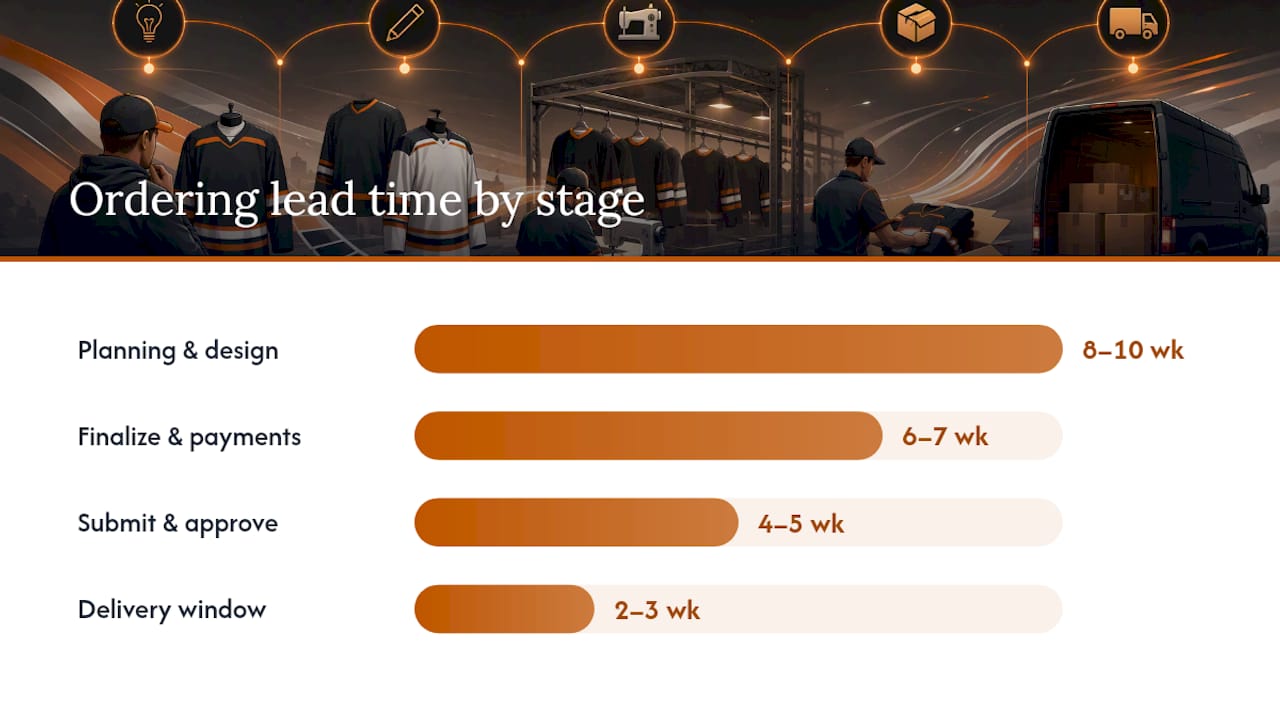
- 8 to 10 weeks out: Pick your jersey style, set a budget, and open the design conversation with your vendor. This is also the point to review a practice jersey order if you need training gear on a separate track.
- 6 to 7 weeks out: Finalize the design, collect every player’s size, and get deposits or payment authorized. Roster changes after this point are your biggest delay risk.
- 4 to 5 weeks out: Submit the order and approve proofs quickly. Every day you sit on a proof email is a day added to your delivery date.
- 2 to 3 weeks out: This is your standard delivery window. If you’re inside this window and haven’t ordered, rush is your only remaining option, and even that has a cutoff.
Before you contact any vendor, have this ready: final roster with names and numbers, jersey style and colorway decided, payment method approved by your organization, and a hard deadline (first game, not “sometime in October”). A team uniform ordering checklist is worth reviewing if this is your first season managing the process.
If you’re setting up recurring orders for a whole season, an NHL-style custom jersey program built around your schedule avoids repeating this scramble every few months.
How can you shorten hockey jersey turnaround?
A few concrete moves shave real days off your delivery date without touching quality.
- Have print-ready artwork and a complete size chart ready before you contact anyone.
- Choose in-stock or template-eligible styles when your calendar is tight. Fully custom cut-and-sew always takes longer than a template with your logo applied.
- Approve one clean proof instead of requesting five rounds of tweaks. Get your coaching staff to agree on the design before it goes to the vendor.
- Name one point of contact for the order. Vendors lose days chasing down three different parents for the same sizing answer.
Pro Tip: Consolidating smaller reorders into one batch often moves your job into a vendor’s bulk workflow, which factories tend to schedule earlier than one-off reorders.
Does jersey customization complexity change your delivery date?
Yes, and this is where a lot of team managers get their timeline wrong. A single-color logo applied to a blank jersey moves through production far faster than a full sublimated design with gradient colors, multiple sponsor logos, and sewn-on number twill.
Sublimation, where the design is dye-printed directly into the fabric, generally moves faster than heat-transfer or embroidered patches because it’s a single print pass rather than a multi-step application process. Add a third or fourth color, a captain’s patch, or player-specific name customization, and you’re adding separate production steps, each with its own quality check.
Sewn tackle-twill numbers, in particular, tend to disqualify a jersey from the fastest rush programs entirely. Certain cuts and sewn-number options often fall outside express eligibility, which is worth confirming before you assume your design qualifies for a one-week turnaround.
If your timeline is genuinely tight, ask your vendor whether swapping sewn twill for a printed number, or dropping from four colors to two, would move you into a faster production tier. Sometimes a small design compromise buys you a full week.
RNK Apparel Co.'s take on realistic hockey jersey timelines
Vendors that keep production in-house tend to give straighter answers about turnaround, because they control their own scheduling instead of waiting on a third-party factory queue. That’s the model Rnkapparel builds its order flow around: design conversation first, one clean proof cycle, then production and shipping handled without handing your order off to another company.
on how that in-house structure has helped teams hit tight deadlines during peak season ordering windows.
— Eric
Getting your team’s order started with RNK Apparel Co.
Rnkapparel gives you a straighter path than piecing together design work, sizing forms, and a separate print vendor on your own. Our team handles the design mockup, the roster and sizing collection, and production under one roof, so you’re not chasing three different companies when your deadline gets tight.
Before you reach out, have your roster with sizes, your preferred colorway, and your first-game date ready. That’s the same information any vendor will ask for, and having it prepped is what actually protects your spot in the production queue during busy months. Browse the hockey t-shirt collection to see current styles and start a custom order, or check the hockey accessories lineup if you’re rounding out a team package beyond jerseys. Get your roster together and start your order today.
Where to verify current hockey jersey turnaround windows
Turnaround windows shift with the seasons, so confirm current numbers directly on a vendor’s site before you build your calendar around them. Check Wooter Apparel’s hockey turnaround page or Triton’s turnaround times page for standard-versus-rush comparisons, and remember that quoted production time rarely includes shipping transit.
Sources
- Custom Hockey Jerseys | Wooter Apparel
- Custom Hockey Uniforms & Jerseys | Hustle Gear
- How Much Do Custom Jerseys Cost? The Team Manager’s Guide to Budgets, Sizing, and On-Time Delivery - Custom Ink Blog
- Turnaround Times - Triton Custom Sports Uniforms and Apparel
