
Yes, you can order a single custom jersey. Print-on-demand and made-to-order production have made single-unit custom jerseys standard, not a special favor from a vendor. The catch: expect a higher per-item price than a team order, and know that some styles, like heavily embroidered jackets, still carry small minimums.
TL;DR:
- Single custom jerseys can be ordered at a higher per-unit cost, especially if the order does not meet volume discounts available at larger quantities.
- Print-on-demand shops offer no-minimum options suitable for one-off or small special-order jerseys, with typical shipping times of a few days to two weeks.
- Small batch suppliers usually accept orders of three to five jerseys at better prices than one-off vendors, but minimums increase significantly at orders of 15 or more.
- Supply chain and production complexity often impose unavoidable minimums on heavily embroidered or multi-panel items, regardless of advertised “no minimum” policies.
- Preparing a simple, high-resolution design and requesting proof before production helps ensure small orders are accurate and avoid unnecessary costs or delays.
Table of Contents
- Custom Jersey Minimum Order: What “Minimum” Actually Means Now
- Main Options for Ordering 1 to 10 Custom Jerseys
- Why Do Custom Jersey Suppliers Set Minimum Order Quantities?
- What Small Custom Jersey Orders Actually Cost and Take
- How to Place a Single or Small Custom Jersey Order
- When Minimums Still Apply, Even for “No-Minimum” Vendors
- How RNK Apparel Handles Small and Single Custom Orders
- What I’ve Learned About Buyers Who Get Small Orders Wrong
- Sources
Custom Jersey Minimum Order: What “Minimum” Actually Means Now
The phrase “custom jersey minimum order” used to mean one thing: call a screen printer, get quoted a 24-piece minimum, and pay upfront for garments you might not need. That model still exists, but it is no longer the only door into custom apparel. Made-to-order production, sometimes called print-on-demand, flipped the math by producing garments one at a time as orders come in rather than batching dozens at once.
That shift matters for anyone asking “how many jerseys do I need to order” before buying anything. The honest answer depends entirely on which production model you use, not on some universal industry rule. A parent buying one jersey for a kid’s birthday and a rec league organizer outfitting eight players are solving completely different problems, and the right supplier for each looks nothing alike.
Main Options for Ordering 1 to 10 Custom Jerseys
Three supplier models cover almost every small-order scenario, and each fits a different situation.
- Print-on-demand / made-to-order. No inventory, no minimum, one jersey produced when you order it. Printful confirms it produces custom jerseys with no minimums using in-house sublimation, and Printify advertises the same no-minimum model with a free online designer. Best for a single fan shirt, a gag gift, or a sample before a bigger order.
- Low-MOQ specialty shops. Some sport-specific vendors accept small batches starting around three to five pieces, usually at a better per-unit price than a true one-off. Peak1Sports lists a five-jersey minimum for custom cycling jerseys, with price breaks kicking in at 15, 25, 50, and 100 units.
- Hybrid: blank plus local customization. Buy stock jerseys and have a local shop add names, numbers, or a logo. This works well for very small runs where full custom production doesn’t pencil out.
If you’re clothing a five-player squad for one tournament, a low-MOQ specialist usually beats a POD shop on price. If you need exactly one jersey with no repeat order coming, POD is the only option that makes sense.
Why Do Custom Jersey Suppliers Set Minimum Order Quantities?
Minimums exist because setup work costs the same whether you print one jersey or a hundred. A screen printing job needs new screens burned per color, per design. Sublimation needs a print file cut and pressed per garment, which scales more easily than screen printing but still eats time per piece. Embroidery digitizing takes real setup labor no matter the quantity.
- No minimum: print-on-demand shops using sublimation or direct-to-film printing.
- 3 to 5 pieces: boutique or sport-specific custom shops.
- 10 to 15 pieces: smaller regional suppliers, per industry guidance on bulk ordering.
- 20 to 30 pieces: typical small factory production runs.
- 50-plus pieces: full factory pricing tiers.
Splitting one team order across two suppliers to dodge a minimum rarely saves money. You pay setup costs twice instead of once, and you lose any volume discount either vendor would have offered on the full order.
What Small Custom Jersey Orders Actually Cost and Take
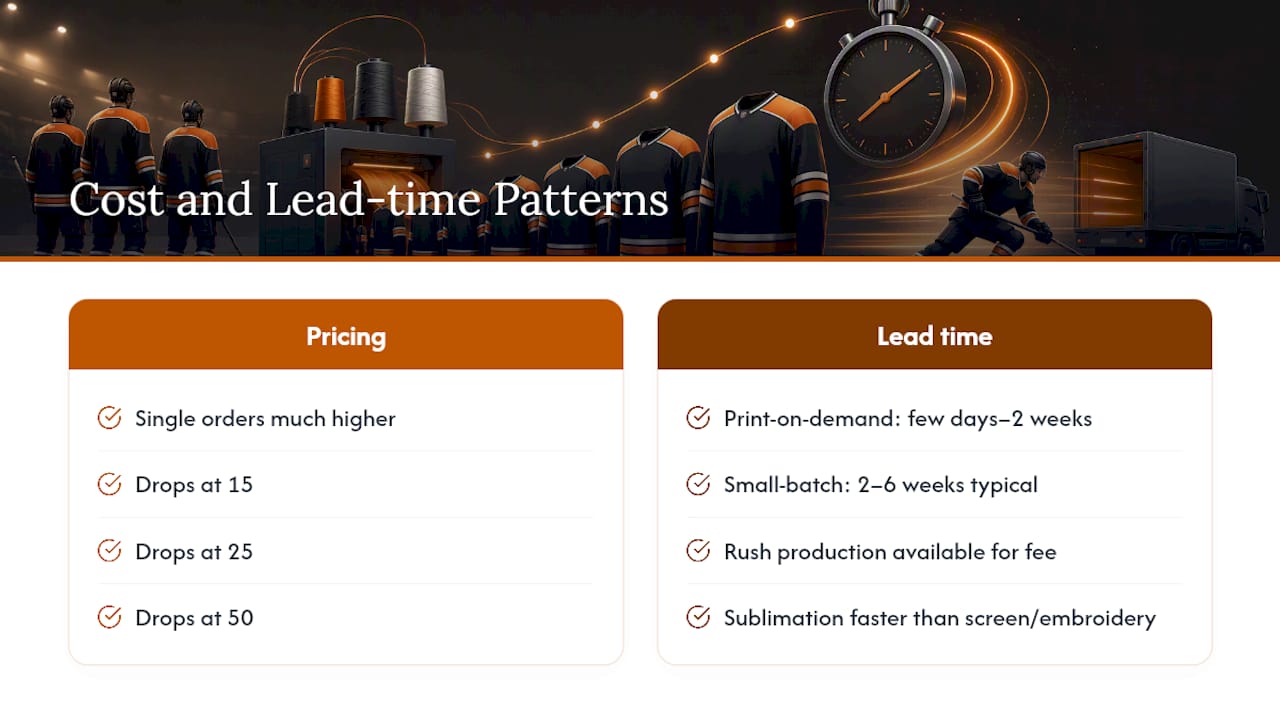
Budget more per jersey when you order fewer of them. Setup costs get spread across just one or two garments instead of dozens, so a single custom jersey often runs noticeably higher than the per-unit price on a 20-piece order. Peak1Sports’ own price breaks show the pattern clearly: cost per unit drops at 15, again at 25, and again at 50 and 100 pieces.
Pro Tip: If you’re on the edge between ordering 4 and 5 jerseys, ask the vendor for pricing at both quantities. Crossing an MOQ threshold sometimes costs less overall than staying just under it.
Lead time follows a similar split. Print-on-demand orders typically ship within a few days to two weeks. Small-batch orders through a traditional shop often run 2 to 6 weeks depending on the backlog, with rush production available for an added fee. Sublimation tends to move faster than screen printing or embroidery, since it skips the drying and curing steps those methods require.
How to Place a Single or Small Custom Jersey Order
Getting a one-off jersey right on the first try comes down to preparation, not luck. Follow this checklist before you submit anything.
- Prep your design file. Vector formats (AI, EPS, SVG) print cleanest at any size; if you only have a logo as a JPEG or PNG, request the highest resolution version you have.
- Confirm the color profile. Ask whether the vendor works in RGB or CMYK, since colors can shift between screen and fabric if this gets skipped.
- Nail down sizing. Provide a size chart reference or, if you’re outfitting a small team, request a sample garment before committing to a full size run.
- Request a digital proof. Every reputable vendor should send a mockup before production starts. Don’t skip this step to save a day of turnaround.
- Ask about hidden costs upfront. Setup fees, rush charges, and shipping speed all vary by vendor, so confirm them before you approve the proof, not after the invoice arrives.
- Check vendor reliability. A quick look at Trustpilot reviews for a supplier can flag delivery or quality issues before you commit money.
Pro Tip: Simplify the design if you’re on the fence about hitting a minimum. Dropping from six colors to three, or swapping embroidery for a sublimated logo, can drop you out of MOQ territory entirely.
When Minimums Still Apply, Even for “No-Minimum” Vendors
Some garments break the no-minimum rule regardless of who you order from. Winter jackets, multi-panel sublimated jerseys, and heavily embroidered pieces often carry small MOQs even at shops that advertise single-item orders everywhere else. Spized explicitly notes that while single jersey orders are standard, winter jackets are a common exception requiring a small minimum.
The reason is mechanical: these items need specialized machines, extra assembly steps, or limited production runs that don’t scale down to one unit economically. If you need just one piece in a complex category, look for a simpler garment style, reduce the design complexity, or ask about ordering a small sample run instead.
How RNK Apparel Handles Small and Single Custom Orders
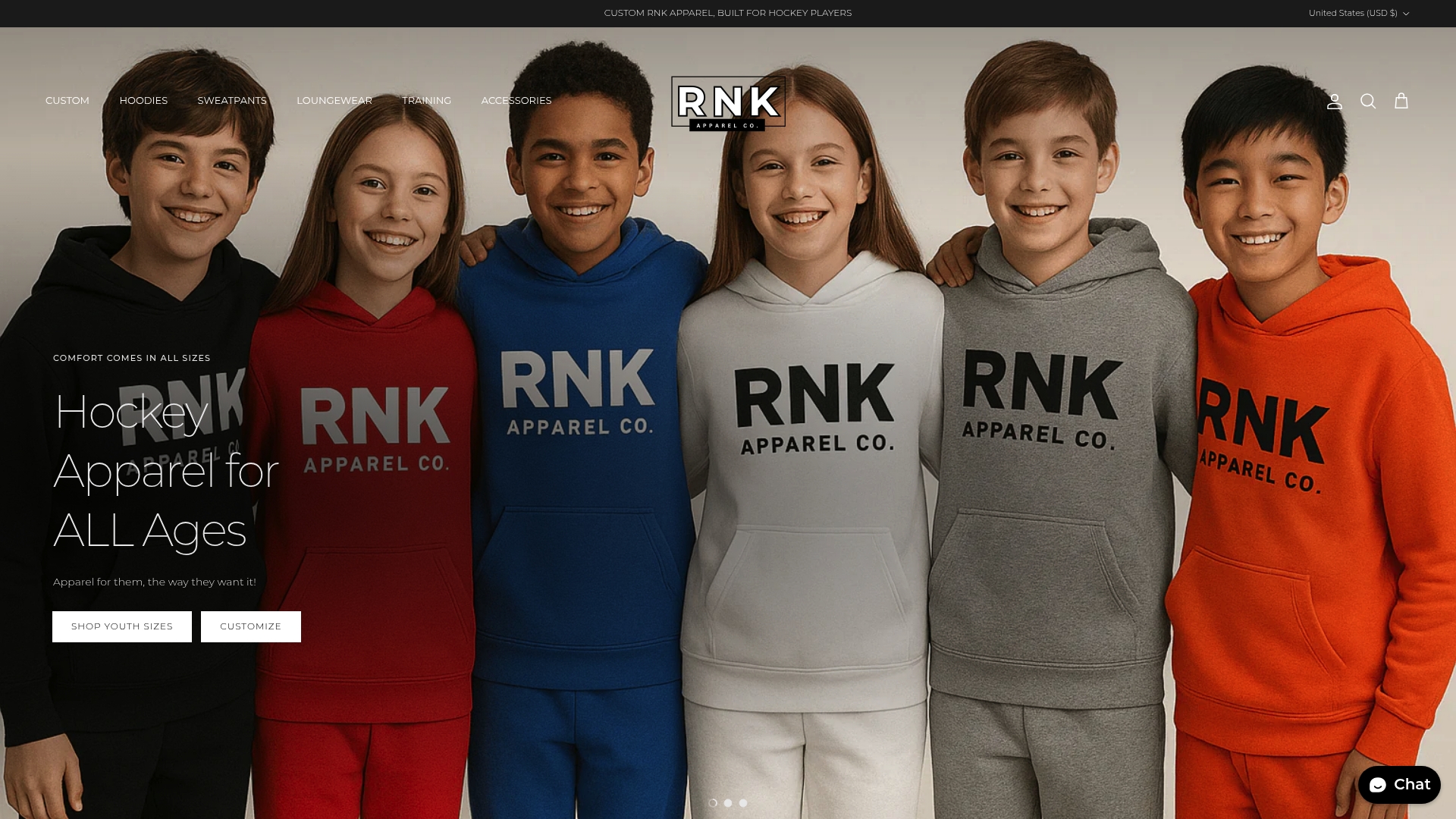
If you’ve been trying to find where to buy one custom hockey jersey without committing to a 20-piece team order, that’s a solvable problem here. Rnkapparel builds custom hockey shirts, hoodies, and small-batch team gear around exactly this scenario, with design support and a proof step before anything goes into production.
Getting started follows the same checklist covered above: request a quote, upload your logo or design, review a digital proof, then approve the sample before the full order runs. For teams weighing quantities before they commit, the small teams buying guide breaks down realistic order sizes, and the team apparel order processing guide walks through what happens after you hit submit.
Browse the hockey graphic tees collection for single-item and small-batch customization, or check the hockey hoodies lineup if outerwear is what you actually need. Either way, reach out for a quote before you assume a minimum applies.
What I’ve Learned About Buyers Who Get Small Orders Wrong
The most common mistake isn’t picking the wrong vendor. It’s picking the wrong garment for the order size. A buyer who wants one heavily embroidered jacket runs into an MOQ wall that a buyer wanting one sublimated jersey never hits. Match the garment complexity to the quantity you actually need, and half the frustration disappears before you even request a quote.
Three habits separate a smooth small order from a messy one: always get a digital proof before production starts, ask about setup fees before you’re staring at a final invoice, and simplify the design if you’re borderline on hitting a minimum. None of this is complicated. Most of it just gets skipped because buyers assume small orders work like big ones, and they don’t.
— Eric
Sources
- Custom jerseys
- Custom jerseys: Design your own, no minimums | Printify
- Custom (Peak1Sports)
- Custom Sports Jerseys bulk ordering explanation
- Design & create your own jersey (Spized)
