

Most embroidery digitizing in the United States runs $10 to $50 for a standard left chest to medium-sized logo, with jacket backs and dense designs climbing past $100. Vendors bill one of two ways: a flat rate by design tier, or a per-1,000-stitches rate. Either way, digitizing is typically a one-time setup fee, but rush turnaround and revision requests can push your final number higher.
TL;DR:
- Per-1,000-stitches digitizing costs between $1 and $3 in the US, making it more economical for designs with high stitch counts.
- Flat-rate pricing tiers are predictable but can lead to overpaying for small or light stitch designs, especially if the design size varies.
- The main cost drivers are stitch count, art complexity, fabric type, and specialty techniques, which can add $10 to $30 or cause quote discrepancies.
- Rush orders, revisions, and intricate designs significantly increase the final price, with rush fees typically adding up to 75% to the base cost.
- For small orders, spreading the digitizing fee across the number of pieces helps determine the true per-piece cost and avoid overbudgeting.
Table of Contents
- How Much Does Embroidery Digitizing Cost by Design Type?
- Per-1,000 Stitches or Flat Rate: Which Pricing Model Wins?
- What Drives the Price Difference Between Quotes?
- Sample Cost Calculations: Digitizing Plus Sew-On
- How to Choose a Digitizing Service Without Guessing
- Are AI and Free Digitizing Tools Ever a Good Idea?
- Budgeting Priorities for Small Teams and Apparel Buyers
- Get Apparel and Logo Prep Handled in One Place
- Sources
- FAQ
How Much Does Embroidery Digitizing Cost by Design Type?
Price depends less on the logo itself and more on where it sits and how many stitches it takes to fill that space. A tiny cap logo at 5,000 stitches costs a fraction of what a jacket back at 25,000 stitches costs, even if both look similarly “simple” to the eye.
Stitch count tracks physical size and density more than artistic complexity. A 4-inch left chest logo typically runs 6,000 to 9,000 stitches. A full 12-inch jacket back can hit 20,000 to 40,000 stitches or more, especially with heavy fill areas. According to DigitizingU’s cost breakdown, most US shops price small logos at $10 to $25, medium designs at $20 to $45, and jacket backs at $30 to $100 or higher. 1DollarDigitizing’s price guide shows similar bands for caps and specialty techniques.
| Design Type | Typical Stitch Count | Typical US Price |
|---|---|---|
| Small/left chest logo | 6,000–9,000 | $10–$25 |
| Medium logo (crest, back yoke) | 8,000–9,000 | $20–$45 |
| Cap/hat front | 5,000–6,000 | $15–$25 |
| Jacket back (large) | 20,000–40,000+ | $30–$100+ |
| Appliqué design | Varies by fabric layer | $20–$60 |
| 3D puff logo | 6,000–9,000 | $15–$50 |
A cap logo often costs more per stitch than a flat garment logo because the curved crown forces the digitizer to account for hoop distortion. That’s why a small hat design sometimes prices closer to a medium logo than a small one.
Per-1,000 Stitches or Flat Rate: Which Pricing Model Wins?
Digitizers bill you one of two ways, and understanding the math behind each keeps you from comparing apples to oranges when quotes come in.
Per-1,000-stitches pricing charges you based on the actual density of your design. CapitalDigitizing’s pricing guide puts the typical US range at $1 to $3 per 1,000 stitches, with some services quoting as low as $0.60 to $1.00 plus a flat minimum fee. Do the math on an 8,000-stitch chest logo at $2 per 1,000 stitches: that’s 8 times $2, or $16 for the digitizing file.
Flat-rate tiers charge one price per category, regardless of exact stitch count within that bracket. A “small logo” tier might cost $20 whether your design is 5,000 or 9,000 stitches.
Here’s when each model works better for you:
- Choose per-stitch pricing when your design is unusually light on stitches and you don’t want to overpay for a flat “small logo” bucket.
- Choose flat-rate tiers when you want predictable budgeting across multiple different logos for the same order.
- Watch for minimum fees: a 3,000-stitch design billed at $2 per 1,000 stitches would only cost $6, but most shops enforce a $10 to $15 minimum regardless of size.
- Expect rush fees of roughly $5 to $20 flat, or 25% to 75% added to the base price, when you need same-day turnaround.
What Drives the Price Difference Between Quotes?
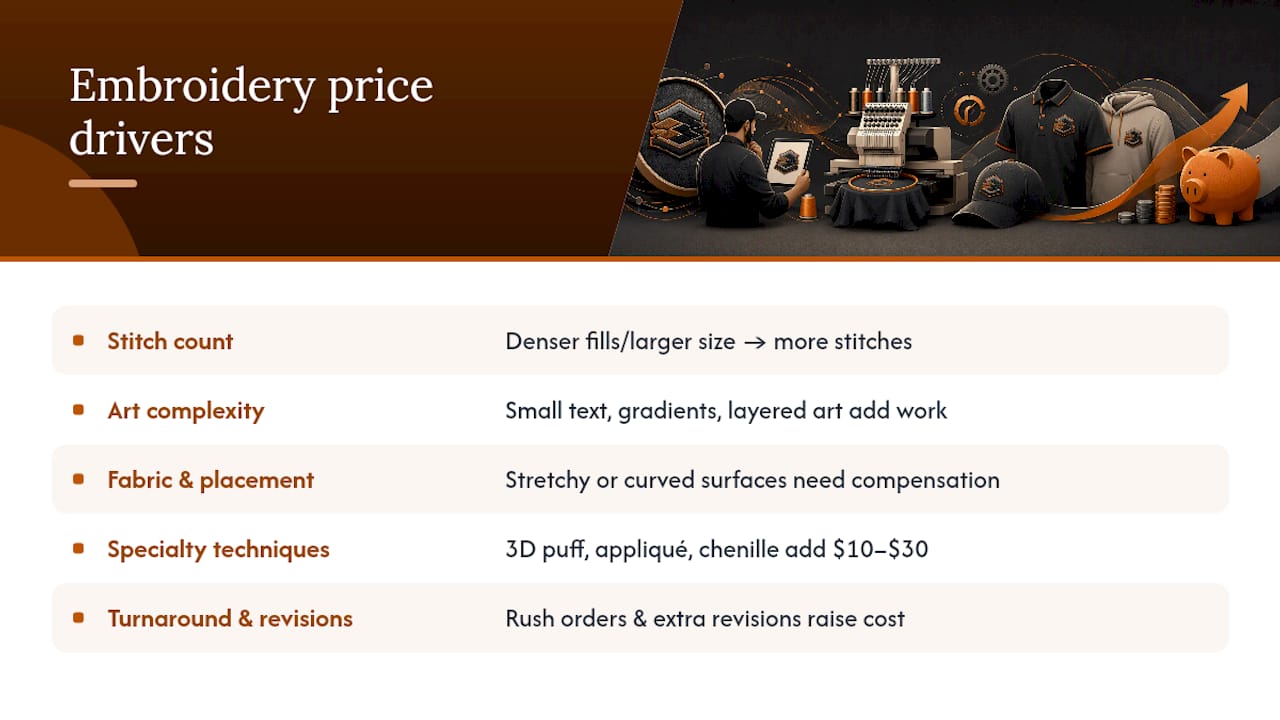
Two quotes for what looks like the same logo can land $30 apart, and the reasons almost always trace back to five factors.
Stitch count is the biggest lever. Denser fill areas and larger physical dimensions both add stitches, and more stitches mean more digitizing time and more thread cost on the sew-out. Art complexity matters just as much: small text under a quarter-inch, color gradients, and layered artwork with overlapping elements all require manual mapping decisions that a simple two-color logo never triggers.
Fabric and placement add friction you might not expect. A logo destined for a stretchy performance jersey or a curved cap crown needs different underlay and push/pull compensation than the same design on a stable cotton hoodie. Digitizers who skip this step produce files that pucker or shift during production.
Specialty techniques carry their own surcharges. 3D puff requires foam-specific underlay settings, appliqué needs placement stitches and cutting instructions, and chenille demands entirely different stitch types. Expect these to add $10 to $30 over a standard flat design.
Finally, turnaround and revisions move the number. Standard delivery often runs 12 to 48 hours, and DigitizingU notes that rush orders and unlimited revision requests are two of the most common places hidden costs creep in.
Sample Cost Calculations: Digitizing Plus Sew-On
Numbers get more useful once you attach them to a real order size. Here are three scenarios built around typical team and small-business quantities.
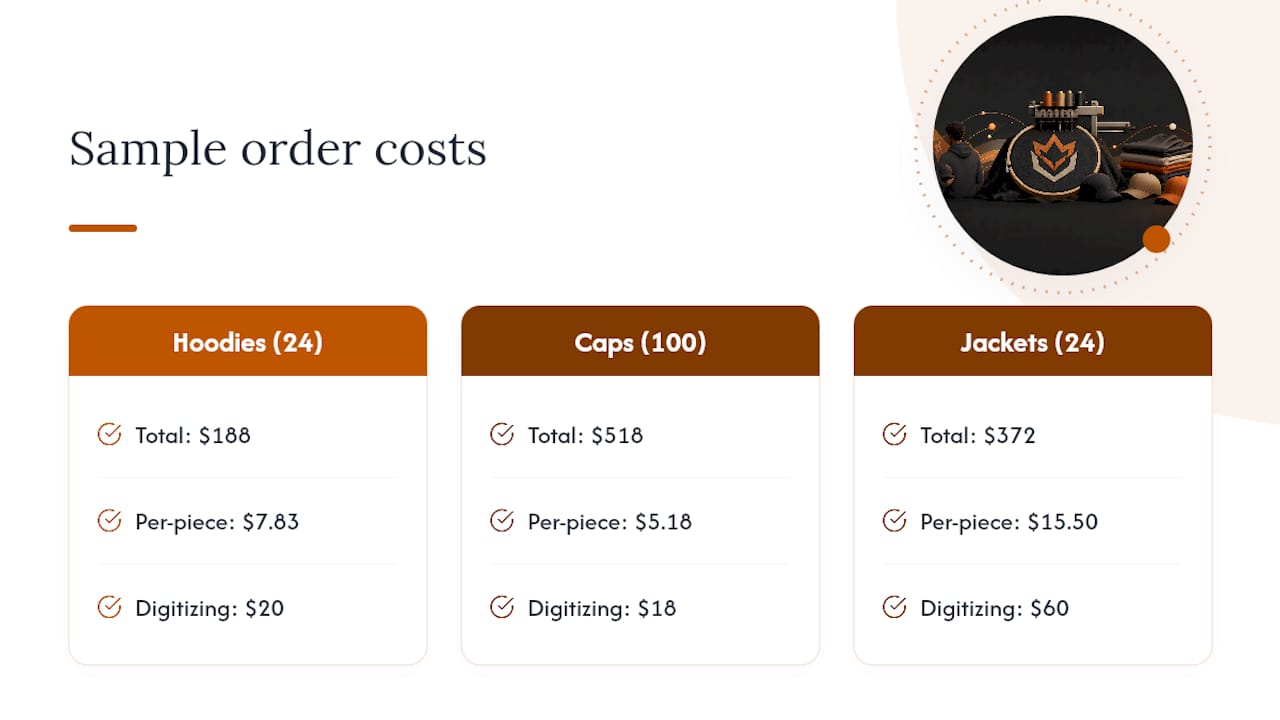
Example A: Small left chest logo, 24 pieces. A 7,000-stitch logo digitizes for around $20. Sew-on labor and thread for a logo that size typically runs $6 to $8 per piece. For 24 hoodies, that’s $20 plus (24 times $7), or roughly $188 total, and about $7.83 per piece.
Example B: Hat/cap front, 100 pieces. A 6,000-stitch cap logo digitizes for about $18, given the curved-surface complexity. Sew-on runs $4 to $6 per cap. At 100 pieces: $18 plus (100 times $5), or $518 total, about $5.18 per piece.
Example C: Jacket back, 24 pieces. A 25,000-stitch jacket back digitizes for roughly $60. Sew-on for that stitch count runs $12 to $15 per jacket. At 24 pieces: $60 plus (24 times $13), or $372 total, about $15.50 per piece.
Pro Tip: Spread your digitizing fee across your actual order quantity to find your break-even point. The formula is simple: digitizing fee divided by number of pieces equals cost per piece added by digitizing alone. On a $20 file split across 100 shirts, that’s just $0.20 per piece — but the same file split across 5 shirts adds $4.00 per piece. Needledown’s pricing guidance treats digitizing as a fixed cost you amortize, not a per-piece variable, which is exactly the mindset that keeps small orders from getting underpriced.
Before requesting quotes, gather your final artwork file, exact placement location, garment fabric type, and target size in inches. Vendors quote faster and more accurately with all four in hand.
How to Choose a Digitizing Service Without Guessing
A good digitizer answers these questions without hesitation, and a vague answer to any of them is worth noting before you commit.
- What file format will you deliver, and is it compatible with my embroidery machine (DST, PES, EXP)?
- What’s your stitch-count estimate for this design, and does that match the price you quoted?
- What’s your revision policy? Some shops include minor scale edits up to about 15% for free; others charge per edit or by the hour.
- Can you provide a test sew-out before I approve a full production run?
- Do you have production examples on fabric similar to mine (performance jersey, fleece, twill)?
Red flags include a vendor who won’t commit to a revision policy in writing, one who advertises “automated digitizing” as their only service, and one who can’t show you actual sewn samples, only digital previews. When you submit your order, include vector artwork (AI, EPS, or PDF), your exact final size in inches, the garment fabric, and a placement photo if possible. A clean vector file prevents most of the guesswork that inflates both price and turnaround.
Are AI and Free Digitizing Tools Ever a Good Idea?
Automated and ultra-cheap digitizing (sometimes advertised around $5) can work fine for a single hobby project you’re not too precious about. The problem shows up in production runs: Gempunch’s cost analysis points to poor underlay, density spikes, and sequencing errors as common results, all of which can stall a machine mid-run or ruin a garment outright.
US-based manual digitizing usually costs more upfront than offshore or auto-generated files, but Impact Digitizing notes that the time-zone alignment and fewer revision cycles often make it cheaper in total cost. For paid team uniforms or bulk orders, that reliability is worth the premium. For a one-off gift, a cheap tool is a reasonable gamble.
Budgeting Priorities for Small Teams and Apparel Buyers
Predictable per-piece cost usually beats chasing the lowest digitizing quote. A team ordering 30 jerseys benefits more from a file that sews cleanly the first time than from saving $10 upfront on a file that needs rework. Rnkapparel’s process leans on solid file prep up front because a bad digitizing file costs far more in wasted garments than it ever saves in fees.
— Eric
Get Apparel and Logo Prep Handled in One Place
Some companies offer digitizing quotes, garment selection, and production handling without juggling three separate vendors. Rather than sourcing a digitizer, then a blank supplier, then a decorator, you upload your logo once and Rnkapparel guides you through vector preflight, recommended sizing, and placement before anything goes to production.
Rnkapparel specializes in made-to-order hockey apparel with built-in customization, so your team logo, player names, and numbers get applied to hoodies, headwear, and tote and bag items without you managing separate files for separate vendors. If you’re not sure what size or format to send, the team logo placement guide walks through it step by step. Visit Rnkapparel to upload your logo and request a quote for your next team or individual order.
Sources
Prices in this guide reflect ranges published by US embroidery digitizing guides, including DigitizingU, CapitalDigitizing, and 1DollarDigitizing, along with break-even budgeting guidance from Needledown. Pricing shifts with vendor, region, and design complexity, so confirm current rates directly with any digitizer before placing a production order.
- How Much Does Embroidery Digitizing Cost in 2026? | Digitizing Guide | DigitizingU
- Embroidery Digitizing Cost Guide: USA Prices 2026
- Needledown embroidery pricing calculator blog
FAQ
What Is the Average Cost per 1,000 Stitches of Embroidery?
Most US digitizing services charge $1 to $3 per 1,000 stitches, with some quoting $0.60 to $1.00 plus a minimum fee, according to CapitalDigitizing.
Can I Digitize Embroidery for Free?
Some free or trial tools exist, but they typically produce files with underlay and density problems unsuitable for production runs. Free options work best for one-off hobby projects, not paid team orders.
Can AI Do Embroidery Digitizing?
AI-assisted and auto-digitizing tools exist and handle basic shapes reasonably well, but they often miss proper underlay, push/pull compensation, and stitch sequencing that experienced digitizers build in manually. For production apparel, a manually reviewed file remains the more reliable choice.
What Are the Best Embroidery Digitizing Companies in the USA?
Quality varies widely, so evaluate any provider on revision policy, test sew-out availability, and production samples on your actual fabric rather than price alone. Rnkapparel handles digitizing and logo prep guidance directly for custom hockey apparel orders, which removes the need to coordinate a separate digitizer.
How Much Does Digitizing Typically Add to a Team Order?
For a standard left chest logo, digitizing usually runs $10 to $25 as a one-time fee, plus $6 to $8 per piece for sew-on, so a 24-piece order typically costs about $188 total.
