
Pick the size that matches your player’s measured chest width plus a pad allowance appropriate for youth players and adults, then confirm that number against the brand’s size chart. That single rule prevents most returns. For a team order, collect three measurements per player: chest (A), body length (B), and sleeve length ©. Ice Warehouse’s sizing standard defines these as the A/B/C method, and it’s the same framework Rnkapparel uses when helping coaches build a team order.
Quick orientation before you measure:
- A (chest): tape around the fullest part of the chest, arms relaxed at the sides
- B (body length): from the high-shoulder point straight down to the desired hem
- C (sleeve length): from center back neck, over the shoulder, down to the wrist
Once you have A/B/C, match chest first to the brand chart. If the number lands on a breakpoint between two sizes, take the larger one for any authentic or game-cut jersey.
Key Takeaways
Measure chest with pads on, match to the brand chart, and size up at every breakpoint for game-cut jerseys.
| Point | Details |
|---|---|
| Measure A/B/C with pads on | Chest, body length, and sleeve length must be taken over shoulder pads for any game jersey. |
| Size up at chart breakpoints | When a measurement falls between two sizes, always choose the larger for authentic and game cuts. |
| Match cut to use | Authentic cuts are built for pads; replica cuts are for street wear. Ordering the wrong cut causes fit problems. |
| Build growth room into youth orders | Add 1–2 sizes for youth players expected to grow within the season; factor in pad thickness. |
| Rnkapparel verifies sizes before production | Send A/B/C measurements to Rnkapparel and the team confirms each size before the order runs. |
Table of Contents
- How do you measure a player correctly for a hockey jersey?
- How jersey cut changes which size you should order
- Youth vs. adult sizing: growth allowance and pad thickness
- How to read a brand size chart correctly
- Team order best practices: collecting sizes and placing the order
- Common sizing mistakes to fix before you submit
- A note from Eric on what we see most often
- Rnkapparel makes team sizing straightforward
- Sources
How do you measure a player correctly for a hockey jersey?
Measuring over gear is non-negotiable for game jerseys. Have the player wear their base layer plus shoulder pads and chest protector, then run the tape. A jersey sized to a bare chest will bind across the shoulders the moment pads go on.
Pure Hockey’s buying guide recommends this exact sequence:
- Put on game gear. Base layer first, then shoulder pads and chest protector.
- Measure chest (A). Wrap the tape around the fullest part of the chest, keeping it level and snug but not tight. Note the number in inches.
- Measure body length (B). Find the high-shoulder point (the bony tip where neck meets shoulder) and drop the tape straight to the player’s preferred hem length. Hip-length is standard for most game jerseys.
- Measure sleeve length ©. Start at center back neck, run the tape over the shoulder and down the arm to the wrist with the arm slightly bent.
- Record both inches and centimeters. Some brand charts list one, some list both.
- Repeat each measurement once. Use the larger reading if the two differ.
If a player can’t wear pads during the fitting, measure the bare chest and add 4 inches for adult shoulder pads or 2–3 inches for youth pads. That’s a workable estimate, not a guarantee, so order a sample if the budget allows.
For practice tops and lightweight training shirts, skip the pad allowance entirely. These are cut closer to the body by design, so a bare-chest measurement maps directly to the chart.
Pro Tip: If a player’s chest measurement lands within half an inch of a size breakpoint on the chart, always go up. A jersey that’s slightly roomy over pads is far more comfortable than one that pulls across the chest during a shift.
How jersey cut changes which size you should order
The same 44-inch chest measurement can land on a size Medium in one cut and a size Large in another. Cut is the variable most coaches overlook, and it’s the reason a player who “always wears a Large” ends up with a jersey that won’t close over their shoulder pads.
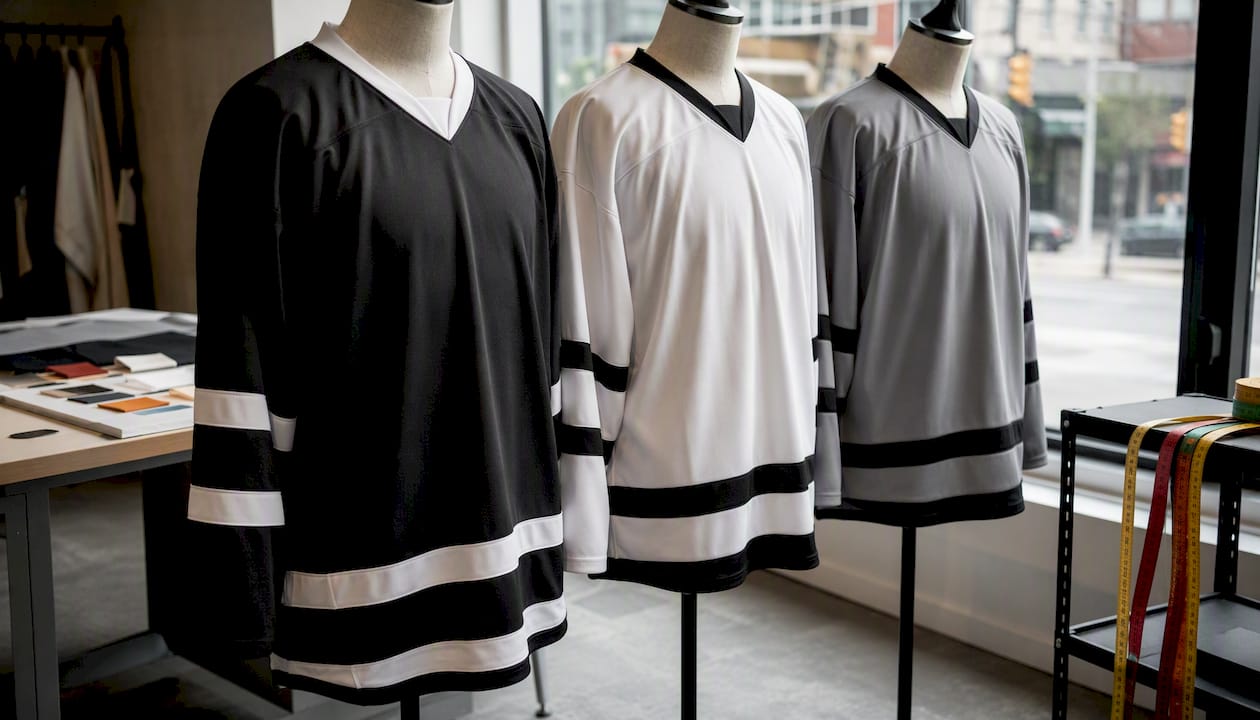
Gear and Glory’s fit guide draws a clear line: authentic jerseys are built to on-ice specs, boxy and roomy to accommodate full pad sets, while replica and fan-fit jerseys are slimmer and cut for everyday wear. The NHL’s rollout of distinct retail categories has made these differences more formalized across the industry.
Here’s the one-sentence rule for each cut:
- Authentic/game cut: size up one from your measured chest size; built for pads, so it runs large on purpose.
- Premium cut: true-to-size or one up; trimmed slightly compared to authentic but still has pad clearance.
- Replica/fan/breakaway: order your measured size; slimmer fit designed for street wear, not pad clearance.
- Practice top: order measured size or one down; shortest and least bulky, meant to sit close to the body.
Teams ordering for actual game play should default to authentic or premium cuts, as replica jerseys worn over full pads may restrict movement and wear out faster.
Youth vs. adult sizing: growth allowance and pad thickness
Youth sizing follows a different logic than adult sizing, and mixing the two systems in a team order is one of the most common mistakes coaches make. Rnkapparel’s youth sizing guide explains the structural differences between the two scales.
For youth players, add sizes beyond the current measured fit to account for one season of growth. Youth shoulder pads add some inches to the effective chest measurement; adult shoulder pads add more inches. Factor both into the order.
A practical reference for common size bands shows general chest and body length ranges alongside typical pad allowances. These are general references and should be confirmed against specific brand charts before ordering.
Key rules for youth orders:
- If a youth player measures at the top of a size band, order the next size up.
- Players near the YL/Adult S crossover often fit better in a small adult cut than a youth large.
- For multi-season planning, order one size larger than current fit for players under 12.
How to read a brand size chart correctly
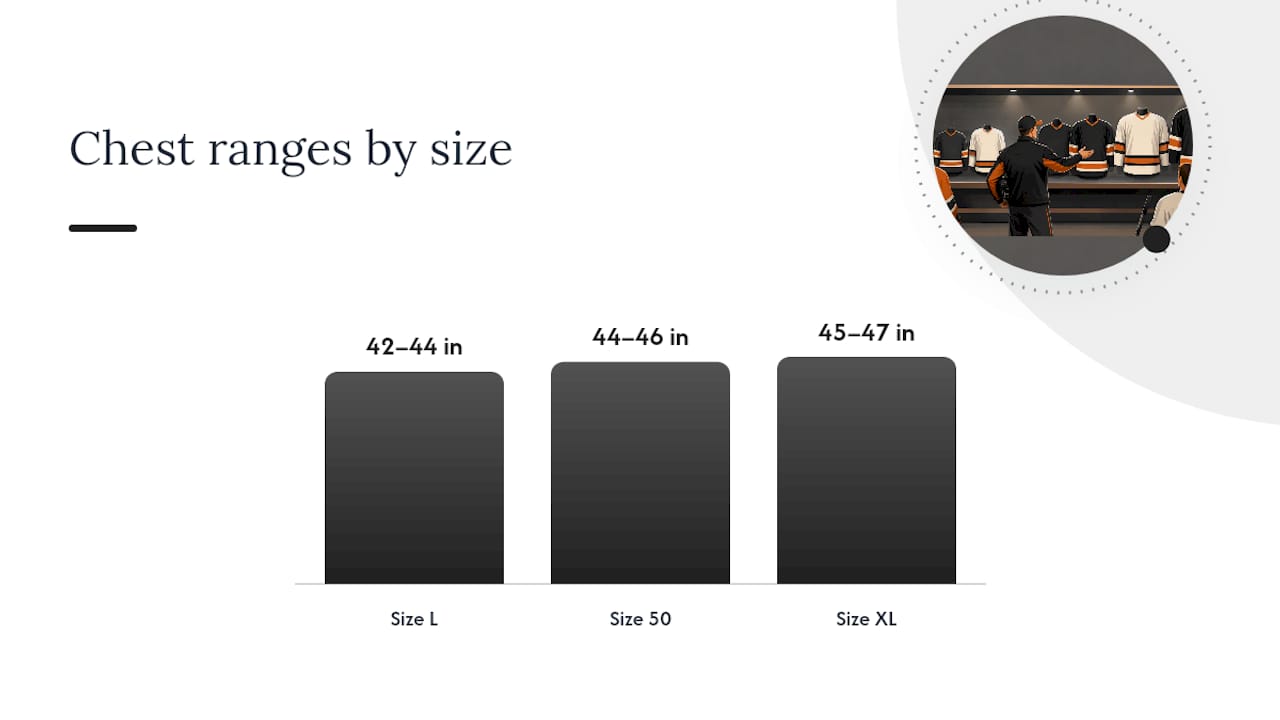
Numeric sizing (48, 50, 52) and letter sizing (S, M, L) don’t share a universal conversion. A size 50 in one brand’s authentic cut sits at roughly a 44–46 inch chest; another brand’s size 50 might run a full inch larger. Goal Sports Wear’s sizing breakdown makes this explicit: always compare your actual chest inches to the chart’s chest column, not the size label alone.
How to work through a brand chart:
- Match chest (A) first. Find the row where your measured chest falls. This is the anchor.
- Check sleeve © second. If your sleeve measurement is longer than the chart shows for that size, go up one size.
- Check body length (B) last. Length is easiest to adjust (tucking in, hem alterations), so it’s the least critical of the three.
- When two sizes both fit your chest, choose the larger for authentic cuts and the smaller for replica cuts.
- Check the gender/cut-specific chart. Women’s replica charts carry different shoulder and sleeve dimensions than men’s unisex charts for the same labeled size.
A worked example: a player measures 43 inches at the chest. The brand chart shows size L covers 42–44 inches and size XL covers 45–47 inches. For an authentic game cut, order XL. For a replica fan jersey, L is the right call.
The NHL Shop places a sizing-chart icon directly on each product page, which is worth bookmarking as a reference for how major brands present their tables.
Team order best practices: collecting sizes and placing the order
A team order without a structured size-collection process almost always produces at least one wrong size. Use this template when gathering player measurements:
| Field | What to collect |
|---|---|
| Player name | Full name |
| Jersey number | Assigned number |
| Chest (A) | Measured in inches, with pads on |
| Body length (B) | Measured in inches |
| Sleeve length © | Measured in inches |
| Cut preference | Authentic / Premium / Replica / Practice |
| Usual clothing size | S / M / L / XL (as a cross-check) |
| Pads worn? | Yes / No |
Order checklist for team managers:
- Collect all measurements at least 3–4 weeks before your target delivery date to allow for custom production lead times.
- Order a sample or prototype jersey in the most common size before committing the full run.
- Set a 48-hour confirmation window after sending sizes to players; late changes after that window delay the whole order.
- Add one spare jersey per five players in the most common size to cover last-minute additions or measurement errors.
- Review Rnkapparel’s exchange and return policy before finalizing, particularly for youth orders where sizing uncertainty is highest. The small-team buying guide covers minimum order quantities and lead-time expectations in detail.
Common sizing mistakes to fix before you submit
Most sizing errors are caught before production if you know what to look for. Here are the eight that show up most often:
- Ordering by shirt size. A player’s everyday medium T-shirt has nothing to do with their hockey jersey size. Always use A/B/C measurements.
- Measuring without pads. A bare-chest measurement for a game jersey produces a jersey that’s too small. Always measure over gear.
- Ignoring sleeve length. A jersey with the right chest but a short sleeve looks wrong and restricts movement. Measure C every time.
- Mixing youth and adult size scales. A youth XL and an adult XS are not the same garment. Confirm which scale the brand chart uses before entering sizes.
- Ordering replica cuts for game play. Replica jerseys worn over pads bind and wear out faster. Match cut to use.
- Assuming numeric sizes are universal. A size 48 from one manufacturer is not the same as a size 48 from another. Always check the chest column.
- Ordering for current fit only in youth orders. A jersey that fits perfectly in October may be tight by March. Build in growth room.
- Skipping the sample. For orders of 10 or more jerseys, one sample jersey saves more money than it costs.
If you suspect a measurement error after collecting sizes, contact Rnkapparel’s sizing team with the player’s A/B/C numbers before the order goes to production. For teams with wide size ranges or unusual builds, a quick email with measurements gets a faster resolution than trying to interpret the chart alone. The troubleshooting guide covers the most common post-order fixes.
A note from Eric on what we see most often
The question we get more than any other at Rnkapparel is some version of “my player is between sizes, what do I do?” The answer is almost always the same: go up, especially for game cuts worn over pads. A jersey with a little extra room in the body is invisible on the ice. A jersey that’s too tight shows up in every photo and makes the player uncomfortable for the entire season.
The second most common issue is coaches collecting sizes by asking players what size they “usually wear.” That method produces a mix of shirt sizes, old jersey sizes, and guesses. The A/B/C measurement process takes about three minutes per player and eliminates that entire category of error.
For teams with mixed youth and adult players, I’d strongly recommend ordering a sample in each size band before committing the full run. The youth sizing playbook on the Rnkapparel blog walks through exactly how to handle those crossover sizes.
Rnkapparel makes team sizing straightforward
Getting sizes right on a team order is the hardest part. Rnkapparel handles the rest: custom name and number application, team logo decoration, and bulk production for youth and adult teams across the U.S.
Every order starts with a size-verification step. Send your A/B/C measurements and Rnkapparel’s team will confirm the right size for each player before production begins. Sample jerseys are available for teams that want to check fit before committing to a full run. Custom hockey T-shirts and team hoodies can be bundled with jersey orders to complete the team kit in one production run.
Start your order at Rnkapparel, or reach out directly with your team’s measurements to get a size confirmation before you commit.
Sources
The sources below were used to build this guide. Each one covers a distinct part of the sizing process.
- Hockey Jersey Sizing Information | Ice Warehouse
- How to Buy a Hockey Jersey
- How to Size Hockey Jersey - Goal Sports Wear
- Find the perfect NHL jersey fit (UK fans) — Gear and Glory
Recommended
- NHL Custom Jersey Guide for Coaches and Teams – RNK Apparel Co.
- Comprehensive Hockey Apparel Size Guide: Finding Your Perfect Rink-Rea – RNK Apparel Co.
- Sizing Guide for Youth Hockey Shirts: Parents’ Playbook – RNK Apparel Co.
- Custom Hockey Apparel for Small Teams: The 2026 Buying Guide – RNK Apparel Co.
