
The fastest, lowest-risk way to get NHL-style custom team and training hockey apparel is to work with a specialist like Rnkapparel, which offers team minimum-order transparency, in-house art proofing, and fit samples. Skip the guesswork: order through a custom-team outfitter built for hockey, not a generic print shop.
Start here:
- Confirm your full roster and collect sizes (measured with pads on)
- Gather your team logo as a vector file (.AI or .EPS)
- Set a short window for players to submit sizes
- Decide your garment mix: game jerseys, practice tees, hoodies, training apparel
- Contact Rnkapparel to request a quote and sizing chart
Typical minimums are around a dozen units per design; most providers set minimum orders near 10–12 pieces for custom team apparel. Standard production takes several weeks after proof approval, so build your timeline backward from your first game or practice date.
Table of Contents
- What products and decoration methods does a custom hockey jersey order actually cover?
- How to place a team custom jersey order without delays
- What should you budget for MOQs, pricing, and lead times?
- How do you get sizing right for a full team?
- What artwork and logo specs does your supplier actually need?
- How do you coordinate a multi-player or multi-team order?
- How do you handle samples, quality checks, and defects?
- Key Takeaways
- What actually matters when ordering custom team hockey apparel
- Rnkapparel makes custom hockey team orders straightforward
- Useful resources to start your order
What products and decoration methods does a custom hockey jersey order actually cover?
“Custom hockey jersey” in this guide means made-to-order team and training apparel, not licensed replica fan gear. The product set is wider than most coaches expect.
Product categories:
- Game jerseys and practice jerseys
- Training tees, long-sleeve tees, and hoodies
- Joggers, shorts, and warm-up apparel
- Accessories: hats, socks, bags, helmet stickers
Decoration method matters more than most teams realize, because it drives both cost and durability.
Sublimation dyes the design directly into the fabric, so it won’t crack or peel and supports unlimited colors. It’s the best choice for complex crests and full-coverage designs. Tackle twill (sewn fabric letters and numbers) gives a traditional, premium look but adds cost per character. Embroidery works well for chest logos on hoodies and accessories. Screen print is cost-effective for simple, high-volume training tees with one or two colors.
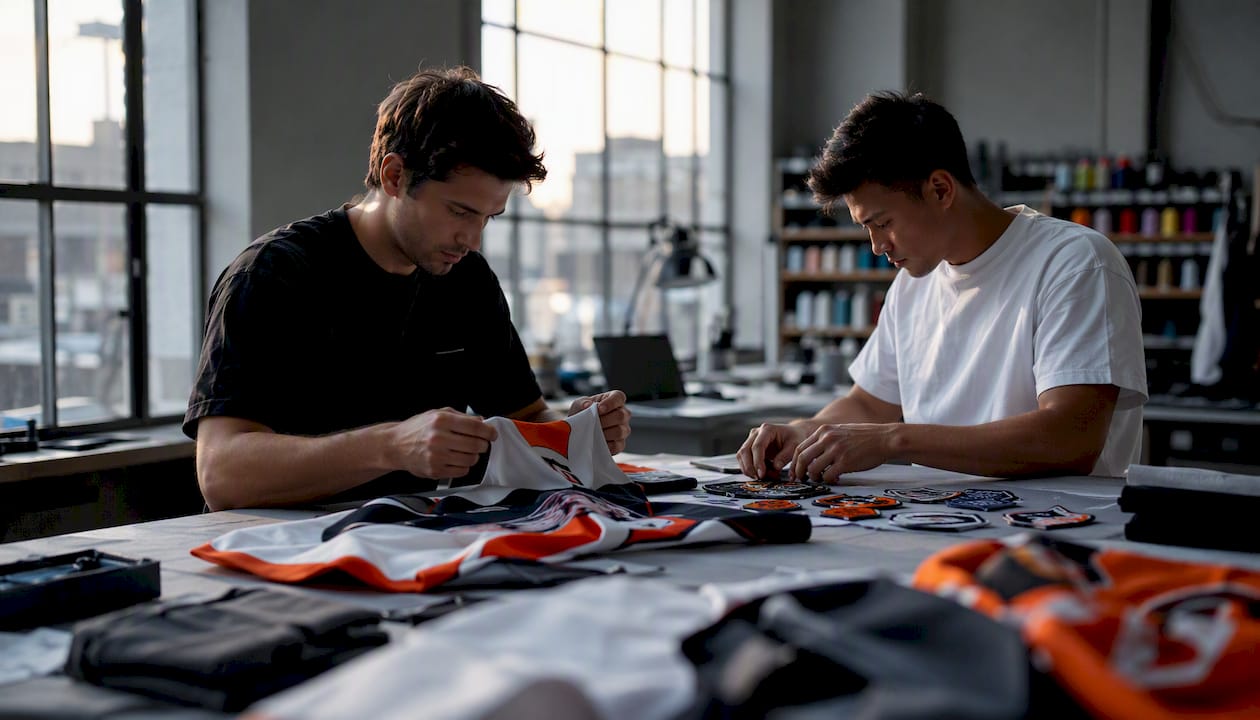
Fabric weight also splits by use case. Game jerseys typically use Dri-Fit polyester fabric of moderate weight suitable for moisture management for lightweight moisture management over equipment. Practice jerseys and training apparel use a heavier polyester fabric designed for daily wear durability, which holds up to daily wear.
How to place a team custom jersey order without delays
Follow this sequence and you’ll avoid the two most common hold-ups: late size submissions and artwork rework.
- Lock the roster. No order starts without a confirmed player list. Stragglers after production begins mean separate orders at higher per-unit cost.
- Open a sizing window. Give players and parents exactly 7–10 days to submit measurements. Firm deadline, no extensions.
- Build a master brief. Document team colors (Pantone references), logo placement, number font, and any sponsor marks before touching the order form.
- Prep your art files. Submit vector files (.AI or .EPS). Raster files (JPG, PNG) cause delays because the supplier must redraw them.
- Review the digital proof carefully. Check every name spelling, number, and color before approving. This is your last free correction.
- Pay the deposit and confirm the sample. Most suppliers require a deposit to begin production. Request a physical sample if your order is large or if it’s your first season with a new supplier.
- Approve the sample, then release full production. Sign off in writing. Keep the approval email.
- Plan distribution. Have a pickup or shipping plan ready before jerseys arrive so you’re not storing 25 boxes in your garage.
Pro Tip: Assign one person as the single approver for all design proofs. Multiple approvers create conflicting feedback loops that stall production by days.
What should you budget for MOQs, pricing, and lead times?
Pricing for custom team hockey apparel depends on four variables: garment type, decoration method, order size, and turnaround speed.
| Variable | Entry Range | Better Pricing Unlocks At |
|---|---|---|
| Minimum order quantity is generally around a dozen units per design; bulk pricing and better rates unlock at 15–20+ units per order. | ||
| Decoration method | Screen print (lowest) | Sublimation costs more upfront but saves on reprints |
| Production lead time is usually measured in multiple weeks under normal conditions | Rush orders shorten production time but require additional fees | |
| Consolidated orders | Per-team pricing | Multi-team league orders unlock factory-direct rates |
Design complexity moves the price needle too. A large chest crest with minimal additional embroidery or twill accents costs less than a jersey loaded with sleeve patches, sponsor logos, and custom numbering on every surface. Keeping decoration focused on the main chest logo is the single easiest way to control per-unit cost without sacrificing visual impact.
Rush fees are real. If your season starts in six weeks and you haven’t ordered yet, budget for the premium. Better: order 8–10 weeks out and avoid it entirely.
How do you get sizing right for a full team?
Sizing is where most team orders go wrong, and wrong sizes mean reorders at full cost.
- Measure with pads on. Chest circumference, sleeve length, and torso length all change significantly when a player is wearing shoulder pads and elbow pads. Measuring without equipment is the most common sizing mistake in team orders.
- Use the supplier’s sizing chart, not a generic one. Download Rnkapparel’s hockey apparel sizing guide before collecting measurements.
- Handle goalies separately. Goalie-cut jerseys typically run 3–4 sizes larger than player cuts. Order and approve goalie sizing as a separate line item.
- Set a hard deadline for size submissions. A 7–10 day window with a clear cutoff prevents stragglers from holding up the entire order.
- Cross-reference youth vs. adult sizing. Youth and adult size scales don’t overlap cleanly. Confirm which scale applies to each player before submitting.
Pro Tip: For youth teams, ask parents to measure their child the night before practice when the child is already in full gear. You’ll get accurate numbers in 48 hours instead of two weeks.
For additional sizing guidance, the hockey sizing resource at Parent Coach Desk is a useful neutral reference for parents who are new to ordering team gear.
What artwork and logo specs does your supplier actually need?
Artwork problems are the second-biggest cause of production delays, right behind late size submissions.
File formats: Submit .AI (Adobe Illustrator) or .EPS files as your primary artwork. A high-resolution PDF (300 DPI minimum) works as a backup. Avoid JPG and PNG for logos and crests. Raster files lose sharpness when scaled to jersey size, and the supplier will charge redraw fees or simply ask you to resubmit.
Color references: Provide Pantone (PMS) color codes for every team color. RGB or HEX values are acceptable for sublimation, but Pantone is the standard for tackle twill and embroidery because thread and fabric colors are matched to physical swatches, not screens.
Proof checklist before you approve:
- Every player name spelled correctly
- Numbers match the roster list
- Logo placement matches the brief (chest, sleeve, back yoke)
- Colors match your Pantone references
- Font matches the approved style guide
Set a 48–72 hour approval window for proofs. Longer windows stall production; shorter ones create rushed approvals that miss errors. One approver, one deadline, one written sign-off.
How do you coordinate a multi-player or multi-team order?
Assign four roles before the order opens. Without them, everyone assumes someone else is handling it.
Design lead: owns the master brief, logo files, and all proof approvals. Size coordinator: collects measurements, chases stragglers, and submits the final size run. Payments coordinator: handles deposits, individual player payments, and any refund requests. Single final approver: the one person who sends the written go-ahead to the supplier.
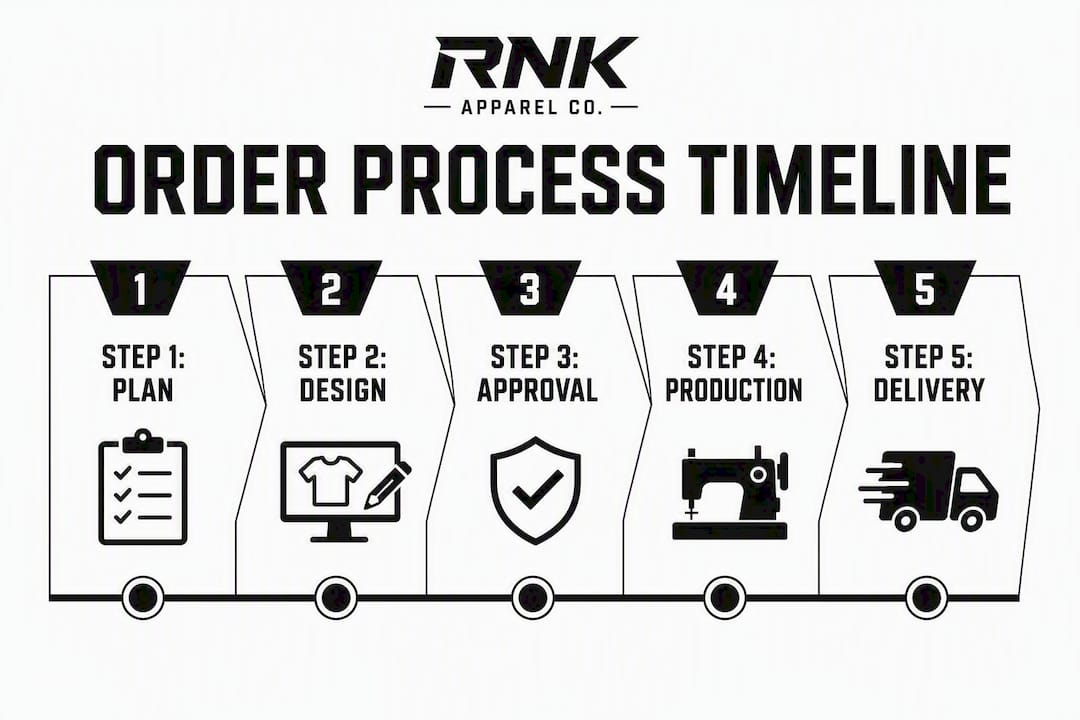
A realistic single-team timeline runs 7–12 weeks from design kickoff to delivery. The steps that most commonly slip: size collection (always takes longer than expected), proof approval (multiple stakeholders create revision loops), and payment collection (one or two players always pay late).
Design approval is the true rate-limiting step, not manufacturing. Lock the design before you open the size window, not after. For league orders spanning multiple teams, a master brief with shared color palettes and logo placement standards keeps team-level mockups consistent without requiring every team to start from scratch.
For payment, a collective invoice paid by the organization is the cleanest model. Individual team-store orders work well for larger programs where parents pay directly, but they require a longer collection window.
How do you handle samples, quality checks, and defects?
Order a physical sample before full production whenever your order exceeds 20 units or involves a new supplier. Plan for this in your timeline: sample review adds 1–2 weeks but prevents expensive mass reorders.
What to inspect on a sample:
- Stitching at seams, cuffs, and collar (no loose threads or puckering)
- Print or sublimation clarity (sharp edges, no bleeding)
- Color match against your Pantone reference
- Name and number placement against the approved proof
- Fabric weight and hand feel against the spec
Common defects and typical remedies: misprints and color mismatches are usually reprinted at no charge when the error is the supplier’s. Sizing errors caused by incorrect measurements submitted by the team are typically the team’s responsibility. Missing customization (a name left off, a wrong number) should trigger a reprint of the affected pieces.
Order two to three extra units per size as spare stock. Exchanges after distribution are slow and expensive; having spares on hand solves most problems in 24 hours.
Pro Tip: Photograph the sample against the digital proof side by side before approving. That image becomes your quality benchmark if a dispute arises later.
For a deeper look at fulfillment and returns workflows, Rnkapparel’s guide on custom team apparel fulfillment covers the full process.
Key Takeaways
Getting custom hockey team apparel right requires confirmed rosters, measurements taken with protective gear on, vector artwork, and a single approver for proofs before production begins.
| Point | Details |
|---|---|
| Minimum order quantities | Most suppliers require about a dozen units per design, with bulk savings improving substantially once the order reaches 15–20 or more units. |
| Measure with pads on | Chest, sleeve, and torso measurements taken over equipment prevent the most common sizing errors. |
| Lead time to budget | Standard production runs 4–6 weeks after proof approval; rush orders take 2–3 weeks with an added fee. |
| Lock design before sizing | Design approval is the rate-limiting step; finalize artwork before collecting player measurements. |
| Rnkapparel for team orders | Rnkapparel handles made-to-order custom hockey apparel for youth and adult teams with design proofing and sizing support. |
What actually matters when ordering custom team hockey apparel
Most ordering mistakes aren’t about the product. They’re about process. Teams that struggle with custom apparel orders almost always have the same problems: no single approver, no firm size deadline, and artwork submitted as a low-resolution PNG.
The advice to measure with pads on sounds obvious until you’ve seen a team of 18 players show up to their first game in jerseys that don’t fit over shoulder pads. It happens every season. The fix costs nothing except a reminder to parents before the size window opens.
Sample orders get skipped because they feel like an extra step. They’re not. A sample is insurance. One reprint on a 25-jersey order costs more than the sample ever would have.
The other thing teams underestimate: consolidating orders. If your program runs two or three teams, ordering together unlocks pricing that a single team simply can’t access. The coordination is harder, but the savings are real, and the process gets easier every season once roles are assigned.
Rnkapparel makes custom hockey team orders straightforward
Custom team hockey apparel doesn’t have to mean weeks of back-and-forth with a generic print shop that has never seen a hockey jersey. Rnkapparel is built specifically for the hockey community, from youth travel teams to adult recreational leagues across the United States and Canada.
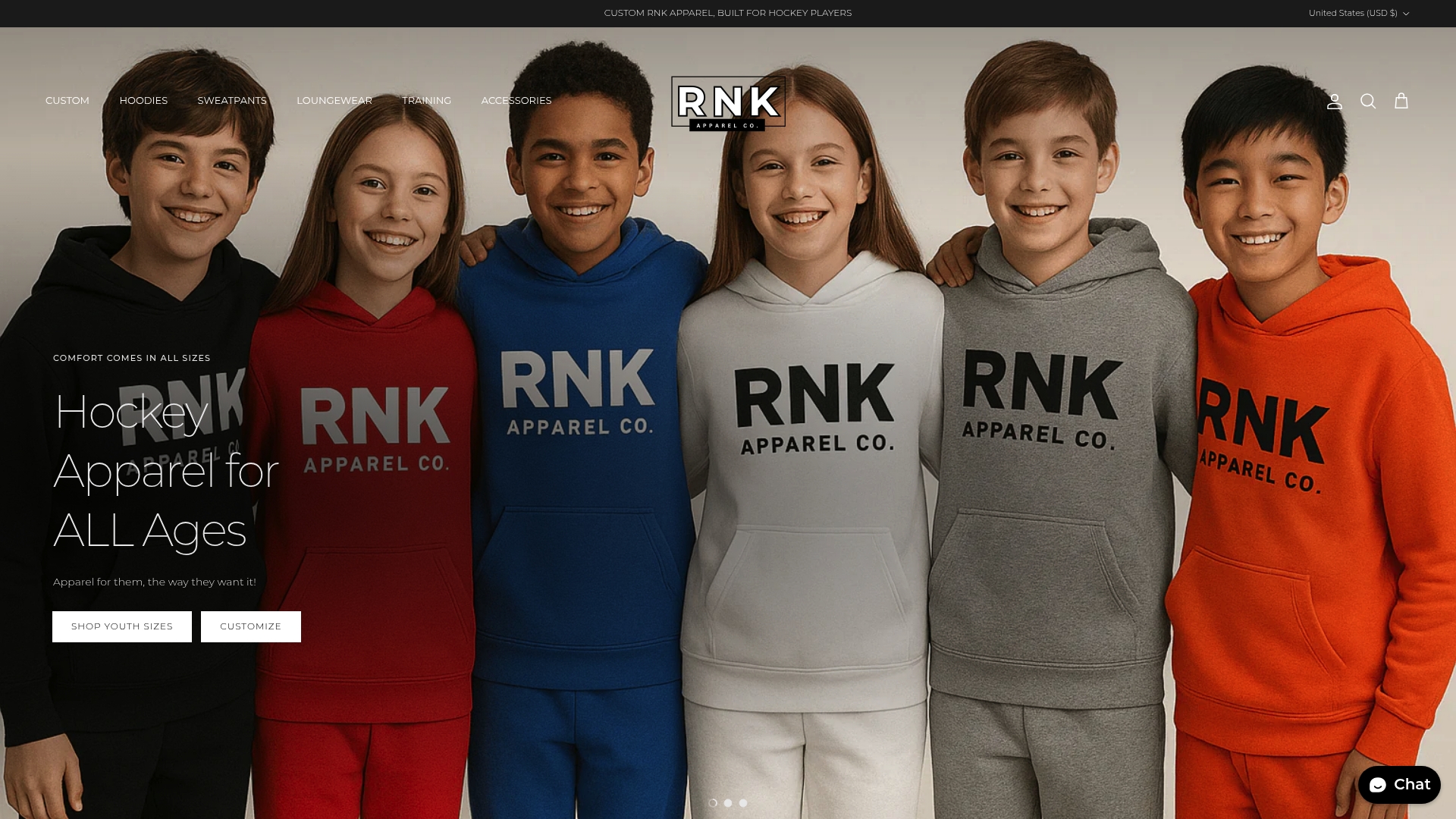
The product range covers everything a team needs in one order: custom hockey graphic T-shirts, hockey hoodies, long-sleeve training tees, youth joggers, performance workout apparel, and accessories that round out a complete team kit. Every order includes design proofing, and sizing support is available before you commit.
To get started, visit Rnkapparel and request a team quote. Have your roster count, garment mix, and logo file ready and you can move from first contact to approved proof faster than most teams expect.
Useful resources to start your order
- Rnkapparel hockey apparel sizing guide — open this first, before you collect any measurements
- Rnkapparel youth hockey team gear guide — practical advice for coaches building consistent team identity
- Custom hockey apparel for small teams — useful if your roster is near the MOQ threshold
- Hockey sizing guide at Parent Coach Desk — neutral third-party reference for parents measuring kids in gear
Save your digital proof and the written approval email. If a dispute arises after delivery, that timestamp is your clearest evidence.
Recommended
- Design Youth Hockey Team Gear: A Coach’s Guide – RNK Apparel Co.
- Customizable Hockey Clothing Options for Teams - Enhance Team Identity | Quality Apparel, Affordable Prices – RNK Apparel Co.
- Custom Hockey Hoodies: The Ultimate 2026 Guide to Performance – RNK Apparel Co.
- Custom Hockey Hoodie Creator: How to Design Your Own Pro-Style Gear in – RNK Apparel Co.
