

Youth sizing is a distinct measurement system built for growing bodies, not a scaled-down version of adult clothing. Parents of youth athletes often discover this the hard way: a Youth XL that fits perfectly in october can feel too short by spring, while an Adult Small bought as the “next step up” hangs awkwardly off narrow shoulders. Understanding why youth sizes differ from adult sizing saves you money, prevents returns, and keeps your athlete comfortable on the ice or the field. Youth sizes range from XS through XL, covering roughly ages 4 through 20, while adult sizing begins at Adult XS or Small for fully developed frames.
Why do youth sizes differ from adult sizing in sports apparel?
Youth sizes differ from adult sizing because children’s bodies grow in proportions that do not match adult frames. A child’s torso is shorter relative to chest width. Shoulders are narrower. Arms are shorter. Apparel manufacturers design youth garments around these specific proportions, not around a miniaturized adult template.
The youth sizing system runs from XS for ages 4–5 up to XL for ages 18–20. Adult sizing picks up where youth leaves off, starting at Adult XS or Small for bodies that have reached or nearly reached full skeletal development. These are two separate systems with different construction logic, not one continuous scale.
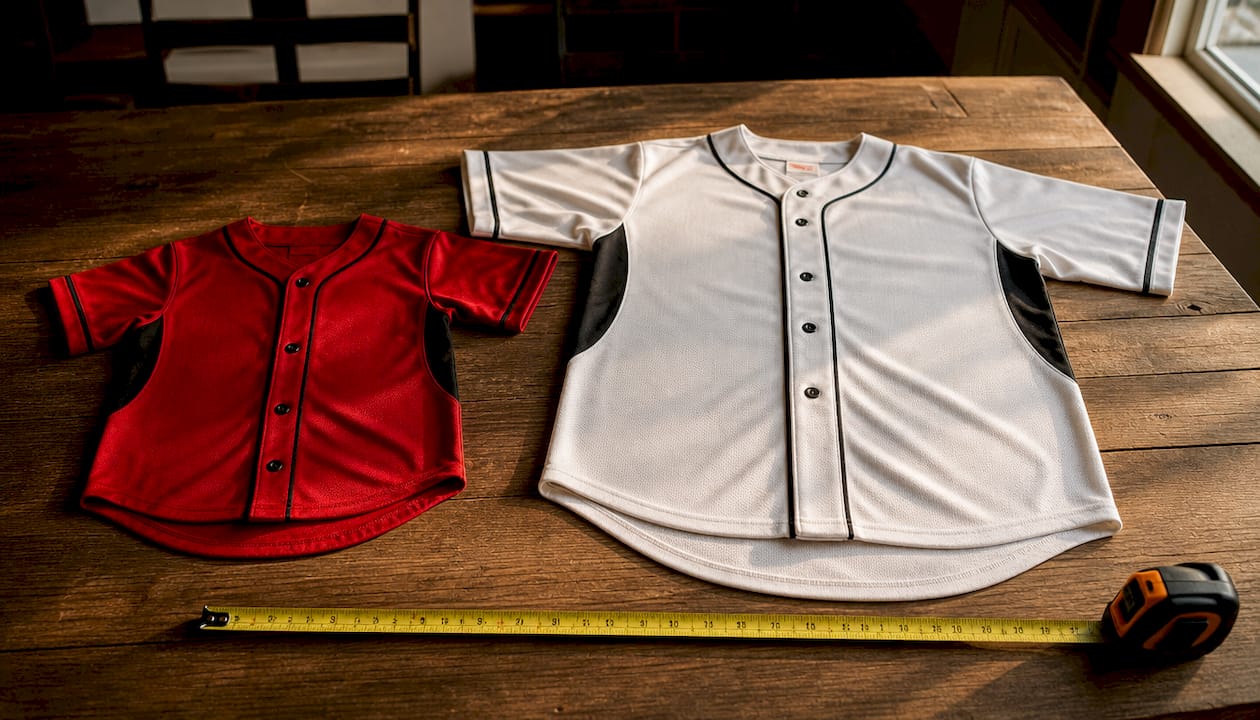
This matters for sports apparel specifically because fit affects movement. A shirt that is too long bunches under pads. A shirt with sleeves that are too wide catches on equipment. Getting the sizing system right is the first decision, not an afterthought.
What are the key dimensional differences between youth and adult sports apparel sizes?
The numbers tell the clearest story. A Youth XL and Adult Small share a chest measurement of roughly 34–36 inches. On paper, they look interchangeable. In practice, they are not.
Torso length
Adult Small runs 3–5 inches longer in body length than Youth Large. That gap means an adult shirt will hang past the waistband on a younger athlete, while a youth shirt will look cropped on a body that has started to grow into adult proportions.
Shoulder width and sleeve length
Adult Small shoulders measure 18–19 inches across. Youth XL shoulders measure 16–17 inches. That 2-inch difference changes how the garment sits and how freely the arms move. Adult sleeves also run 1–2 inches longer than their youth counterparts at the same chest size.
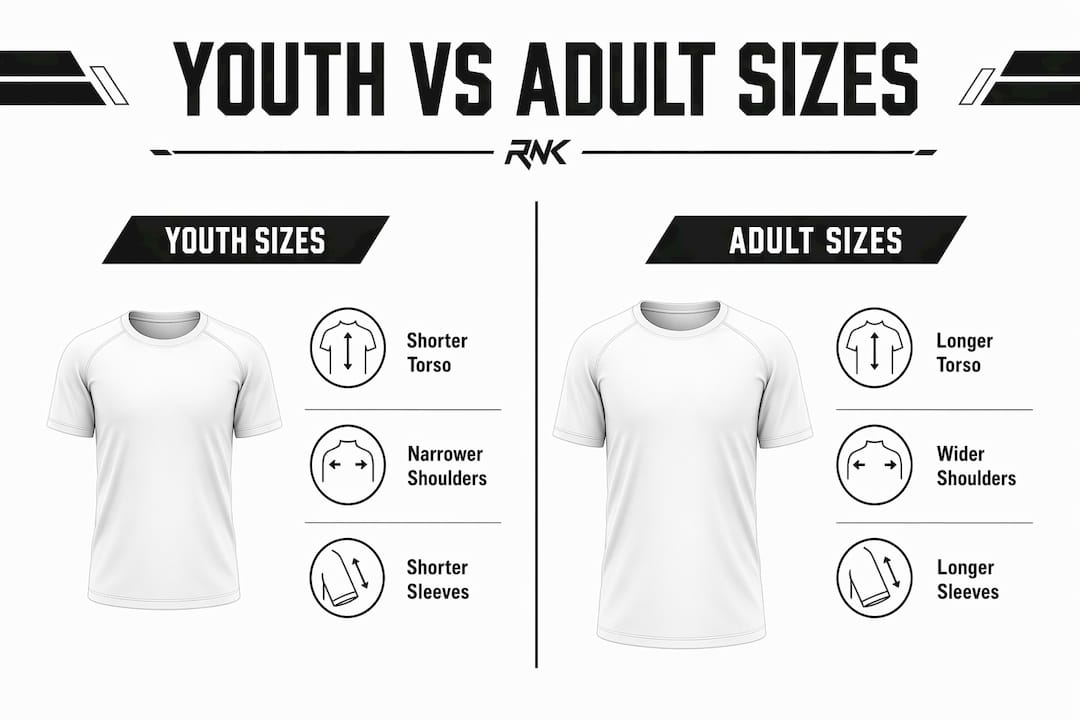
The table below shows the core dimensional gaps at the crossover point:
| Measurement | Youth XL | Adult Small |
|---|---|---|
| Chest width | 34–36 in | 34–36 in |
| Body length | ~26 in | ~29–31 in |
| Shoulder width | 16–17 in | 18–19 in |
| Sleeve length | Shorter by 1–2 in | Standard adult |
Key takeaway from these numbers: chest width overlaps, but every other dimension diverges. Parents who size by chest measurement alone will consistently get the wrong fit.
Pro Tip: Always measure torso length from the base of the neck to the natural waistline before ordering. That single measurement will tell you more than chest width alone.
How are youth apparel designs tailored differently than adult garments?
Construction differences go beyond measurements. Youth garments use straighter, boxier silhouettes designed for active movement, while adult garments feature tapered shapes that follow a mature body’s contours. These are fundamentally different design philosophies.
Here is what that means in practice:
- Silhouette: Youth shirts are cut with minimal taper from chest to hem. Adult shirts narrow at the waist to follow adult proportions.
- Necklines: Youth styles use simpler, smaller necklines that are easier to pull on and off. Adult necklines are wider to accommodate broader shoulders and neck.
- Fabric weight: Youth apparel prioritizes softer, lighter fabrics that sit gently against sensitive skin. Adult apparel leans toward durability and structure.
- Seam placement: Youth garments place seams to allow unrestricted arm movement during play. Adult seams account for a wider range of body shapes.
These differences are not cosmetic. A youth athlete wearing an adult-cut shirt will feel the taper pulling across the back during a skating stride. An adult wearing a youth-cut shirt will feel the boxy hem bunching under a belt or waistband.
Pro Tip: When ordering team apparel for a mixed-age group, request a sample garment in both Youth XL and Adult Small before placing the full order. The fit difference is obvious the moment you hold them side by side.
What sizing guidance helps parents navigate the youth-to-adult sizing transition for sports gear?
The transition from youth to adult sizing is the moment most parents get tripped up. Here is a clear, step-by-step approach that works:
- Measure chest width and torso length. Age is a starting point, not a reliable guide. Measuring actual body dimensions is far more reliable than guessing by birth year. Use a soft tape measure and record both numbers before consulting any size chart.
- Follow the Youth XL to Adult Small progression. The correct next step after Youth XL is Adult Small, not Adult Medium. Skipping directly to Adult Medium produces an oversized garment that fits poorly across the shoulders and chest.
- Do not skip sizes. The jump from Youth XL to Adult Medium is too large. Proportions shift too dramatically across the shoulders, sleeves, and torso length. Stick to the sequential progression.
- Order a sample before a team bulk order. For youth hockey teams with players at different growth stages, ordering one sample in each size at the crossover point prevents costly bulk ordering mistakes.
- Consult brand-specific charts. The same nominal size can vary by inches between manufacturers. Measurement-based sizing is especially critical for sports apparel because manufacturer specs differ widely.
Sports teams managing older youth divisions routinely stock both Youth XL and Adult Small as bridging sizes. This keeps visual consistency across age groups while giving each player a proper fit. It is a practical approach any parent or team manager can replicate.
What common misconceptions do parents have about youth versus adult sizing?
The biggest misconception is that chest width is the primary sizing factor. It is not. Body length is the decisive factor in how a garment actually fits and looks on a growing athlete.
“A Youth XL shirt physically sits higher on the torso compared to an Adult Small. If a growing athlete is sized by chest measurement alone, the youth shirt creates a cropped look that is uncomfortable and visually awkward during play.”
Other common misconceptions worth correcting:
- “Youth XL is just a smaller Adult Small.” The chest width overlaps, but the body length, shoulder width, and sleeve length all differ significantly. They are not interchangeable.
- “My child wears a Youth XL, so Adult Medium is the safe next step.” Adult Medium is two full size steps up from Youth XL. The correct progression is Youth XL to Adult Small.
- “Size labels are consistent across brands.” They are not. A Youth XL from one manufacturer can differ by an inch or more in body length from another brand’s Youth XL.
- “Youth sizes are just about being smaller.” Youth sizes reflect different body proportions entirely. The ratio of torso length to chest width, shoulder width to sleeve length, and neckline size to body width all differ from adult norms.
Understanding these distinctions protects you from ordering apparel that fits on the hanger but fails on the ice.
How do youth and adult sizing differences impact sports apparel performance and comfort?
Fit is not just about appearance. In sports apparel, the wrong size system affects how an athlete moves, layers equipment, and performs.
- Mobility: Youth cuts with boxier silhouettes allow full arm rotation during skating strides and stick handling. An adult-cut shirt on a youth athlete restricts movement at the shoulders because the taper pulls across the back.
- Layering: Youth athletes wearing pads and base layers need a shirt that sits correctly over those layers. A shirt that is too long bunches under a chest protector. A shirt with sleeves that are too wide catches on elbow pads.
- Sleeve length: Adult sleeves run 1–2 inches longer than youth sleeves at the same chest size. On a youth athlete, that extra length folds at the wrist and interferes with glove fit.
- Confidence: Apparel that fits correctly looks correct. A youth athlete in a shirt that hangs past the hips or gaps at the shoulders looks and feels out of place. Fit directly affects how confident a player feels stepping onto the ice.
- Transition readiness: A youth athlete who has grown into Adult Small proportions but is still wearing Youth XL will feel the shirt riding up during play. Recognizing the youth-to-adult transition early prevents this problem before it affects performance.
The right size system keeps the garment where it belongs: out of the athlete’s way.
Key Takeaways
Youth sizes differ from adult sizing because they are built around different body proportions, not just smaller measurements, and body length is the single most important factor parents should measure before ordering.
| Point | Details |
|---|---|
| Body length beats chest width | Torso length is the decisive fit factor; chest measurements overlap at the crossover point. |
| Follow the correct progression | Move from Youth XL to Adult Small, never directly to Adult Medium. |
| Measure before ordering | Age-based sizing causes errors; measure chest width and torso length every time. |
| Construction differs by design | Youth garments use boxier cuts and softer fabrics; adult garments are tapered and more structured. |
| Sample before bulk orders | Order one garment in each crossover size before committing to a full team order. |
What I’ve learned from watching parents size youth athletes year after year
Most sizing mistakes I see come from one habit: parents pick a size based on what fit last season. Kids grow unevenly. A player who wore Youth Large in september may need Youth XL by january, and Adult Small by the following fall. The label from last year is not a reliable guide for this year.
The Youth XL to Adult Small progression is the one piece of advice I give every parent at the crossover stage. It feels counterintuitive because Adult Small sounds like a step down in size. It is not. It is a step into a different sizing system with longer torso length, wider shoulders, and longer sleeves. That shift matters more than the number or letter on the tag.
The other thing I tell parents: fit and comfort outrank labels every time. A youth athlete who is comfortable in their gear plays better. They are not adjusting their shirt between shifts or pulling at a sleeve that is too long. Getting the size right is one of the simplest performance advantages you can give a young player. Use the youth apparel sizing guide at Rnkapparel as a starting point, then measure and confirm before every new season.
— Eric
Rnkapparel’s youth and adult hockey apparel built for growing athletes
Rnkapparel designs custom hockey apparel for youth and adult players, with size options that cover the full crossover range from Youth XL through Adult sizes. Every garment is built for the demands of hockey: active cuts, durable fabrics, and customization options including team logos, player names, and numbers.
Parents ordering for youth athletes at the transition stage can choose from the youth training hockey apparel collection, which is cut specifically for growing bodies. For players who have moved into adult proportions, the custom hockey t-shirts collection offers adult sizing with the same performance-focused construction. Rnkapparel’s size charts are available on each product page, and the team is available to help parents confirm the right size before placing a team order.
FAQ
Why are youth sizes not just smaller adult sizes?
Youth sizes are built around different body proportions, including shorter torso length, narrower shoulders, and shorter sleeves, which do not match adult frames at any scale. They are a separate sizing system, not a miniaturized version of adult clothing.
What size comes after Youth XL in adult sizing?
Adult Small is the correct next size after Youth XL. Skipping to Adult Medium produces an oversized fit because the shoulder width and torso length jump too dramatically between those two sizes.
Can I size my child by age alone?
Age is a starting point, not a reliable guide. Measuring chest width and torso length gives a far more accurate result, since children of the same age can differ significantly in body proportions.
Why does body length matter more than chest width?
Chest measurements overlap between Youth XL and Adult Small, so chest width alone does not distinguish the two sizes. Body length is the dimension that changes most between the two systems and has the greatest impact on how the garment looks and feels during play.
How do sports teams handle sizing at the youth-to-adult crossover?
Teams managing older youth divisions typically stock both Youth XL and Adult Small as bridging sizes. This approach maintains consistent team appearance while giving each player a garment that fits their actual body proportions.
