

Before you place a bulk order for your team, verify three things: fabric spec (GSM and fiber blend), seam construction (four-needle, six-thread flatlock with a high stitch density appropriate for durability), and decoration method (sublimation for jerseys; reinforced embroidery or sewn twill for outerwear patches).
Miss any one of those, and you’re gambling on gear that fails mid-season. This youth apparel durability factors checklist covers what to confirm before ordering, what to inspect at delivery, and how to run team laundry without destroying graphics or seams.
Before you order, confirm these six things:
- Request a physical sample with the exact fabric, GSM, and fiber blend you specified — not a stock swatch
- Ask for stitch type and SPI in writing (four-needle, six-thread flatlock; specify 12–14 stitches per inch for durability)
- Confirm decoration method and whether sublimation was heat-set at a temperature range appropriate for polyester jerseys
- Request ISO 105-C06 colorfastness results and a post-wash shrinkage report
- Get the vendor’s warranty and repair policy in writing before signing off on bulk production
- Confirm lead times: sampling typically runs 5–7 days, bulk production 12–15 days, plus shipping
Table of Contents
- What does your youth apparel durability factors checklist need to cover?
- Which fabrics actually hold up for youth hockey jerseys, hoodies, and joggers?
- What seam and stitching specs prevent failures on youth hockey gear?
- How do sublimation, embroidery, and heat transfer hold up through a season?
- Which hardware and trim specs reduce premature failures?
- How does correct sizing reduce stress on seams and prints?
- What team-laundry protocol actually preserves performance fabrics?
- How do you inspect samples and incoming bulk before distribution?
- How do lead times and budget choices affect what you actually get?
- Key Takeaways
- What most coaches get wrong about apparel durability
- Get durable custom gear from Rnkapparel without the guesswork
- Useful sources and supplier documents to request
What does your youth apparel durability factors checklist need to cover?
A printable checklist coaches and managers can run through during vendor calls and at delivery.
Order-time verifications
- Fabric composition and GSM confirmed in writing (see fabric section below for ranges by garment type)
- Heat-setting confirmation for polyester blends (critical if elastane is included)
- Decoration method specified per garment: sublimation for jerseys, embroidery or sewn twill for hoodies and patches
- Seam type and SPI confirmed; reinforcement locations called out (shoulders, underarm, crotch, hem)
- Size-range sample set approved before bulk run (especially for mixed U8–U18 rosters)
- Lead time, order quantity minimums, and rush surcharge policy documented
- Signed warranty and repair terms on file
Packing and delivery checks
- Sealed sample retained for comparison against bulk delivery
- Individual polybag with care label and size label on each garment
- AQL 2.5 inspection level requested for major defects on incoming bulk
- Photo documentation of any defects, date-stamped, for vendor dispute resolution
Team-manager care items
- Sorting policy posted in locker room (color, decoration type)
- Wash temp capped at 40°C (104°F); gentle cycle only
- Approved detergent list (mild, low-alkaline; no fabric softener)
- Repair workflow assigned: who handles small seam failures and patch replacements
The youth sports apparel buying checklist from Rnkapparel covers several of these points in detail and is worth keeping alongside this guide.
Which fabrics actually hold up for youth hockey jerseys, hoodies, and joggers?
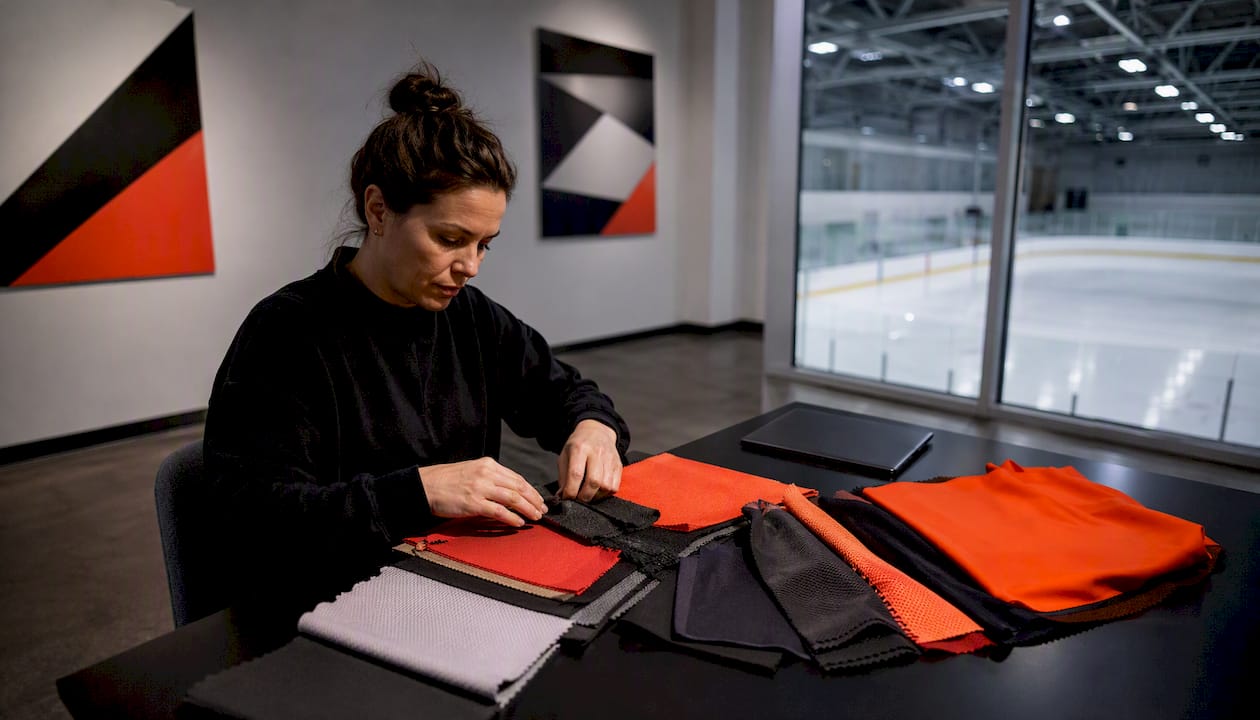
Fabric choice is where most durability problems start. The right fiber blend and weight depend on what the garment does, not just what it looks like.
| Garment Type | Recommended Fiber Blend | GSM Range | Primary Durability Factor |
|---|---|---|---|
| Match/game jersey | 100% polyester or poly-spandex | 150 GSM | Sublimation dye acceptance, wicking |
| Training jersey | Polyester or poly-spandex | 150–180 GSM | Wash cycle endurance, stretch recovery |
| Bench hoodie / sweatshirt | Polyester fleece or cotton-poly fleece | — | Abrasion resistance, warmth retention |
| Warmup jacket | Polyester interlock or woven shell | 150–200 GSM | Wind resistance, seam load |
| Joggers / warmup pants | Polyester-spandex or nylon-spandex | 180 GSM | Recovery, waistband durability |
Polyester specs for teamwear show that heat-set polyester typically shrinks only 1–2% in length after washing when properly processed. That number jumps if heat-setting is skipped, which is why you always request a post-heat-set shrinkage report before approving bulk production.
For premium abrasion resistance, nylon-elastane blends outperform standard polyester, but they cost more and require more precise dyeing. For most youth team budgets, polyester is the practical choice. Save nylon blends for high-wear positions or premium warmup jackets where abrasion at the elbows and seat matters most.
Request these test results before approving any fabric: shrinkage after machine wash (under 3%), ISO 105-C06 colorfastness at Grade 4 or better, and Martindale abrasion/pilling data where the vendor can provide it. Tightly woven constructions also help with UV-stable color retention during outdoor bench sessions and off-season storage.
Pro Tip: If your jerseys include any spandex content, always request a stretch-and-recovery test result alongside the shrinkage report. Spandex degrades faster at high wash temperatures, and a recovery test catches that before 50 jerseys come back misshapen.
What seam and stitching specs prevent failures on youth hockey gear?
The industry standard for load-bearing seams on active team apparel is four-needle, six-thread flatlock construction at 12–14 SPI. That combination distributes stress across multiple thread paths, which is exactly what you need at shoulder seams and side seams when players are pulling on gear over pads.
Seams that need reinforcement:
- Shoulder seams: highest pull stress when jerseys are worn over chest protectors
- Side seams and underarm gussets: stress from arm movement and layering
- Crotch seam on joggers and shorts: load-bearing during skating and stretching
- Hem joins and neckline: deformation from repeated on/off over helmets
- Zipper ends on warmup jackets: bartack reinforcement prevents zipper pull-through
Inspection steps on your sample:
- Pull the seam firmly by hand; it should show no gaping, thread breakage, or puckering
- Count stitches per inch on a ruler; 12–14 stitches per inch is standard, and 14 is better for high-stress zones.
- Look for skipped stitches, which indicate machine tension problems and predict early failure
- Check that bartacks are present at all stress points before approving the sample
A seam-pull strength target above 150 N is a reasonable benchmark to request from vendors who run formal tensile testing.
How do sublimation, embroidery, and heat transfer hold up through a season?
Decoration method is the second-biggest durability variable after fabric weight. Each method has a clear best use on youth hockey gear.
Sublimation embeds dye directly into polyester fibers, so graphics physically cannot peel or crack. The surface stays breathable because there’s no ink layer sitting on top of the fabric. That’s why sublimation is the right call for full-coverage game jerseys and any garment that goes under pads.
Embroidered patches and sewn twill numbers are extremely durable for outerwear, but they add bulk and can fray at the edges if the backing isn’t reinforced. They work well on bench hoodies, jacket crests, and nameplate applications where the garment isn’t pressed against protective equipment.
Screen print and heat transfers cost less upfront but crack and peel in high-friction zones after repeated washing. Use them on lower-stress pieces like warmup tees and spirit wear, not on game jerseys or anything worn under chest protectors.
Placement rules that extend decoration life:
- Avoid heavy embroidery on chest panels that sit under chest protectors
- Keep embroidery away from elbow panels on warmup jackets (friction point)
- Use sublimation for primary numbers and names on jerseys; use sewn twill for outerwear numbers
- For player names on hoodies, embroidery with a woven backing outlasts heat-transfer vinyl by several seasons
Pro Tip: Ask your vendor whether player names and numbers are sublimated as part of the base print or applied separately. Separately applied heat-transfer numbers on a sublimated jersey are a durability weak point — the base jersey lasts, but the numbers peel. Specify that names and numbers must be part of the sublimation file, not a secondary application.
Which hardware and trim specs reduce premature failures?
Small parts fail before fabric does more often than coaches expect. Specify these on your purchase order.
- Zippers: YKK or equivalent branded coil zippers with bartack reinforcement at both ends; lock sliders on warmup jackets prevent accidental unzipping during play
- Labels: woven size and brand labels survive machine washing; heat-sealed care labels outlast printed ones, which fade after a dozen cycles
- Elastic: covered elastic in waistbands with a documented recovery rate; uncovered elastic loses tension faster under repeated heat and stretch
- Drawcords: specify break-strength and knot-retention test data for hood and jogger cords; cord ends should be heat-sealed or tipped to prevent fraying
Youth hockey joggers and warmup bottoms are where waistband elastic failures show up first, so it’s worth calling out elastic specs explicitly on those SKUs.
How does correct sizing reduce stress on seams and prints?
A jersey that’s too tight at the shoulders will fail at the seam before the fabric wears out. Order a size-range sample set covering your full roster (U8–U18) and fit-check before approving bulk production. Never size a bulk run from a single medium sample.
- Shoulder seam should sit at the natural shoulder point, not pulled inward
- Allow extra ease in practice jerseys worn over base layers and pads
- Specify athletic cut with added length for players wearing chest protectors under jerseys
- Longer hems and reinforced necklines reduce deformation from repeated helmet-on/off cycles
- If in doubt between sizes, size up for practice jerseys; game jerseys can run closer to body
Pro Tip: For youth team gear design, request a graded spec sheet showing how the pattern scales from the smallest to the largest size. Poorly graded patterns create stress points at the armhole and side seam on the extreme sizes even when the medium fits perfectly.
What team-laundry protocol actually preserves performance fabrics?
Sublimated jerseys stay vibrant through many wash cycles when washed correctly. The protocol below works for bulk team loads.
- Pre-sort by color group and decoration type; keep sublimated jerseys separate from heavily embroidered outerwear to prevent snag damage
- Turn sublimated and printed garments inside-out before loading the machine
- Wash cold (max 40°C / 104°F) on a gentle cycle; hot water degrades elastane and loosens heat-transfer adhesives
- Use mild, low-alkaline detergent only; fabric softeners coat polyester fibers and reduce wicking performance over time
- Tumble dry on low heat or air-dry flat; high heat is the single fastest way to shrink spandex blends and warp decoration edges
- Do not overload the machine; overcrowded loads create friction that pills fabric and stresses seams
Repair triage: Keep a repair kit with thread matched to your stitch type. Small seam failures caught early take five minutes to fix; ignored, they become a full side-seam split by playoff time. For ripped numbers on hoodies, a sewn patch over the original extends life by a full season before replacement is necessary.
Pro Tip: Assign one team manager as the laundry lead and post the protocol on a laminated card in the equipment room. Parent volunteers mean well, but a single hot-wash cycle on a bag of sublimated jerseys undoes a season’s worth of careful ordering.
How do you inspect samples and incoming bulk before distribution?
A spec-first approach prevents the most common production surprises. Run these checks before you sign off on anything.
Sample approval:
- Verify fabric GSM and composition against your purchase order (request a fabric swatch with lab data)
- Check seam type and SPI against spec; pull-test the seam by hand
- Wash and dry the sample once, then measure for shrinkage and check print adhesion at edges
- Confirm decoration placement matches your approved artwork file
Incoming bulk:
- Request AQL 2.5 inspection for major defects (open seams, wrong size labels, decoration misregistration)
- Pull a random sample from the shipment; do not inspect only the top layer of cartons
- Photograph defects close-up (seam detail, print edges, label) with a date stamp
- Segregate nonconforming garments immediately and document for vendor review
Third-party lab reports from SGS or Intertek covering ISO 105-C06 colorfastness, Martindale abrasion, and seam strength are worth requesting from any vendor producing over 100 units for your program.
How do lead times and budget choices affect what you actually get?
Standard production timelines run 5–7 days for sampling, 12–15 days for bulk production, and 25–30 days for sea freight. Rush production (7–10 days) carries a surcharge and often limits fabric options to whatever is in-stock, which usually means lighter GSM and fewer fiber choices.
- Budget runs often default to lighter GSM (under 150 for jerseys) and lower filament counts; heavier GSM and nylon blends add material cost but improve wash-cycle endurance
- Minimum order quantities for cut-sublimate-sew programs typically run 25–50 units; smaller runs may push vendors toward stock fabrics
- Always request a signed sample approval document and a written warranty/repair policy before production begins
- Small-run premiums are real; factor them into your per-unit cost when comparing vendors
The bulk order process for youth hockey sweatshirts covers sizing and minimums in more detail if bench wear is a significant part of your order.
Key Takeaways
Durable youth hockey apparel requires three verifications before ordering: fabric spec (GSM and fiber blend), seam construction (four-needle, six-thread flatlock with a sufficiently high stitch density for durability), and decoration method (sublimation for jerseys, reinforced embroidery for outerwear).
| Point | Details |
|---|---|
| Three mandatory verifications | Confirm fabric GSM/blend, seam type at 12–14 stitches per inch, and decoration method before approving bulk production. |
| Sample before bulk | Always run a physical sample through one wash cycle and pull-test the seam before signing off. |
| Team-laundry protocol | Cold wash (max 40°C), gentle cycle, mild detergent, low-heat dry; turn printed garments inside-out. |
| Written warranty required | Get repair and warranty terms in writing; rush orders often limit fabric options and QA steps. |
| Rnkapparel for custom orders | Rnkapparel offers youth hockey jerseys, hoodies, joggers, and long-sleeve tees with custom logos and player names for U.S. teams. |
What most coaches get wrong about apparel durability
The conversation around youth hockey gear durability almost always focuses on fabric weight, and fabric weight does matter. But the real failure point in most team kits isn’t the fabric — it’s the decoration application and the seam at the stress point that nobody checked on the sample.
A 180 GSM polyester jersey with a heat-transfer number applied over the sublimation base will outlast its decoration by two seasons. The jersey survives; the number peels by January. That’s not a fabric problem. It’s a spec problem that a five-minute sample inspection would have caught.
The other thing coaches underestimate is how much team laundry protocol matters relative to fabric quality. A well-specified 150 GSM sublimated jersey washed correctly will outlast a 200 GSM jersey run through hot cycles by a parent volunteer who didn’t know better. The gear is only as durable as the system around it.
Rnkapparel’s guide to durable youth hockey clothing makes this point clearly: the spec conversation has to happen before the order, not after the first wash cycle reveals the problem.
Get durable custom gear from Rnkapparel without the guesswork
Teams that follow this checklist still need a vendor who can actually deliver on the specs. Rnkapparel builds custom youth hockey apparel, including hockey long-sleeve tees, custom hockey shirts, youth training apparel, and joggers, with full customization for team logos, player names, and numbers. Every order is built to spec, not pulled from generic stock.
The difference here is practical: you get a sample before bulk production, a clear decoration spec (sublimation or embroidery matched to the garment), and a team that has worked with youth hockey programs across the U.S. Submit your team sizing and logo to request a sample kit or a quote at rnkapparel.com.
Useful sources and supplier documents to request
When validating durability claims from any vendor, ask for these specific documents:
- ISO 105-C06 colorfastness test report (Grade 4 minimum for team apparel)
- Martindale abrasion test results for pilling resistance on jersey and fleece fabrics
- ASTM D737 air permeability data for performance jerseys
- ASTM stretch and recovery test results for any garment with spandex content
- Post-heat-set shrinkage report (under 3% length change after machine wash)
- Third-party lab reports from SGS or Intertek for orders over 100 units
- Signed sample approval document retained by both buyer and vendor
- Written warranty and repair policy covering decoration failure and seam defects
Keep a copy of this checklist alongside your purchase order so every spec is traceable back to a document, not a verbal promise.
