

Fit, reinforced construction, and moisture-managing fabrics are the three things that actually determine whether youth hockey clothing lasts a season or falls apart by January. Skip the brand name on the tag and focus on those three. For training hoodies, tees, and casual warm-up gear, Rnkapparel’s youth collection checks all three boxes with customizable options built for US teams. Under the kit, pair any training layer with a HECC-certified cut-resistant base layer for neck and arm protection.
- Fit first: clothing that restricts movement gets yanked off, worn wrong, or replaced early
- Construction: reinforced seams, bartacks at stress points, and heavy-duty zippers separate gear that lasts from gear that doesn’t
- Base layer certification: look for HECC or BNQ certification on any cut-resistant shirt worn under pads
Pro Tip: Order one size sample before committing to a full team run. A single hoodie or tee in your most-ordered size costs almost nothing compared to a bulk return.
Table of Contents
- How do you pick durable youth hockey clothing that actually lasts?
- How do you measure kids and pick the right size for hockey clothing?
- Which fabrics and construction details actually hold up for youth hockey apparel?
- Item-by-item guide: hoodies, joggers, base layers, and training tees
- How can you test garment quality before you buy?
- How do you wash and extend the life of youth hockey clothing?
- What do custom youth hockey orders cost, and how long do they take?
- Key Takeaways
- Why fit and construction matter more than most buyers realize
- Rnkapparel makes it straightforward to order quality youth hockey apparel
- Sources and further reading
How do you pick durable youth hockey clothing that actually lasts?
Five criteria separate long-lasting hockey apparel from the stuff that pills, splits, or fades after ten washes.
1. Fit and mobility. Fit beats brand every time for youth players. Poorly fitting gear increases injury risk and gets discarded faster. Look for articulated cuts, no-chafe flat seams, and enough ease across the shoulders for a full arm raise.

2. Construction quality. Double-needle stitching, bartacks at pocket corners and cuff stress points, and ripstop panels in high-wear zones are the marks of a garment built to survive a season. Zippers matter too: a flimsy pull fails before the fabric does.
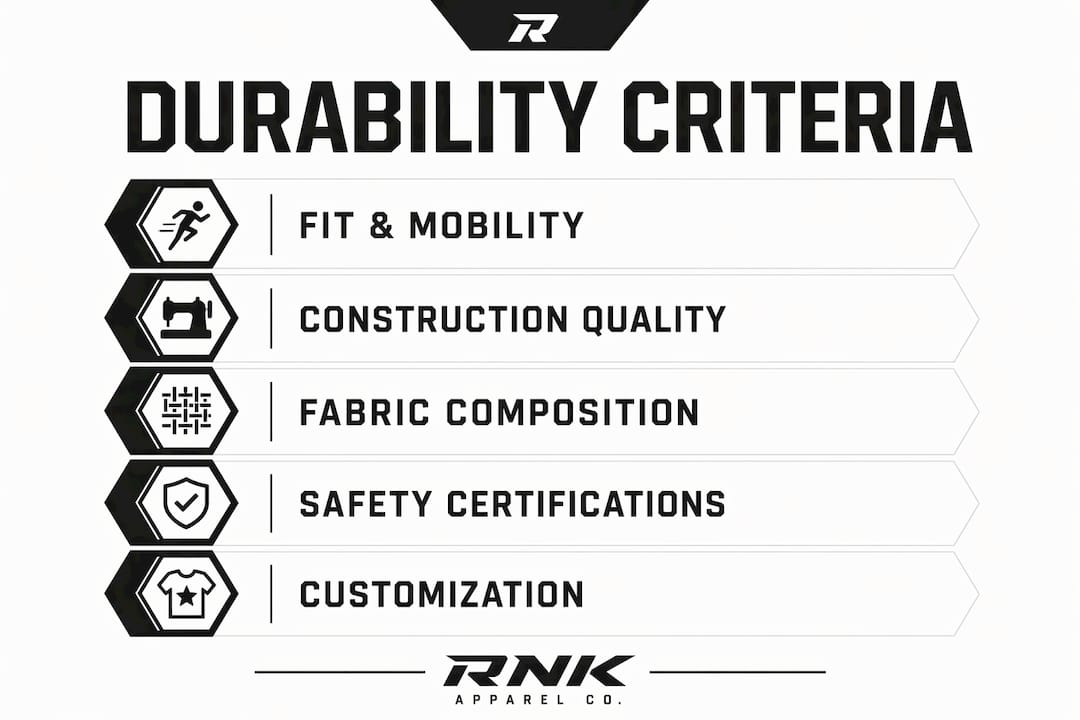
3. Fabric weight and composition. Heavier GSM (grams per square meter) generally means more durability in fleece and jersey knits. Polyester blends resist abrasion and hold their shape through repeated washing better than 100% cotton in high-contact zones.
4. Safety tech for base layers. HECC and BNQ certifications confirm blade cut resistance in the neck and arm areas. These aren’t optional for youth players on ice. Modern certified fabrics also manage moisture at the vapor stage, which means kids actually keep the layer on instead of stripping it off mid-practice.
5. Customization durability. Embroidery outlasts heat-press in almost every real-world test. If your team is ordering printed tees, ask about discharge printing or plastisol thickness. Thin heat-press transfers crack within a season; proper screen prints or embroidered patches hold for years.
Pro Tip: When ordering team apparel, collect exact chest and sleeve measurements from every player. A youth sizing guide built for hockey athletes accounts for layering under pads, which standard kids’ sizing charts ignore.
How do you measure kids and pick the right size for hockey clothing?
Getting the size wrong on a bulk team order is expensive. Here’s a repeatable process.
Measurement checklist (take all six before ordering):
- Chest: measure at the widest point, arms relaxed at sides
- Waist: natural waist, not the hip
- Hip: widest point below the waist
- Shoulder to wrist: arm slightly bent, shoulder seam to wrist bone
- Inseam: floor to crotch, shoes off
- Shoe size: needed for sizing socks and skate-adjacent gear, not apparel
Sizing rules that actually apply to hockey clothing:
- Size true for training tees and casual wear worn over a base layer
- Size up one for hoodies and warm-up jackets worn over full padding
- Never size down for casual apparel the way you would for skates (skates run 1–1.5 sizes smaller than street shoes; hoodies do not)
- Add a small oversize allowance across a team order to account for growth mid-season
Fit checks when shopping online:
- Look for “ease allowance” or “relaxed fit” language in the product description
- Confirm sleeve articulation: a gusseted or articulated sleeve means the arm seam sits at the shoulder, not pulled forward
- Check cuff fit specs: cuffs should close snugly without restricting wrist rotation
- Ask the supplier for a flat-lay measurement sheet if photos are ambiguous
For teams with players at the edge of a size range, the extra-sizes guidance from Rnkapparel explains exactly how to split a bulk order to cover the full roster without over-ordering.
Which fabrics and construction details actually hold up for youth hockey apparel?
| Feature | What to look for | Why it matters |
|---|---|---|
| Fiber | Polyester blend (65/35 or 100% poly) | Abrasion resistance, shape retention, fast drying |
| Cut-resistant layer | UHMWPE fiber, HECC or BNQ certified | Blade protection at neck and arms for youth on ice |
| Fabric weight | 280 GSM for fleece; 150–180 GSM for jerseys | Heavier weight = more durability in high-contact zones |
| Seam construction | Double-needle, bartacked at stress points | Prevents seam failure at pocket corners and cuffs |
| Zipper quality | Heavy-duty tooth, reinforced tape | Zipper failure is the most common early-wear defect |
| Moisture management | Vapor-stage wicking (EVAP-style knit) | Keeps kids comfortable so they keep the layer on |
Polyester blends dominate performance hockey apparel because they resist abrasion and dry fast. For base layers specifically, UHMWPE (ultra-high-molecular-weight polyethylene) fiber is what gives HECC-certified shirts their cut resistance without adding bulk. Merino wool blends work well in base layers for odor control and temperature regulation, though they require gentler care than synthetic options.
Moisture-wicking fabrics move sweat away from skin faster than cotton, which reduces chafing and keeps kids focused on skating rather than adjusting their gear. For youth players who train multiple days a week, that comfort factor directly affects how long a garment stays in rotation.
When reading product descriptions, the words “reinforced,” “double-needle stitch,” and “ripstop weave” are meaningful signals. Third-party certifications (HECC, BNQ) are verifiable. Vague terms like “premium quality” or “pro-grade” are not.
Item-by-item guide: hoodies, joggers, base layers, and training tees
Hoodies: Look for 280–320 GSM fleece, taped interior seams, and a zipper with a reinforced tape backing. Water-resistant coatings on travel hoodies protect against rink-side slush. Drawcords should be flat and knotted at the ends so they don’t pull through the channel. Rnkapparel’s custom hockey hoodies are built for team customization with embroidery and print placement that doesn’t compromise seam integrity.
Joggers and warm-ups. A gusseted crotch is the single feature that separates a jogger built for athletes from one built for lounging. Add articulated knees, reinforced hem cuffs, and abrasion panels at the inner ankle (where skate bags drag), and you have warm-up pants that survive a full season. Elastic plus drawcord waist keeps fit stable across a range of body types. The youth hockey jogger guide from Rnkapparel covers construction specs in detail.
Base layers. HECC or BNQ certification is non-negotiable for any base layer worn on ice. Beyond protection, look for vapor-stage moisture management: fabrics engineered to move sweat before it becomes liquid keep kids comfortable enough that they don’t strip the layer off. Lightweight compression is fine for youth players; avoid heavy compression that restricts breathing or movement.
Training tees and casual hockey shirts. Mid-to-heavyweight jersey knit (150–180 GSM) holds up to repeated washing without thinning. Double-needle hems resist rolling. For printed tees, stretch fabric recovery matters: a fabric that doesn’t bounce back after stretching will crack a print faster than any washing machine will.
Pro Tip: Label inside seams with a player’s name or number using a sewn tag rather than a marker. Marker fades; a sewn tag survives the wash cycle and keeps team gear sorted without damaging the print on the outside.
How can you test garment quality before you buy?
In-person checks:
- Pull gently at a seam: you should feel resistance, not give
- Inspect zipper teeth for uniform spacing and a tape that lies flat
- Stretch the cuff and release: it should snap back without distortion
- Flip the garment inside out and look for taped or bound seams at stress points
Online checks:
- Request close-up photos of interior seams, zipper tape, and cuff construction
- Ask for the fabric GSM or denier in the product Q&A or spec sheet
- Confirm zipper brand or type (YKK is a widely recognized standard)
- Look for third-party certifications listed in the product description, not just marketing copy
If a supplier can’t answer a direct question about stitch count or seam construction, that’s useful information too.
How do you wash and extend the life of youth hockey clothing?
- Wash cold, inside out: cold water preserves fabric structure and prevents print cracking; inside-out washing protects the outer surface
- Skip fabric softener on technical fabrics: softener coats moisture-wicking fibers and kills their performance within a few cycles
- Use a mesh laundry bag for small items like socks, patches, and accessories to prevent snag damage
- Tumble dry low when the care label allows; air dry HECC/BNQ base layers to preserve the cut-resistant fiber structure
- Don’t store gear compressed in a bag for extended periods: permanent creasing weakens seams and distorts prints
Simple repairs extend garment life significantly. Re-stitching a bartack takes two minutes and prevents a pocket corner from unraveling entirely. Replacing a zipper pull costs almost nothing. Patching an abrasion panel on the inner ankle of a jogger adds months of wear. Most manufacturers offer warranty coverage for seam failures within the first season; document defects with photos and contact the supplier promptly.
Pro Tip: Keep a basic repair kit at the rink bag: a needle, heavy-duty thread, and a few spare zipper pulls. Rotate team garments across players evenly and log wash cycles so no single piece takes all the wear.
What do custom youth hockey orders cost, and how long do they take?
Pricing for US-based custom youth apparel varies by item, decoration method, and order volume. Embroidery adds cost per piece but outlasts heat-press by years. Screen printing on mid-run orders (24+ pieces) brings per-unit cost down significantly compared to single-piece digital printing.
- Custom tees: typically $15–$35 per piece depending on fabric weight, print method, and quantity
- Hoodies: typically $35–$65 per piece for custom embroidery or screen print on quality fleece
- Joggers: typically $30–$55 per piece with custom decoration
Turnaround times inside the US typically range from a few weeks for small batch runs to longer periods for large team orders, especially during pre-season. Build in extra time for mockup approval: a week of back-and-forth on artwork before production starts is normal.
Order-planning checklist:
- Collect exact measurements from every player before placing the order
- Confirm print file specs (vector format, minimum resolution) with the supplier early
- Request a digital mockup and, for large orders, a physical size sample before full production
- Ask about minimum order quantities for each decoration method, since embroidery minimums often differ from screen print minimums
Key Takeaways
Durable youth hockey clothing comes down to three decisions: fit over brand, certified base layers, and reinforced construction ordered with a 5–8% growth allowance for team runs.
| Point | Details |
|---|---|
| Fit beats brand | Prioritize articulated cuts, no-chafe seams, and correct ease allowance over logo recognition. |
| Certified base layers | Choose HECC or BNQ-certified cut-resistant shirts for any youth player on ice. |
| Construction signals | Look for double-needle seams, bartacks, ripstop panels, and heavy-duty zippers before buying. |
| Team ordering buffer | Add a 5–8% oversize allowance and order extra of the most-used sizes to cover mid-season growth. |
| Rnkapparel for custom orders | Rnkapparel supplies customizable youth training hoodies, tees, and joggers with team ordering workflows and realistic US lead times. |
Why fit and construction matter more than most buyers realize
The conventional wisdom in youth hockey apparel is to buy the biggest brand you can afford and call it done. That’s the wrong frame. A well-constructed mid-tier hoodie with reinforced seams and the right fit will outlast an expensive piece with thin stitching and a generic cut every time.
What most team managers underestimate is the compounding cost of poor fit. A hoodie that’s too tight across the shoulders gets worn less, washed less carefully, and replaced sooner. A jogger without a gusseted crotch splits at the seam by mid-season. These aren’t quality failures in the traditional sense; they’re fit and construction failures that look like quality failures after the fact.
The other thing worth saying plainly: cut-resistant base layers aren’t premium add-ons. For youth players on ice, HECC or BNQ certification is a baseline safety standard, not an upgrade. The good news is that certified fabrics have gotten significantly more comfortable, and vapor-stage moisture management means kids no longer have a reason to skip the layer.
Rnkapparel’s approach of offering samples before full production runs is exactly the right workflow for team orders. One physical sample catches sizing and construction issues before they multiply across a 20-piece run.
Rnkapparel makes it straightforward to order quality youth hockey apparel
Custom youth hockey gear shouldn’t require a purchasing department to figure out. Rnkapparel offers youth training hoodies, custom graphic tees, joggers, and accessories built to the construction standards this guide covers: reinforced seams, moisture-managing fabrics, and decoration methods chosen for longevity.
The ordering workflow is built for teams: upload your logo, choose your colors, get a digital mockup, and request a size sample before committing to the full run. Realistic US lead times, embroidery and screen print options, and a product range that covers everything from on-ice warm-ups to casual off-ice wear. Browse the youth training collection or reach out directly to start a team order with a mockup.
Sources and further reading
- Best youth hockey gear for new players — Pro Stock Hockey: fit-first guidance and sizing rules for youth players
- Cut-Pro™ Youth Shirt — Evermade: HECC-certified cut-resistant base layer with vapor-stage moisture management
- Pro Youth Compression Shirt — Duzter: BNQ-certified compression shirt with care instructions for preserving cut resistance
- Moisture-wicking skate shirts: 9 performance benefits — CZT: fabric performance education for training apparel
- Stretch fabric for active children: A parent’s guide — CZT: recovery and abrasion resistance explained for parents
- Youth training hockey apparel — Rnkapparel: full collection of customizable youth training pieces
- Sizing guide for youth hockey shirts — Rnkapparel: measurement checklist and layering adjustments for team orders
- How to choose quality hockey clothing for kids — Rnkapparel: construction and fit criteria from the Rnkapparel team
Recommended
- Youth Training Hockey Apparel | Performance Wear for Young Players – RNK Apparel Co.
- Hockey Apparel Youth: A Complete Guide - Hockey Apparel Youth Players Wear 2025 | Comfort, Performance, Customization – RNK Apparel Co.
- Youth Hockey Hoodies: The Ultimate 2026 Buying Guide for Players & Par – RNK Apparel Co.
- Customizable Hockey Clothing Options for Teams - Enhance Team Identity | Quality Apparel, Affordable Prices – RNK Apparel Co.
