

Youth hockey apparel sizing is defined by one non-negotiable reality: children grow fast, unevenly, and in every direction at once. Understanding why youth teams need extra sizes starts with recognizing that a 10-year-old and a 12-year-old on the same roster can have body measurements as different as two adults separated by a decade. Fabrikn and Luson Sport both document how youth sizing complexity demands a wider range of sizes to reduce waste and reorders. Kiwi Sizing confirms that youth cuts differ structurally from junior cuts, requiring coaches and administrators to treat size selection as a technical decision, not an afterthought.
Why youth teams need extra sizes: the core case
The short answer is this: youth athletes do not fit a predictable size curve. Their proportions shift faster than any adult grading system accounts for, and a roster of 15 players can easily span six or seven distinct size needs. Youth grading requires stronger jumps between smaller sizes because children’s proportions change quickly. That is not a minor technical detail. It means a YS and a YM are not just slightly different. They can represent entirely different body shapes.
The industry term for this is size gradation, which refers to the mathematical and proportional rules used to scale a garment pattern up or down across a size run. When gradation is done correctly for youth bodies, each size step reflects real measurement differences in torso length, shoulder width, and sleeve length. When it is done poorly, or when adult gradation rules are applied to youth patterns, the result is apparel that fits the middle of the size range acceptably and fails everyone at the edges.
For youth hockey teams specifically, this matters because players wear their gear during high-movement activities. A hoodie that pulls across the shoulders or a t-shirt with a neckline that sits wrong does not just look bad. It affects how a player moves, how confident they feel, and whether they actually wear the team apparel at all.
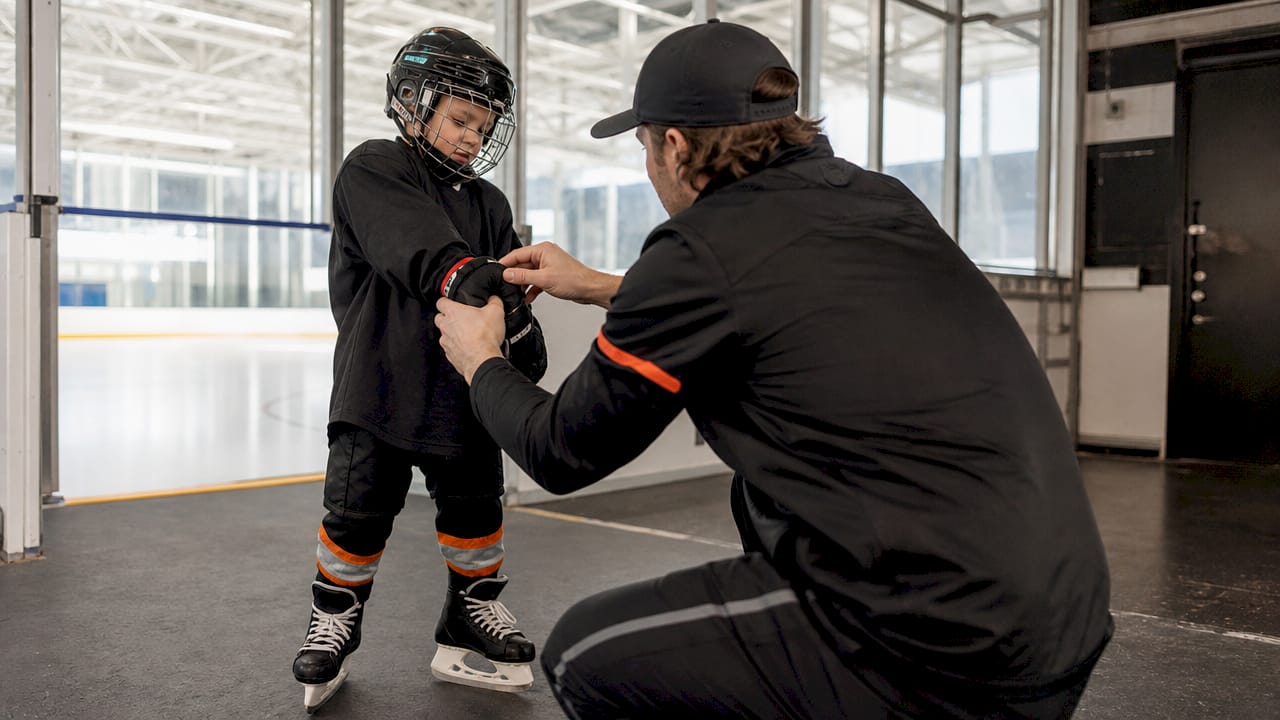
What makes youth sizing different from adult and junior sizing?
Youth and junior sizing are not the same thing, and conflating them is one of the most common mistakes coaches make when ordering team apparel. Youth sizing focuses on shorter torsos and less tailored cuts designed for children from toddlers through early teens. Junior sizing, by contrast, is slimmer and cut for teenagers whose bodies are closer to adult proportions.
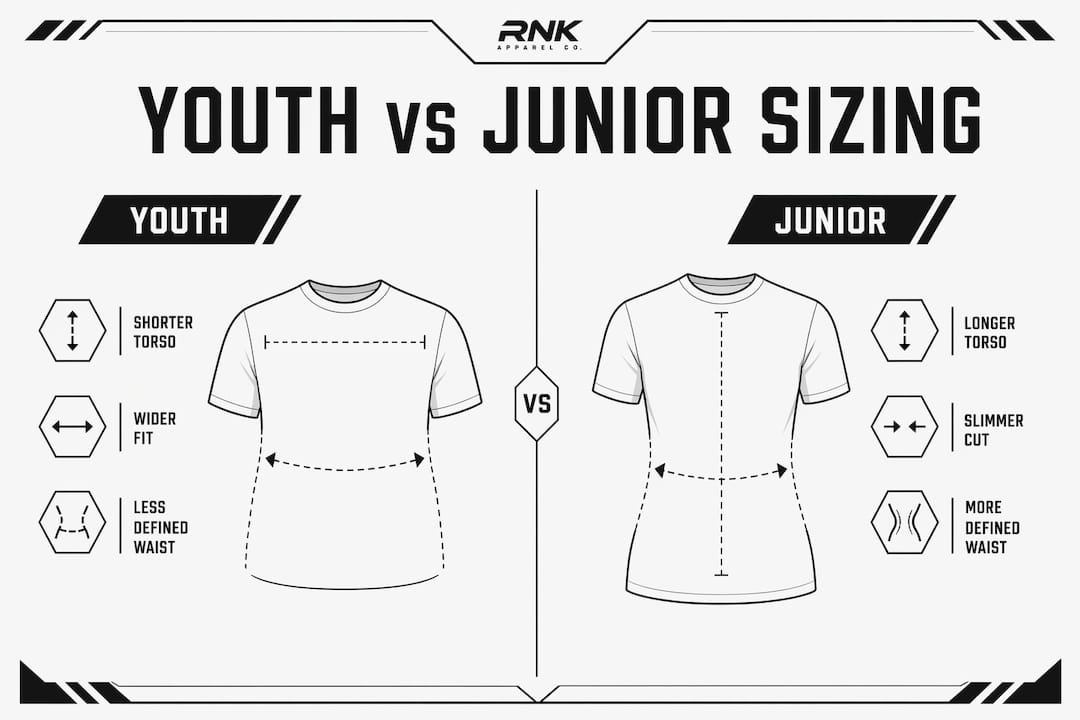
The practical difference shows up in measurements like chest-to-waist ratio, torso length, and shoulder slope. A youth XL is not a junior small. Ordering junior sizes for a 9-year-old player because the youth XL “ran out” creates a fit problem that no amount of washing or wearing in will fix.
| Measurement | Youth sizing | Junior sizing |
|---|---|---|
| Torso length | Shorter, less defined waist | Longer, more tapered |
| Shoulder width | Narrower, less structured | Closer to adult proportions |
| Chest-to-waist ratio | Straighter cut | More fitted through the waist |
| Age range | Toddler through early teen | Teen through young adult |
| Grading jumps | Larger proportional steps | Smaller, more linear steps |
Pro Tip: When reviewing a supplier’s size chart, check whether they list separate youth and junior size runs. If a supplier uses one chart for both, their youth grading is almost certainly borrowed from adult patterns and scaled down, which causes fit failures at the smaller and larger ends of the range.
How does a wider size range improve fit and functionality?
A broader size run does more than cover more players. It reflects the actual distribution of body types on a real roster. Grading based on real wearer data — heights, chest measurements, waist, and age — improves mobility, appearance, and reduces the need for rework. That is the difference between apparel that looks uniform on the ice and apparel that looks like everyone grabbed whatever was left in the box.
Here is what happens when a youth hockey team orders a narrow size run:
- Players at the smaller end of the roster receive oversized apparel that bunches at the shoulders and drags at the wrists.
- Players at the larger end receive gear that restricts movement through the chest and back.
- Coaches face midseason reorders because the two or three sizes that were ordered run out while edge sizes sit unused.
- Team morale takes a hit when some players look sharp and others look like they borrowed their older sibling’s gear.
- Administrators spend time and money on replacements that could have been avoided with better initial planning.
“A wider range of sizes improves mobility, appearance, and reduces rework.” — Fabrikn size gradation research
The inverse is also true. Ordering more sizes does not linearly increase inventory complexity. A balanced size spread actually makes reorder management easier because mid-range size points are more predictable and popular than the extremes. The goal is not to stock every conceivable size. The goal is to cover the realistic distribution of your roster with enough buffer to handle growth and new additions.
How to plan and manage youth team apparel sizing for a full roster
Effective sizing management starts before a single order is placed. The most reliable approach combines direct measurement collection, size chart cross-referencing, and a buffer strategy that accounts for the reality of youth sports rosters.
- Measure every player directly. Do not rely on parents to self-report sizes. Chest, waist, and torso length measurements take less than five minutes per player and eliminate the guesswork that causes most sizing failures.
- Cross-reference measurements against the supplier’s specific size chart. Generic size charts from other brands do not transfer. Each manufacturer grades differently, and a YL from one supplier can fit like a YM from another.
- Request samples across the full size run before committing to a bulk order. One base size sample is insufficient. Samples in YS, YM, YL, and YXL reveal fit issues that a single middle-size sample will never expose.
- Order 15 to 20% above your active roster count as a buffer. This buffer accounts for new players joining mid-season, growth spurts between ordering and delivery, and sizing errors that only become apparent when players try gear on.
- Track sizing data across seasons. A simple spreadsheet logging each player’s measurements and the size they ended up wearing gives you a baseline for the following year’s order. Over two or three seasons, you will see patterns that make ordering faster and more accurate.
Pro Tip: When placing a bulk order for youth hockey sweatshirts or other team apparel, ask your supplier to confirm which sizes they hold in stock versus which require production lead time. Sizes at the extremes of the youth range often have longer lead times, so ordering early prevents midseason shortages.
What are common pitfalls when selecting youth team sizes?
The most damaging mistake in youth team apparel ordering is treating youth sizing as a scaled-down version of adult sizing. Scaled-down adult patterns cause sizing failures at the extremes, with neckline imbalance and sleeve length mismatch being the most visible problems. A jersey that fits a YM acceptably can look structurally wrong on a YS or a YXL if the grading was not built for youth proportions from the start.
Other common pitfalls include:
- Ordering only three sizes. Many administrators default to small, medium, and large to simplify the order. This works for adult teams with relatively stable body types. For youth teams, it leaves players at both ends of the roster without a proper fit.
- Ignoring body proportion differences within the same age group. Two 11-year-olds can have chest measurements that differ by four inches. Age-based ordering without measurement data produces the same result as guessing.
- Assuming last season’s sizes still apply. Youth athletes grow an average of two to three inches per year during peak growth phases. A player who wore a YM in October may need a YL by March.
- Choosing suppliers who do not offer youth-specific grading. Some suppliers label adult XS and S as “youth” sizes without changing the cut or proportions. Ask directly whether their youth sizing uses youth-specific grading rules or adult patterns with different labels.
Supplier communication is the most underused tool in youth apparel management. A direct question about grading methodology takes 30 seconds and can prevent an entire season of fit complaints.
What are the benefits beyond fit when using extra sizes?
Proper sizing does more than make apparel functional. It shapes how players feel about being part of the team. Youth training apparel that fits correctly signals to every player that they belong, regardless of their body type or size.
| Benefit | Impact on team |
|---|---|
| Inclusivity | Players of all body types feel represented and valued |
| Player confidence | Comfortable gear reduces self-consciousness during games and practice |
| Visual uniformity | Properly fitted apparel creates a professional, cohesive team appearance |
| Reduced reorders | Accurate size planning cuts midseason replacement costs |
| Roster flexibility | Buffer stock accommodates new players and growth without emergency orders |
Team spirit wear that fits well also gets worn outside of practice. Players who wear their team gear in public are walking advertisements for the program. That visibility matters for recruitment, community presence, and the overall culture of the team. A hoodie that fits properly gets worn. One that does not gets left in a bag.
Key takeaways
Youth hockey teams need a broad size run because youth bodies grow fast, vary widely in proportion, and do not fit adult grading patterns scaled down.
| Point | Details |
|---|---|
| Youth sizing is not adult sizing | Youth grading uses larger proportional jumps and shorter torso cuts that adult patterns do not replicate. |
| Wider size runs reduce waste | A balanced size spread covers more players accurately and lowers midseason reorder frequency. |
| Measure every player directly | Self-reported sizes from parents produce consistent errors; direct measurement eliminates most fit failures. |
| Order 15 to 20% buffer stock | Extra units above roster count cover growth spurts, new players, and sizing corrections. |
| Request multi-size samples | Testing YS, YM, YL, and YXL samples before bulk ordering reveals fit problems a single sample hides. |
What I’ve learned from watching teams get sizing wrong every season
Every fall, I watch the same scenario play out across youth hockey programs. A well-intentioned administrator places a bulk order in August, picks three sizes, and by November half the team is wearing gear that does not fit. The players who got the wrong size stop wearing the team apparel outside of mandatory events. The parents are frustrated. The coach is fielding complaints instead of coaching.
The uncomfortable truth is that most sizing failures are not supplier problems. They are planning problems. Teams that take 20 minutes to measure every player and cross-reference a supplier’s actual size chart almost never have midseason fit crises. Teams that guess based on age or last year’s order almost always do.
What I find most interesting about youth hockey specifically is that the stakes are higher than in other sports. Hockey players wear their team identity hard. The hoodie, the t-shirt, the warm-up gear. These are not just clothes. They are part of how a young athlete understands their place on the team. When the gear fits, it reinforces that belonging. When it does not, it quietly undermines it.
My advice to any coach or administrator reading this: treat sizing as a first-order decision, not an administrative detail. Build a measurement session into your preseason schedule. Ask your supplier the hard questions about grading methodology. Order the buffer stock. The 20 minutes you spend on sizing in August will save you hours of headaches in January.
— Eric
How Rnkapparel supports youth hockey teams with the right size range
Rnkapparel builds its youth hockey collections with size runs designed for real youth body proportions, not scaled-down adult patterns. From custom hockey t-shirts to team hoodies, every product is available across a full youth size range with detailed size charts to support accurate ordering.
Rnkapparel also offers ordering support for coaches and administrators managing large rosters, including guidance on size distribution, sample availability, and bulk order planning. You can add player names, numbers, and team logos across the full size run without minimum order complications. If you are outfitting a youth hockey team and want apparel that actually fits every player on your roster, Rnkapparel is built for exactly that.
FAQ
Why do youth teams need extra sizes compared to adult teams?
Youth athletes grow rapidly and have body proportions that vary significantly within the same age group. A wider size run covers this variation and reduces the fit failures that occur when teams order only a few sizes.
What is the difference between youth and junior sizing?
Youth sizing uses shorter torsos and straighter cuts for children through early teens, while junior sizing is slimmer and closer to adult proportions for teenagers. The two size systems are not interchangeable.
How many extra sizes should a youth hockey team order?
Programs should order 15 to 20% above their active roster count as a buffer to cover growth spurts, new players, and sizing corrections during the season.
Why is requesting multiple size samples important before a bulk order?
A single middle-size sample hides fit problems that only appear at the smaller and larger ends of the size run. Testing YS, YM, YL, and YXL samples reveals neckline, sleeve, and torso fit issues before they affect the full order.
Does ordering more sizes make inventory management harder?
Not significantly. A balanced size spread actually simplifies reorder management because mid-range sizes are more predictable. The key is covering the realistic distribution of your roster rather than stocking every possible size.
