

Youth hockey teams rely on eight core types of practice jerseys: mesh pinnies (scrimmage vests), lightweight polyester practice jerseys, heavyweight/durable training jerseys, reversible jerseys, sleeveless/tank training tops, compression and performance tops, thermal base layers, and warmup hoodies with joggers. For most indoor training sessions, lightweight polyester is the go-to. Pinnies work best for quick scrimmages where you need to split teams fast. Thermal base layers belong on cold-ice conditioning days, especially for younger skaters at U8 and U10 levels who lose body heat quickly.
Before you order, three things matter most:
- Measure your roster (chest and torso length), not just age, since hockey equipment layering throws off standard age-based sizing.
- Estimate quantities with a buffer: one practice jersey per player plus some extra for growth and replacements, and multiple sets of pinnies per team.
- Pick your print method early — sublimation on polyester locks in color permanently, while heat-press vinyl on stock jerseys ships faster for recreational programs.
Table of Contents
- 1. What are the main types of youth hockey practice jerseys?
- 2. What materials and construction features actually matter?
- 3. How do you size youth practice jerseys correctly?
- 4. How do you wash and care for practice jerseys to make them last?
- 5. How do you choose and order the right jerseys for your team?
- 6. Which customization and printing method holds up best?
- Key Takeaways
- What coaches often get wrong about practice jerseys
- Rnkapparel makes custom youth hockey practice kits simple
- Useful sources and further reading
1. What are the main types of youth hockey practice jerseys?
Youth hockey programs use a wider range of practice apparel than most coaches initially plan for. Each type serves a different drill format, temperature condition, or age group.
Mesh pinnies and scrimmage vests
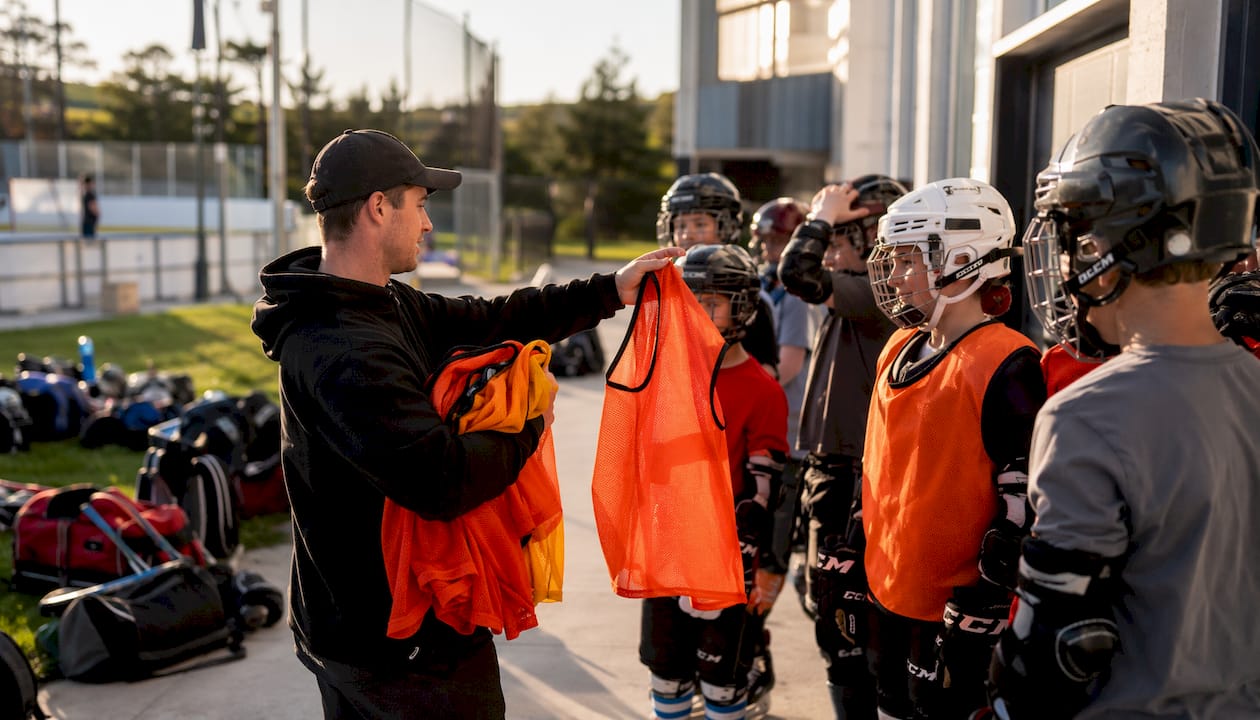
Pinnies are the fastest way to split a team for small-sided games. They pull over any jersey or shoulder pads in seconds, making them ideal for U8 through U15 scrimmages. The trade-off: they wear out faster than any other type, typically lasting one to two seasons under heavy use. Coaches who run small-sided games regularly go through two or three sets per season.
Lightweight polyester practice jerseys
The workhorse of youth hockey practice. Lightweight polyester jerseys handle most indoor training sessions well because they wick moisture, dry quickly, and hold up to frequent washing. They suit a wide range of youth players and can last multiple seasons when cared for properly.
Heavyweight and durable training jerseys
Heavier construction means more abrasion resistance, which matters for older players (U15 and up) doing contact drills or skating with full gear. The downside is reduced breathability, so these work better for lower-intensity sessions or cold arenas.
Reversible jerseys
One jersey, two colors. Reversibles cut equipment costs for programs that run frequent scrimmages without wanting to buy separate pinnies. They add slight bulk compared to a single-layer jersey, but for U12 and older players who can manage the flip, they’re a practical budget move.
Sleeveless and tank training tops
Sleeveless designs reduce overheating during high-intensity skating drills. Trainers recommend them specifically for intense practice formats because removing sleeve fabric at the shoulder improves arm mobility and heat release. Best for U12 and older players doing off-ice conditioning or high-tempo on-ice work.
Compression and performance tops
Compression tops sit tight against the skin and support muscle groups during skating. They work well as a standalone layer for off-ice training or under a looser practice jersey on the ice. Not ideal as the only layer for contact drills.
Thermal base layers
Cold arenas demand thermal base layers, especially for U8 and U10 players who skate shorter sessions and cool down fast. Long-sleeve thermal tops worn under a practice jersey add warmth without restricting movement. Rnkapparel’s hockey long-sleeve tees fill this role well for youth programs.
Warmup hoodies and joggers
Bench wear and pre-skate warmup gear. Hoodies and joggers don’t go on the ice, but they’re part of a complete practice kit. They protect players during warm-ups, between drills, and on the bench. Pairing them with a coordinated practice jersey builds team identity without adding cost to the on-ice budget.
Pros and cons by jersey type
| Jersey Type | Breathability | Durability | Print Compatibility | Best For |
|---|---|---|---|---|
| Mesh pinnies | High | Low (1–2 seasons) | Limited | Quick scrimmages |
| Lightweight polyester | High | Medium (2–4 seasons) | Excellent | Most indoor training |
| Heavyweight training | Low–Medium | High | Good | Contact drills, cold arenas |
| Reversible | Medium | Medium | Moderate | Budget scrimmage programs |
| Sleeveless/tank | Very High | Medium | Good | High-intensity drills |
| Compression top | Medium | High | Limited | Off-ice conditioning |
| Thermal base layer | Low | High | Moderate | Cold-ice sessions |
| Warmup hoodie/jogger | Medium | High | Excellent | Bench wear, warm-ups |
Pro Tip: For U8 and U10 programs, skip the heavyweight jersey entirely. Young skaters overheat faster than older players, and a lightweight or sleeveless top keeps them moving comfortably through a full practice.
2. What materials and construction features actually matter?
Fabric choice drives everything downstream: how the jersey feels at practice, how long prints last, and how many washes it survives.
Polyester and cationic polyester are the standard for practice jersey construction. Cationic polyester accepts dye more evenly and resists fading under repeated washing, which matters when you’re running jerseys through the laundry twice a week. Tricot mesh (commonly 70 denier) adds structure while keeping weight low. Moisture-wicking finishes pull sweat away from the skin during intense drills.
Construction details that coaches often overlook:
- Raglan sleeves extend the shoulder seam to the collar, giving skaters a fuller range of arm motion than standard set-in sleeves.
- Side-panel mesh inserts add ventilation at the torso without compromising the jersey’s structure.
- Reinforced seams at the shoulders and underarms resist the stress of repeated gear contact.
- Hem length matters for hockey: a waist-length hem stays tucked under shoulder pads and doesn’t bunch during skating.
Print compatibility depends on fabric. Sublimation bonds dye directly into polyester fibers and produces the most durable result. Heat-press vinyl adheres to the surface and works on both polyester and blended fabrics. Screenprint suits cotton-heavy blends but fades faster on performance polyester. Fabric denier and finish directly affect how well any of these methods hold up over time.
3. How do you size youth practice jerseys correctly?
Age-based sizing fails for hockey. A U12 player wearing full shoulder pads, chest protector, and elbow pads needs a jersey that fits over all of it, and that player’s actual chest measurement may differ significantly from the age-group average.
Sizing checklist for team managers:
- Collect chest measurements from parents before placing any order.
- Add 2–4 inches to each chest measurement to account for layering over pads.
- Check torso length separately — taller players need longer hems to stay covered during skating.
- Request a size sample from your supplier before committing to a full order.
- Order at least one size up for players near the top of a size bracket.
- Stock buffer quantities: two to three extra smalls, mediums, and larges per roster for mid-season growth.
Suppliers with extended and consistent sizing ranges from youth small through adult sizes make it easier to outfit a full roster without gaps. Rnkapparel’s sizing guide for youth hockey shirts walks through this measurement process in detail.
Pro Tip: For younger age brackets (U8–U12), unisex cuts speed up turnaround and reduce sizing complexity. Gendered cuts become more relevant at U15 and older, where body proportions diverge more noticeably.
4. How do you wash and care for practice jerseys to make them last?
Practice jerseys for youth hockey take a beating: two to four sessions per week, sweat, ice spray, and gear contact. The right care routine adds a full season of life.
- Wash in cold water — hot water degrades moisture-wicking finishes and loosens heat-press vinyl.
- Turn printed jerseys inside out before washing to protect the decoration surface.
- Skip fabric softener on performance polyester; it coats the fibers and kills moisture-wicking performance.
- Line dry or use a low-heat dryer setting. High heat is the single biggest cause of print delamination.
- Check colorfastness before mixing dark and light jerseys in the same wash load for the first time.
- Treat grass and ice-spray stains with a pre-wash enzyme spray before the cycle, not after.
Pinnies typically last one to two seasons under heavy use. Lightweight polyester jerseys hold up two to four seasons with proper care. Heavyweight training jerseys can go longer, but seam wear from gear contact eventually limits them. The most common damage beyond print failure is seam separation at the shoulders — reinforced construction at the point of order prevents this.
5. How do you choose and order the right jerseys for your team?
Translating jersey knowledge into an actual order takes a clear process. Here’s a step-by-step workflow that reduces errors and reorders:
- Define your budget per player, separating practice jerseys from game kits.
- Choose your primary jersey type based on the drills you run most (lightweight polyester for most programs; pinnies as a supplement).
- Collect all player measurements using the sizing checklist above.
- Decide on customization level — numbers only, names and numbers, or full logo sublimation.
- Request samples from your supplier before committing to a full run.
- Confirm lead times — stock jerseys with number-only decoration ship significantly faster than full custom sublimation orders.
- Place the order with buffer quantities — one jersey per player plus 10% extra, and two to three pinnie sets per team.
On pricing: fabric choice and print method drive cost more than quantity alone. Stock polyester jerseys with heat-press numbers cost less and arrive faster. Full sublimation on custom-cut jerseys costs more and takes longer but delivers a finished look that holds up for multiple seasons. For recreational youth programs, stock jerseys with basic decoration hit the right balance of speed and cost. The youth sports apparel buying checklist from Rnkapparel covers this workflow in more detail.
6. Which customization and printing method holds up best?
Print method choice affects how your jerseys look after fifty washes, not just on delivery day.
Sublimation is the most durable option for polyester jerseys. Dye bonds directly into the fiber, so it cannot crack, peel, or fade under normal washing. It supports unlimited color complexity and works for full-coverage designs. The limitation: sublimation requires 100% polyester fabric and typically carries higher minimum order quantities.
Heat-press vinyl works on polyester and blended fabrics and suits teams that need names and numbers without a full custom design. Quality athletic-grade vinyl films rated for repeated wash cycles hold up well, but lower-grade vinyl peels after heavy use. It’s the fastest turnaround option for stock jerseys.
Screenprint suits cotton-heavy fabrics and works for simple, bold designs. On performance polyester, it fades faster than the other two methods and isn’t recommended for jerseys that go through the wash twice a week.
For placement on hockey jerseys specifically: large back numbers (typically 6–8 inches) are standard. Smaller chest or shoulder numbers work well as secondary identifiers. Avoid large front-chest prints that sit directly over padding contact points — they delaminate faster and can create uncomfortable pressure points under gear. Rnkapparel’s coach’s guide to youth hockey gear design covers placement in detail.
| Print Method | Durability | Cost | Lead Time | Best Fabric |
|---|---|---|---|---|
| Sublimation | Highest | Higher | Longer | 100% polyester |
| Heat-press vinyl | Medium–High | Medium | Short | Polyester, blends |
| Screenprint | Medium | Lower | Short | Cotton, cotton blends |
Pro Tip: If your program orders jerseys every two to three years, sublimation pays for itself. If you replace jerseys annually or need a fast turnaround, heat-press vinyl on stock polyester is the smarter call.
Key Takeaways
Lightweight polyester practice jerseys suit most youth hockey programs, but matching jersey type to activity, age group, and season is what separates a functional kit from one that gets replaced mid-season.
| Point | Details |
|---|---|
| Match type to activity | Use pinnies for scrimmages, lightweight polyester for most drills, thermals for cold-ice sessions. |
| Measure, don’t guess | Collect chest and torso measurements; age-based sizing fails when players layer over pads. |
| Order with a buffer | One jersey per player plus 10% extra reduces mid-season reorder scrambles. |
| Choose print method by lifespan | Sublimation on polyester lasts longest; heat-press vinyl ships faster for stock orders. |
| Rnkapparel for youth hockey | Rnkapparel offers customizable youth training apparel with extended sizing and ordering support for full rosters. |
What coaches often get wrong about practice jerseys
The most persistent mistake isn’t buying the wrong jersey type. It’s treating practice jerseys like scaled-down game kits. Game jerseys are built to look sharp for two hours. Practice jerseys need to survive two hundred washes, daily gear contact, and players who grow three inches between September and March.
The second mistake is prioritizing appearance over function at the younger age brackets. A U8 player in a beautifully sublimated jersey that restricts shoulder movement or traps heat is worse off than one in a plain lightweight mesh top. Coaches who focus on appearance over function at the youth level tend to see more complaints from parents and more reorders mid-season.
The fix is straightforward: spec the jersey for the practice format first, then add customization. Raglan sleeves, side-panel mesh, and reinforced seams aren’t premium features — they’re baseline requirements for a jersey that will actually last. Teams that get this right spend less over a full season, not more.
Rnkapparel makes custom youth hockey practice kits simple
Getting the right practice jerseys ordered shouldn’t take three rounds of back-and-forth. Rnkapparel builds youth hockey performance training gear with extended sizing from youth small through adult, so one order covers your full roster without gaps. Every jersey ships with customization options — names, numbers, team logos — and the team handles the sizing and decoration details so you don’t have to.
Need warmup layers to complete the kit? Rnkapparel’s hockey hoodies and youth hockey joggers pair directly with practice jerseys for a coordinated bench-to-ice setup. Browse the full hockey graphic tees and practice shirts collection, or reach out for a team quote and sample order to confirm sizing before you commit.
Useful sources and further reading
- Youth Training Hockey Apparel — Rnkapparel
- Sizing Guide for Youth Hockey Shirts — Rnkapparel
- Why Youth Teams Need Extra Sizes — Rnkapparel
- Design Youth Hockey Team Gear: A Coach’s Guide — Rnkapparel
- How to Choose Soccer Team Jerseys for Youth, School, and Club Teams — The Soccer Factory
- Youth Mesh Jersey 6 Pack — SKLZ
- Alleson Athletic 705Y Youth Practice Jersey — Momento Brands
Recommended
- Youth Training Hockey Apparel | Performance Wear for Young Players – RNK Apparel Co.
- Design Youth Hockey Team Gear: A Coach’s Guide – RNK Apparel Co.
- Hockey Apparel Youth: A Complete Guide - Hockey Apparel Youth Players Wear 2025 | Comfort, Performance, Customization – RNK Apparel Co.
- Youth Hockey Hoodies | Custom & Affordable Kids Hockey Apparel – RNK Apparel Co.
