

Jersey fabric weight is the fabric’s areal mass, measured in grams per square meter (GSM). Lightweight jersey typically runs in a lower GSM range suitable for t-shirts and summer layers; midweight generally covers everyday tees and dresses; heavyweight includes heavier fabrics used for sweatshirts, hoodies, and structured garments. Knowing your band tells you almost everything else about how the fabric will behave.
TL;DR:
- Fabric weight alone does not determine jersey’s feel, as fiber content, knit construction, and stitch density also significantly influence its hand and stretch.
- Typical jersey GSM ranges from under 160 for lightweight, breathable fabrics to over 350 for heavyweight hoodies, with variations depending on fiber blend and construction.
- To accurately measure GSM at home, cut and weigh a 10 cm by 10 cm sample, then multiply the weight by 100, and average multiple samples from different fabric points.
- Heavier jersey fabrics generally offer better opacity, drape, and support dense printing or embroidery, making them ideal for structured garments and team logos.
- When ordering for a team, match fabric weight to the garment’s purpose; practice tees should be midweight, game tees lighter, and hoodies heavier for durability.
Table of Contents
- What GSM Measures and How to Read Jersey Fabric Weight Labels
- Practical Jersey Weight Ranges From Ultralight to Ultra-Heavy
- How to Measure Jersey GSM at Home or in Production
- How Fabric Weight Shapes Drape, Opacity, Stretch, and Stitching
- How RNK Apparel Matches Fabric Weight to the Game
- One GSM Number Per Job, If You’re Ordering for a Team
- Order Custom Team Gear With the Right Fabric Weight
- Where These GSM Numbers Come From
- Sources
What GSM Measures and How to Read Jersey Fabric Weight Labels
GSM stands for grams per square meter, and it’s the number suppliers print on spec sheets because it’s consistent regardless of fabric width or roll size. A 180 GSM cotton jersey and a 180 GSM polyester jersey weigh the same per square meter even though they feel completely different in your hands.
American sewists sometimes see fabric weight quoted in ounces per square yard instead. As a rough guide, 1 ounce per square yard equals about 34 GSM, so a 6 oz jersey lands somewhere near 200 GSM. Treat that as a ballpark for translating labels, not a precise formula.
Here’s the catch: GSM alone doesn’t tell the whole story. Three factors interact to produce the final hand and stretch of a fabric.
- Fiber content: cotton, polyester, modal, and spandex blends all carry weight differently even at identical GSM.
- Knit construction: single jersey versus interlock changes density and stability independent of the stated weight.
- Stitch density: a finer yarn knit tightly can outweigh a coarser yarn knit loosely, which is why two 160 GSM fabrics can feel like different materials entirely.
Practical Jersey Weight Ranges From Ultralight to Ultra-Heavy
Jersey fabric weight generally falls into five working bands, and each one points toward a different category of garment. These aren’t rigid boundaries. Suppliers commonly quote a nominal GSM that can vary by plus or minus 5 to 10 GSM from what you’d measure on a scale, so treat the numbers below as a planning guide rather than gospel.
Premium heavyweight hoodies commonly run 350 to 400 GSM, while entry-level hoodie weights start closer to 280 GSM. That gap explains why two hoodies at the same price point can feel worlds apart. It’s also why a “medium weight” label from one supplier might feel closer to heavyweight from another. Knit tightness and fiber choice both push the felt hand up or down within a stated band.
How to Measure Jersey GSM at Home or in Production
You don’t need a lab to check whether a fabric matches its label. The cut-and-weigh method is the industry standard, and it works just as well on a kitchen counter as it does on a factory floor.
- Condition the sample. Let the fabric sit in a stable room for at least two hours, ideally overnight, so humidity doesn’t skew the weight.
- Cut a precise 10 cm by 10 cm square. A dedicated sample cutter gives cleaner edges than scissors and a ruler, but careful scissor work works fine for home use.
- Weigh the square on a precision scale. Aim for 0.01 g resolution if you can get it; a kitchen scale accurate to 1 gram will only get you a rough estimate.
- Multiply the weight in grams by 100. That converts your 100 cm² sample into grams per square meter.
- Repeat with two or three more samples cut from different spots on the fabric, then average the results.
Pro Tip: Cut your samples from different points across the fabric width, not just one corner. Roll-to-roll and widthwise variation is common enough that a single sample can mislead you.
If you’re placing a bulk order for team gear, ask the supplier for a lab-tested GSM report rather than relying on the spec sheet alone. It costs you nothing to ask, and it can save you from a shipment that feels thinner than what you approved.
How Fabric Weight Shapes Drape, Opacity, Stretch, and Stitching
Weight decides more of your garment’s behavior than fiber choice does in most cases. A 140 GSM cotton jersey drapes and clings; a 260 GSM cotton jersey holds a silhouette and resists clinging. If you’re sewing a bodycon dress, go light. If you’re sewing a structured crewneck, go heavy.
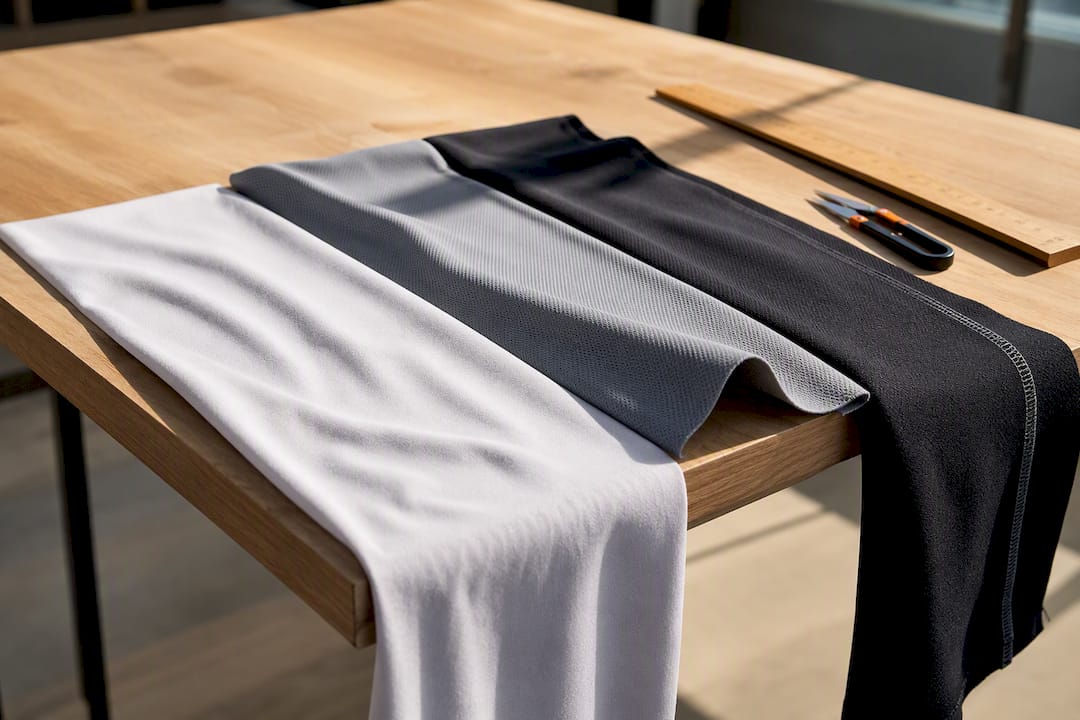
Opacity follows the same logic. Lightweight jersey under 160 GSM often needs a lining or a second layer for anything worn without an undershirt, especially in pale colors. Midweight and heavier jersey usually clears that bar on its own.
Stretch and recovery depend on more than GSM. Stitch density and spandex content matter just as much. A tightly knit 180 GSM jersey with 5% spandex will snap back better than a loosely knit 220 GSM jersey with none, even though the heavier fabric weighs more per square meter.
Decoration is where weight really earns its keep. Higher GSM fabrics give screen printers and embroiderers a more stable base to work against, which matters for anything with dense ink coverage or heavy stitch counts.
- Lightweight jersey (under 160 GSM) usually needs a backing stabilizer for embroidery to prevent puckering.
- Midweight jersey handles standard screen printing without extra support in most cases.
- Heavyweight jersey (200 GSM and up) tolerates dense logos, multi-color prints, and large embroidered numbers with minimal distortion.
That last point matters enormously for team orders, where logos and player numbers take real abuse over a season of wear and washing.
How RNK Apparel Matches Fabric Weight to the Game
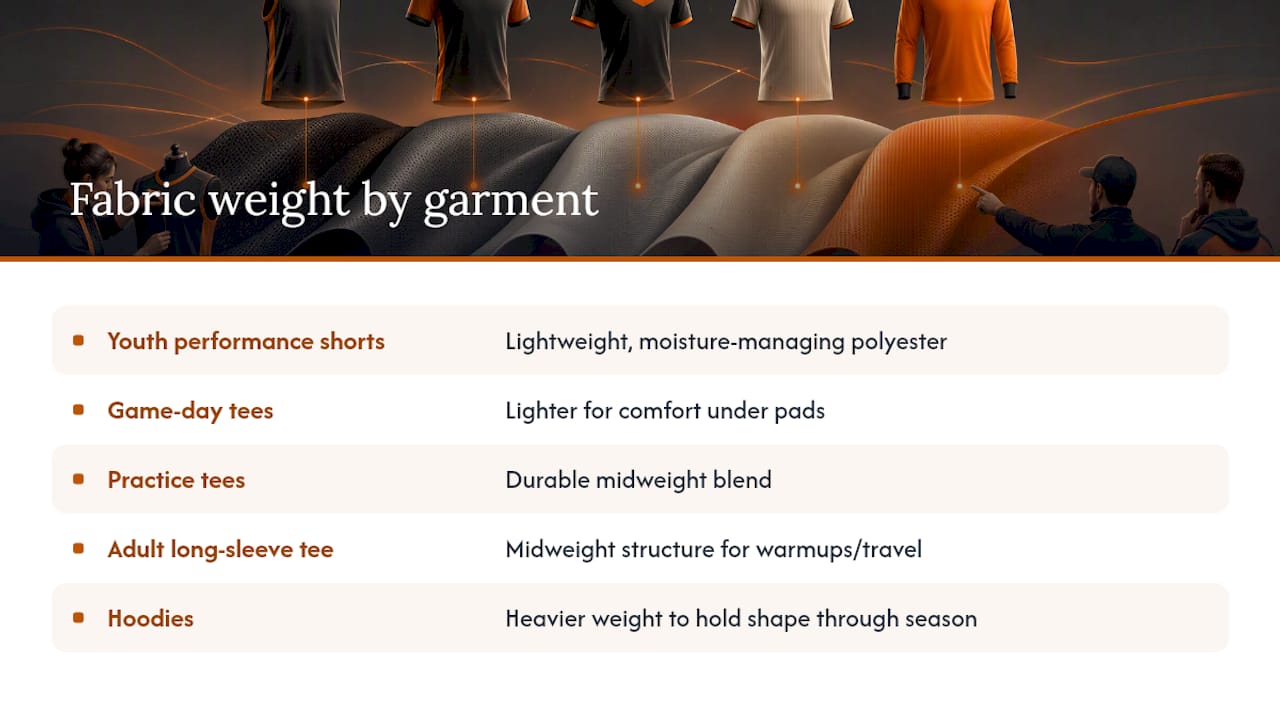
Choosing GSM for hockey gear isn’t a style decision. It’s a function decision. Youth Performance Shorts call for a lightweight, moisture-managing polyester that won’t trap heat during a shift, while an adult long sleeve tee built for warmups or travel days can carry more midweight structure without sacrificing comfort.
When you’re ordering custom team gear, the fabric choice should follow the job the garment does. Practice tees take a beating and benefit from a durable midweight blend. Game-day tees can run lighter for comfort under pads. Hoodies need enough weight to hold their shape through a season of bags and buses. Before placing a bulk order, request swatches, ask for the exact GSM and fiber blend, and confirm finishing details like brushing or pre-shrinking. Rnkapparel’s material guide for hockey apparel breaks down which blends show up across its product line and why.
One GSM Number Per Job, If You’re Ordering for a Team
If you only remember one rule from this article, make it this: match fabric weight to the job, not the price tag. Practice tees typically feature medium-weight fabrics in a poly blend that perform well over washing. Game tees are lighter for comfort under equipment. Team hoodies generally require heavier fabric weights to maintain shape and durability. Anything lighter reads as a windbreaker with sleeves, not a hoodie a kid wants to wear to school.
The trade-off is always the same: lighter fabric breathes better and costs less, heavier fabric lasts longer and holds print detail better. Numbers on a spec sheet only tell you so much. Order a swatch before you commit fifty jerseys to a blend you’ve never touched.
— Eric
Order Custom Team Gear With the Right Fabric Weight
Rnkapparel is built around exactly the decision this article walks through: matching fabric weight to what a garment actually has to do on the ice, on the bench, or in the locker room. Instead of guessing at a generic “hockey tee” and hoping the fabric holds up to a season of practices, Rnkapparel lets you choose blend, weight, and finish alongside your logo, roster names, and numbers.

If you’re outfitting a team, start by requesting fabric swatches and the exact GSM for whichever product you’re eyeing; that single step avoids the most common complaint with custom orders, which is a fabric that feels thinner or stiffer than expected once it arrives. Browse the custom hockey t-shirt collection for game and practice tees, or check the hockey hoodie lineup if your team needs something heavier for cold rinks and travel days. Either page lets you lock in colors, roster details, and fabric specs before you place a bulk order.
Where These GSM Numbers Come From
- Nordelvia’s measurement guide covers the cut-and-weigh method in detail, including conditioning and averaging.
- Apex Fashion Lab’s jersey guide breaks down GSM bands by knit construction and garment type.
- Nonwovens Factory’s testing guide explains production-grade tools for verifying supplier claims. When a supplier can hand you a lab-tested report instead of a printed spec sheet, trust the report.
Sources
- Fabric weight GSM: how to measure and understand it - Nordelvia
- How to check T-shirt GSM: 4 practical methods - Nonwovens Factory
- Jersey fabric guide: types, GSM chart - Apex Fashion Lab
