
Choose a snapback when you need one-size convenience, streetwear style, or a safe gift for someone whose head size you don’t know. Choose a fitted hat when you want a precise, athletic fit and a clean back panel for embroidery. Sizing is usually what settles the argument. If you’re ordering for a group and can’t measure every head, that alone should push you toward adjustable options.
TL;DR:
- Most snapbacks fit a wide range of adult head sizes, making them ideal for group orders where exact measurements are unavailable.
- Fitted hats offer a precise, athletic fit with a clean back panel, but require multiple sizes and are harder to return once embroidered or worn.
- For team or event orders, a common approach is to mainly choose adjustable snapbacks, with a smaller proportion of fitted or flexfit hats for key players.
- Be sure to request samples and confirm sizes before placing large fitted hat orders to avoid stock or sizing issues.
- Proper care involves hand washing or gentle cycles and air drying, as machine drying can shrink or warp fitted and snapback hats.
Table of Contents
- What Is a Snapback Hat?
- What Is a Fitted Hat?
- Snapback vs Fitted: How Do They Really Compare?
- How Do You Choose the Right Hat for Your Situation?
- How Should Teams and Bulk Buyers Size Their Orders?
- How Do You Keep a Hat Fitting and Looking Right?
- Our Take on Choosing Hats for Teams and Fans
- Get Custom Hats Without Guessing on Sizes
- Sources
- FAQ
What Is a Snapback Hat?
A snapback is defined by its closure: a plastic snap strip on the back panel that lets you adjust the band in small increments. That strip typically gives about 3 inches of range, which covers a wide range of adult head circumferences, meaning one size fits nearly all adults, according to the sizing data from RareCustom’s hat guide. Most snapbacks also have a taller, structured crown and a flat brim, which is where the streetwear look comes from.
That single-SKU simplicity is also why snapbacks are cheap to produce and easy to stock.
- One size covers almost every adult head, so you skip measuring entirely
- Structured crown holds its shape and displays logos well
- Flat brim reads as casual or streetwear, not athletic
- Lower cost per unit since there’s no size forecasting involved
If you’re buying a gift, ordering event giveaways, or handing out hats to people whose sizes you’ll never know, a snapback removes the guesswork.
What Is a Fitted Hat?
A fitted hat has no adjustable closure at all. It’s built to an exact head measurement using fractional sizing, such as 7, 7 1/8, or 7 1/4, each tied to a specific circumference in inches, per RareCustom’s sizing breakdown. That closed back is the whole point: no snap, no strap, no seam interrupting the panel.
- Fractional sizing means a 360-degree snug fit with no pressure points from a plastic strip
- The uninterrupted back panel gives embroidery a cleaner, more premium look
- Structured fronts hold block letters and logos sharper than unstructured caps, according to Dirt Cheap Headwear’s coaching guide
- Requires multiple SKUs per design, which means more forecasting and more risk of leftover stock
Fitted hats make sense when you know exact sizes, when the hat is part of a premium product line, or when the look needs to read as athletic rather than casual.
Snapback vs Fitted: How Do They Really Compare?
Fit is the biggest divide. A snapback’s plastic strip covers a wide range of adult head circumferences in quarter-inch clicks, which is why one size works for nearly everyone. A fitted hat skips adjustment altogether and matches your exact fractional size instead.
By the numbers: A single one-size snapback covers a large majority of adult head sizes through its snap range, according to RareCustom’s sizing data. That’s why most bulk merchandise defaults to snapback or strapback closures first.
Comfort splits along similar lines, but not the way people assume. A snapback’s strip can press on one spot if it lands wrong; a fitted hat distributes pressure evenly around the whole band. That said, breathability depends more on fabric and eyelets than on closure type. A cheap, thick-front snapback can trap more heat than a mesh-paneled fitted hat, so don’t assume an open back always means cooler, per Implementer’s buyer guide.
Style and cost differences are easier to call:
- Style signal: Snapbacks lean streetwear and casual; fitted hats lean athletic and premium, largely because of that clean back panel
- Crown height: Taller crowns (common on snapbacks) read bolder; lower profiles feel more classic
- Cost and inventory: One snapback SKU vs. several fitted SKUs means fitted lines cost more to stock and forecast, per Dirt Cheap Headwear
- Customization: Fitted hats win on embroidery cleanliness; snapbacks win on flexibility and shelf simplicity
Neither wins outright. It comes down to whether you’re optimizing for fit precision or for logistical ease.
How Do You Choose the Right Hat for Your Situation?
Run through this before you commit to either style:
- Do you know exact head sizes? If yes, fitted becomes viable. If no, default to adjustable.
- What’s the return policy? Fitted hats are much harder to return once embroidered or worn, so check this before ordering in fractional sizes.
- What’s the purpose? A gift, a giveaway, or a fan item favors snapback. A team uniform piece or premium drop favors fitted.
- Does the aesthetic matter more than access? If the clean, uninterrupted back panel is central to the design, that tips toward fitted even if it means more SKUs.
Three questions worth asking the seller or manufacturer directly: Can I get a sample before committing to a bulk fitted order? What sizes are actually in stock right now, not just listed? And what’s the reorder timeline if I misjudge quantities?
Red flags to watch for: a seller who won’t offer any sample units, or a strict no-return policy on fitted hats with no size-exchange option. Both increase your risk of eating the cost of a mistake.
Pro Tip: For a gift where you’re unsure of the recipient’s size, always default to a snapback or strapback. A slightly loose fitted hat is a bigger letdown than a tightly adjustable one.
How Should Teams and Bulk Buyers Size Their Orders?
A practical rule of thumb for team or event orders is to order mostly one-size adjustable hats, with a smaller portion split between small/medium and large/XL fitted or flexfit options. That mix covers a large majority of adult head sizes without requiring you to measure every person in advance, according to sizing guidance cited by Walmart’s hat resource.
Ordering mostly adjustable hats simplifies logistics when recipients are unknown, while a small percentage of fitted or flexfit sizes covers the outliers most teams still have.
Snapbacks make the most sense for event merch, fan giveaways, or any order where you can’t collect measurements ahead of time. For rosters where you can measure key players, such as captains or staff getting a premium version, fitted or flexfit becomes worth the extra SKU management.
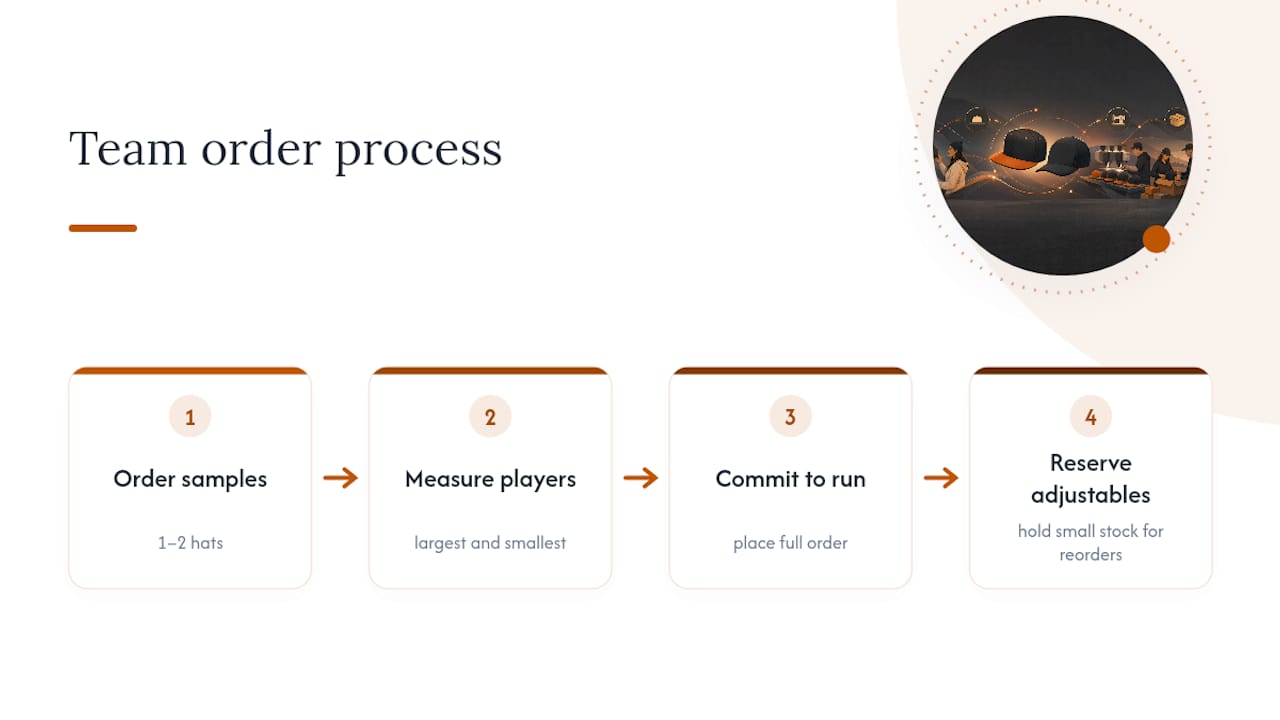
Order one or two samples before committing to a full run, measure your largest and smallest players directly, and hold back a small reserve of adjustable hats for reorders. That reserve is what keeps you from either running short or sitting on dead inventory nobody will wear.
How Do You Keep a Hat Fitting and Looking Right?
Wash structured caps by hand or on a gentle cycle, and air dry them on a form. Machine drying is the fastest way to shrink a fitted hat or warp a snapback’s brim.
- Hand wash or gentle cycle, always air dry
- If a fitted hat runs slightly loose, adhesive foam sizing strips are a cheap fix, running about $0.10 to $0.25 each, versus replacing the whole hat, per RareCustom’s production notes
- Reshape a bent brim gently by hand while slightly damp; if the crown itself has warped, replacement is usually cheaper than repair
A too-tight fitted hat almost always needs replacing rather than stretching.
Our Take on Choosing Hats for Teams and Fans
Adjustable hats are the safer default whenever headcount or sizes are uncertain, and fitted hats earn their place only when you can actually measure the people wearing them. The distribution split holds up well in practice: heavy on adjustable, light on fitted for the sizes that matter most. Ordering a sample before committing to a bulk fitted run isn’t optional caution. It’s the difference between a team that fits and a box of hats nobody claims.
— Eric
Get Custom Hats Without Guessing on Sizes
Some custom hockey apparel and hat providers offer options to reduce size-forecasting risk for team hats and fan gear. Instead of committing to a full fitted run blind, you can request samples, mix adjustable and fitted styles by roster, and add logos, player names, or numbers before anything ships.
That matters most for coaches and managers who don’t have every player’s head size on file yet. Rather than guessing between one-size snapbacks and a wall of fitted SKUs, you can start with a manageable order, check fit against real players, and scale from there. Browse the headwear collection to see current styles, or check the custom hockey team hat guide for design ideas before you place a bulk order.
Sources
- Custom Hat Sizing Guide: Finding the Perfect Fit for Every Head | RareCustom Blog
- Hat sizing and team-order strategy (sizing tape and guidance) | Walmart page
- Custom Baseball Hats for Teams: A Coach’s Guide | Dirt Cheap Headwear
- Snapbacks vs Fitted Hats: Which One Is Better for You? - Implementer
FAQ
Do MLB players wear fitted or snapback hats?
On-field MLB caps are fitted, matched to each player’s exact head size for a snug, no-slip fit during play. Snapbacks are more common for fan merchandise and casual wear off the field.
Are snapbacks still in style?
Yes, snapbacks remain a staple in streetwear and casual fan gear because of their flat brim, structured crown, and one-size convenience. They’ve stayed relevant precisely because they don’t require exact sizing to look right.
Do fitted hats look better than snapbacks?
Fitted hats generally look cleaner because the back panel has no snap or strap breaking up the design, which is why they’re favored for premium or athletic-branded merchandise. Whether that reads as “better” depends on whether you want a polished look or a casual one.
What makes a hat a snapback?
A snapback is defined by its plastic snap closure on the back panel, which allows roughly 3 inches of adjustment across about 21 to 24 inches of head circumference. That closure, paired with a structured crown and flat brim, is what separates it from a fitted hat.
How many fitted hats should I order for a team versus snapbacks?
Some providers can help with sample orders to fine-tune size splits before committing to a full team run.
