
The ten strongest limited-edition hockey fan wear ideas are: numbered collector hoodies, cultural-crossover jerseys, serialized beanies, rally towels, custom water bottles, player-tribute tees, embroidered scarves, swag bag puck sets, coordinated accessory bundles, and throwback colorway crewnecks. These work because they combine visibility, perceived scarcity, and genuine utility. Start by requesting a mockup from Rnkapparel before you commit to quantities or pricing.
- Why these items win: fans wear or display them beyond game day, which extends your brand’s reach.
- Scarcity drives demand: numbering a run of 100 hoodies creates urgency that a standard reorder never will.
- Utility keeps items out of drawers: water bottles, beanies, and rally towels get used, so your logo stays visible.
Table of Contents
- 1. Top limited-edition hockey fan wear ideas ranked by impact
- 2. Design approaches that make a run feel exclusive
- 3. Production timelines, quantities, and cost factors
- 4. How to build hype and distribute limited drops
- 5. Materials and printing methods that hold up
- 6. How to build coordinated sets fans actually want to wear
- 7. Licensing and legal checks before you produce anything
- 8. Why limited editions resonate in 2026
- 9. How to price and size limited runs without getting stuck with inventory
- 10. Marketing strategies that go beyond the drop itself
- Rnkapparel makes limited-edition hockey drops straightforward
- Key Takeaways
- The drops that last are the ones with a story
- Useful sources and Rnkapparel resources
1. Top limited-edition hockey fan wear ideas ranked by impact
Group your drop into three buckets before you order a single unit. Premium collector pieces justify higher price points and drive pre-order revenue. Mid-range apparel and accessories cover the bulk of your audience. Low-cost giveaways fill swag bags and seed visibility in the crowd.
Premium collector pieces
- Numbered collector hoodies with embroidered team crest and serialized hang tag
- Cultural-crossover jerseys tied to a milestone, anniversary, or artist collaboration (think the LA Kings x System of a Down model)
- Player-tribute tees with embroidered name and retired number
Mid-range apparel and accessories
- Throwback colorway crewnecks or long-sleeve tees
- Embroidered scarves and coordinated beanies
- Custom team gear including branded water bottles and bag tags
Low-cost giveaways
- Rally towels, logo pucks, and mini-sticks distributed at game-day events
- Sticker sets and woven patch packs for swag bags
Pro Tip: Number every premium piece, even if the run is 500 units. “Edition 47 of 500” printed inside the collar costs almost nothing to add and meaningfully increases perceived collectibility.
2. Design approaches that make a run feel exclusive
Visual strategy separates a limited drop from a standard reorder. Three approaches consistently work: alternate colorway drops, throwback motifs, and cultural crossovers.
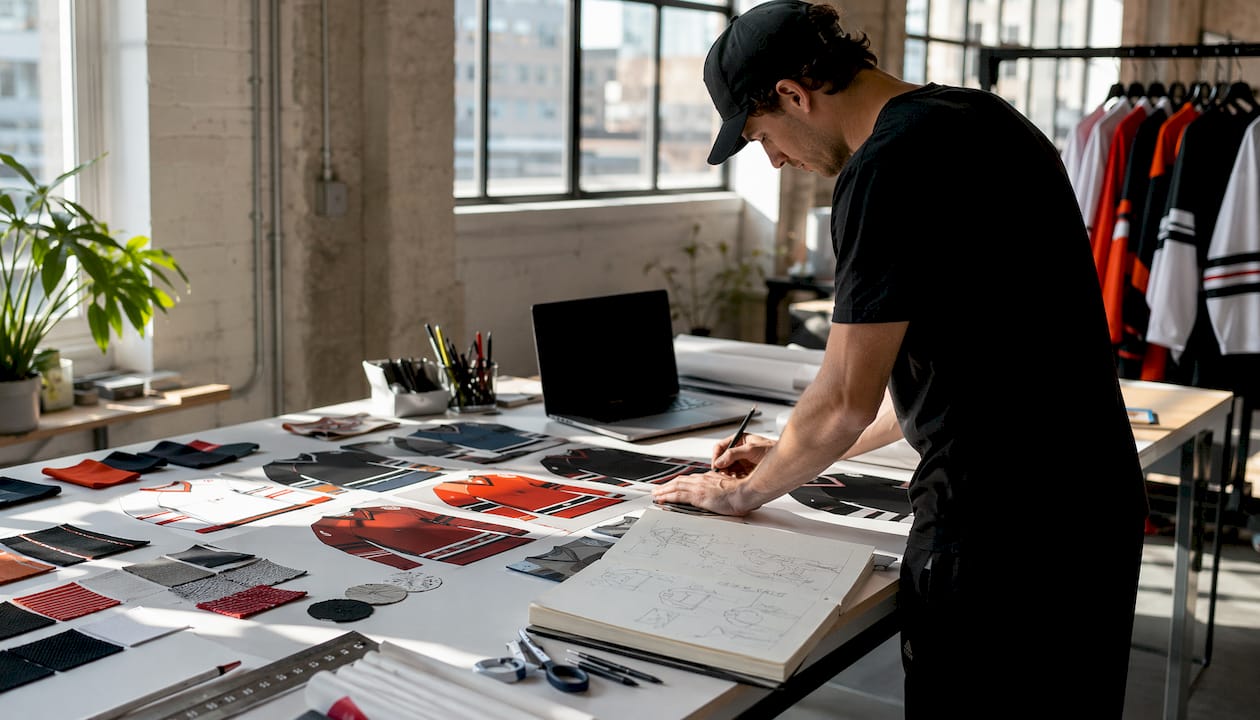
Alternate colorways take your existing mark and flip it to an unexpected palette, say, a black-and-gold team that drops a bone-white and burgundy winter edition. Throwback motifs pull from a founding season or a championship year. Cultural crossovers pair team aesthetics with music, film, or a player milestone, turning garments into collector’s items rather than standard merchandise.
Personalization tiers let you serve every buyer without cannibalizing your premium tier:
| Tier | What’s included | Cost impact | Perceived value |
|---|---|---|---|
| Base | Team logo, no name | Lowest | Standard |
| Printed name/number | Digital print on back | Low–moderate | Personal keepsake |
| Embroidered name | Stitched lettering | Moderate | Premium feel |
| Serialized + hand-numbered | Serial tag, numbered collar | Highest | Collector’s item |
Personalization turns mass-produced fan wear into individual keepsakes. Each tier up adds some percentage to unit cost while often increasing the price a buyer will pay.
3. Production timelines, quantities, and cost factors
Realistic lead times vary sharply by run size. Quick-turn personalization services have shortened timelines for certain items, but embroidery and specialty packaging still require buffer time.
Typical lead times vary by run size, increasing as quantity grows, with additional options like embroidery and packaging becoming available at larger scales.
Vendor brief checklist before you order:
- Finalize artwork files (vector preferred, 300 dpi minimum for raster)
- Confirm trademark clearance on all logos and player names
- Specify garment style, color, and size breakdown
- Choose print/embroidery method per item
- Confirm packaging: poly bag, hang tag, or branded box
- Lock quantity and serialization range
- Set hard deadline working backward from launch date
Cost factors stack quickly: base garment, printing or embroidery, personalization, hang tags, packaging, and shipping. A plain screen-printed tee at 250 units runs far cheaper per unit than an embroidered, serialized hoodie at 50 units. Know your margin target before you brief a vendor.
4. How to build hype and distribute limited drops
Distribution tactics make or break sell-through. Swag bags and limited releases generate the most hype when tied to a specific event moment: opening night, a rivalry game, or a championship anniversary.
- Pre-order with a hard deadline. A two-week window with a visible countdown creates urgency and funds production before you spend a dollar.
- Timed online drop. Announce a specific date and time. Scarcity perception spikes when buyers know the window closes.
- In-arena exclusives. Reserve a portion of the run for game-day pickup only. Fans who show up get something the online buyer cannot.
- Swag bag seeding. Drop a quantity of low-cost items (rally towels, pucks, stickers) into bags distributed at the gate. Visible items in the crowd create organic demand.
- Player or influencer reveal. Have a player wear the piece during warmups or post an unboxing. Authentic wear beats any ad.
- Auction the serialized #1. The lowest serial number commands a premium. A live or online auction for #1 of 100 generates buzz and covers a chunk of production cost.
Pro Tip: Layer your drop: announce the collaboration two weeks out, reveal the design one week out, open pre-orders three days out, then close the window hard. Each step gives fans a reason to share.
5. Materials and printing methods that hold up
Fan wear travels from the arena to the street to the wash and back. Fabric and print method choices determine whether a piece lasts one season or ten years.
| Fabric | Durability | Hand-feel | Print-friendliness |
|---|---|---|---|
| 50/50 poly-cotton blend | High | Soft, light | Excellent for screen print and DTG |
| Heavy fleece (cotton-poly blend) | Very high | Warm, substantial | Good for screen print; embroidery ideal |
| Performance knit (100% poly) | High | Smooth, moisture-wicking | Sublimation or heat transfer preferred |
Printing method guide:
- Screen print: best for bold, simple designs at 50+ units; most durable wash-after-wash
- Direct-to-garment (DTG): ideal for photo-realistic or complex art at small quantities; softer hand than screen print
- Embroidery: premium look for logos and names; adds weight and texture; best on fleece and structured caps
- Heat transfer: fast turnaround for short runs; less durable than screen print over time
Sample care label text to preserve limited-edition quality: “Machine wash cold, inside out. Tumble dry low. Do not bleach. Do not iron directly on print or embroidery.”
6. How to build coordinated sets fans actually want to wear
Coordinated drops feel like a collection, not a pile of merch. Matching color palettes and accessory sets are growing in popularity as fans use bag tags, water bottles, and beanies to create a cohesive look beyond the jersey.
Two bundle formats that sell well:
- Player pack: hoodie + beanie + branded water bottle. Price as a set at a 10–15% discount versus individual items. Works as a pre-order incentive.
- Family pack: adult hoodie + youth tee + scarf + sticker sheet. Targets parents at youth tournaments. Matching family apparel is one of the fastest-growing segments in fan gear.
Styling rules that keep a drop cohesive: limit the palette to three colors maximum, repeat the same motif (a crest, a number, a pattern) across every item at different scales, and balance logo size so a small bag tag and a large hoodie back feel like they belong together. For marketing photos, shoot all items flat-lay together before shooting them worn. The flat-lay establishes the collection; the worn shots sell the individual pieces.
7. Licensing and legal checks before you produce anything
Using a team logo, player name, or trademarked artwork without permission exposes you to cease-and-desist letters and potential damages. Run this checklist before briefing any vendor.
- Confirm the trademark owner. League marks (NHL shield, conference logos) require league licensing. Team marks are typically owned by the franchise. Local amateur team marks may be owned by the association or the club.
- Secure written permission. A verbal okay is not enough. Get a signed license or written authorization that specifies the item type, quantity, and distribution channel.
- Review your merchandise contract. Some team agreements restrict third-party production or require royalty payments on gross sales.
- Vet third-party artwork. If a designer created the art, confirm you own the rights or have a commercial license before printing.
- Player name and likeness. Using a current or former player’s name or image for commercial merchandise requires a separate right-of-publicity clearance, even for amateur leagues.
Sample permission clause for vendor briefs: “Vendor acknowledges that all artwork, logos, and player references supplied by [Team Name] are licensed or owned by [Team Name] and may be reproduced solely for the quantities and item types specified in this purchase order.”
This is general information, not legal advice. Confirm current trademark and right-of-publicity rules with a qualified attorney for your specific situation.
8. Why limited editions resonate in 2026
Three trends are converging to make limited drops more effective than standard merch programs: coordinated accessory sets, deep personalization, and apparel treated as a canvas for self-expression.
Coordinated accessory sets have moved from a niche preference to a mainstream expectation. Fans now expect a beanie and a water bottle to match the hoodie. Personalization goes further: treating apparel as a canvas and letting fans pick messages, numbers, or small art elements increases emotional value and long-term retention of limited-edition pieces. Cultural crossovers add a third layer: a jersey tied to a band, a film, or a player milestone that becomes a collector’s item the moment it sells out.
Scarcity perception drives behavior in the stands too. When 50 fans in section 12 are wearing the same numbered hoodie, the 200 fans around them notice. That visible social proof creates demand at the next game.
9. How to price and size limited runs without getting stuck with inventory
Pricing a limited run starts with your cost floor, not your desired margin. Add up base garment, decoration, packaging, and shipping, then apply a suitable multiplier depending on tier. A serialized collector hoodie with a certain landed cost can generally retail at a significant markup. A rally towel that costs little works as a free giveaway or a modest add-on.
Size the run conservatively. A sellout at 150 units builds more demand for the next drop than 300 units with 80 left over. Pre-orders solve this cleanly: open a two-week window, count confirmed orders, add 10–15% buffer for walk-up demand, and order that number. You never carry dead inventory, and the sold-out notice becomes its own marketing moment.
For items without pre-orders, use a tiered release model: an ultra-limited serialized run for collectors, a mid-tier personalized run for players and families, and a basic fan edition for general supporters. Each tier protects the scarcity of the one above it while maximizing total revenue.
10. Marketing strategies that go beyond the drop itself
Social media and influencer tactics extend the life of a limited drop well past launch day. The goal is to create content moments at every stage: announcement, reveal, launch, and sellout.
Before launch: post a teaser showing a partial design or a fabric swatch. Tag the player or artist involved. Build a waitlist via a simple email signup.
At launch: post the full reveal with a countdown timer in stories. Use Instagram Reels or TikTok for a 15-second unboxing. Pin the drop link in your bio.
During the window: share fan photos wearing previous drops. Repost any organic content. Run a “tag a teammate” giveaway for one free unit to drive shares.
After sellout: post the sold-out announcement. Screenshot the waitlist count. Tease the next drop. The sold-out post often gets more engagement than the launch post because it validates the scarcity.
Player partnerships cost less than you think at the amateur and semi-pro level. A local player with 5,000 engaged followers wearing your piece at warmups reaches a more relevant audience than a generic ad buy. Offer a small revenue share or a free player pack in exchange for two posts.
Rnkapparel makes limited-edition hockey drops straightforward
Getting a limited run from concept to arena-ready in three to five weeks is exactly what Rnkapparel is built for. You get small-batch production with no minimum order pressure, multiple personalization tiers from basic printed names to serialized embroidered pieces, and coordinated accessory production so your hoodie, beanie, and water bottle arrive as a matched set.
Start with custom hockey hoodies as your hero piece, add accessories and small-ticket items for swag bags, and use Rnkapparel’s in-house mockup tools to visualize the full drop before you commit to quantities. Submit your vendor brief or request a quote directly at rnkapparel.com to get a production timeline and per-unit pricing for your specific run.
Key Takeaways
Limited-edition hockey fan wear succeeds when scarcity, personalization, and coordinated design work together across every item in the drop.
| Point | Details |
|---|---|
| Start with three tiers | Collector pieces, mid-range apparel, and low-cost giveaways serve different buyers without undercutting each other. |
| Serialization drives value | Numbering a run, even at 500 units, increases perceived collectibility at minimal added cost. |
| Pre-orders eliminate inventory risk | A two-week pre-order window lets you order exactly what you’ve sold, plus a 10–15% buffer. |
| Coordinate the full drop | Matching palette and motif across hoodies, beanies, and accessories makes the release feel like a collection. |
| Rnkapparel for production | Rnkapparel supports small-batch runs, personalization tiers, and coordinated accessory sets for hockey teams across the US and Canada. |
The drops that last are the ones with a story
The conventional wisdom on limited editions is that scarcity alone sells. It does, once. What keeps a drop relevant two seasons later is the narrative attached to it.
A serialized hoodie tied to a team’s 25th anniversary means something different from a generic numbered run. The number on the hang tag becomes a conversation starter. The design references something real. Fans who weren’t at the original game want one because the story traveled further than the item did.
The practical implication: before you brief a vendor, write two sentences about what this drop commemorates. A milestone, a player tribute, a rivalry game, a championship run. Those two sentences become your marketing copy, your social caption, and the reason a buyer keeps the piece instead of donating it after one season.
On stock management: a sold-out notice is an asset. Resist the urge to reorder. If demand persists, launch a second edition with a distinct design rather than restocking the first. Scarcity is only real if you protect it.
Useful sources and Rnkapparel resources
- Custom hockey promotional products — item variety reference for swag bags, rally towels, and giveaway gear
- Personalized hockey gifts buying guide — price bracket guidance and coordination trends for 2026
- Cultural-crossover jersey examples — milestone and artist-collaboration design reference
- Rnkapparel hockey hoodies — hero piece options for limited runs with personalization
- Rnkapparel hockey accessories — beanies, water bottles, and bag tags for coordinated drops
- Rnkapparel fan apparel and identity guide — background on why personalization and limited editions carry emotional weight
- Rnkapparel design guide — practical mockup and design tips for the production checklist
- Rnkapparel.com — submit a vendor brief, request a quote, or start a mockup for your limited run
