

Vintage hockey apparel is defined as clothing and jerseys that reference or reproduce the historical designs, crests, and color palettes of hockey franchises from past decades. The role of vintage styles in hockey apparel goes far beyond nostalgia. These garments function as cultural symbols, lifestyle fashion, and identity markers for fans and players alike. From the Boston Bruins’ Spoked-B crest to the NHL’s third-jersey program, retro hockey wear has crossed from the ice into streetwear, music culture, and collector markets. Understanding why these styles endure tells you something important about how sports and fashion intersect.
How vintage hockey apparel preserves franchise identity
Classic hockey apparel design is built on repeatable symbols. Crests, color palettes, and typography are the visual anchors that link a franchise’s past to its present. The Boston Bruins’ Spoked-B crest, introduced in the 1948–49 season, is one of the clearest examples. Fans recognize it instantly whether it appears on a 1970s throwback or a modern replica. That recognition is not accidental. It is the result of deliberate design continuity across generations.
Nostalgia in hockey apparel is really about continuity of team identity across generations, not just retro aesthetics. A fan who grew up watching a team in the 1980s and a fan who started watching in 2010 can both wear the same throwback jersey and feel the same connection. That shared visual language is what makes vintage styles culturally sticky. It is why franchises protect their historic crests with the same care they give to current branding.
Defunct teams create a different but equally powerful dynamic. When a franchise folds or relocates, its vintage apparel becomes the only remaining merchandise. Fans of the Hartford Whalers or the Quebec Nordiques still wear their gear decades later. Retro gear functions as a design object and a way to keep a team’s memory alive within fan culture. That demand does not fade. It often grows.
Pro Tip: If you want to honor a franchise’s full history, look for licensed throwback jerseys that recreate the exact crest and color specifications from a specific era. Inaccurate reproductions undercut the cultural meaning of the piece.
- Classic crests like the Bruins’ Spoked-B serve as visual anchors across eras.
- Throwback jerseys maintain brand legacy by recreating historical accuracy.
- Defunct team apparel preserves fan identity when current merchandise no longer exists.
- Continuity of iconic symbols explains why vintage styles stay relevant as teams modernize.
What technology made vintage hockey jerseys mainstream fashion?
The shift from functional gear to lifestyle apparel happened because of a specific technological change. Sublimation printing, introduced in the 1990s, permanently embedded graphics into fabric. That process made it possible to create bold, cartoonish, and brand-like designs that had never been achievable with traditional stitching or screen printing. The result was a jersey that looked more like a fashion statement than a piece of athletic equipment.
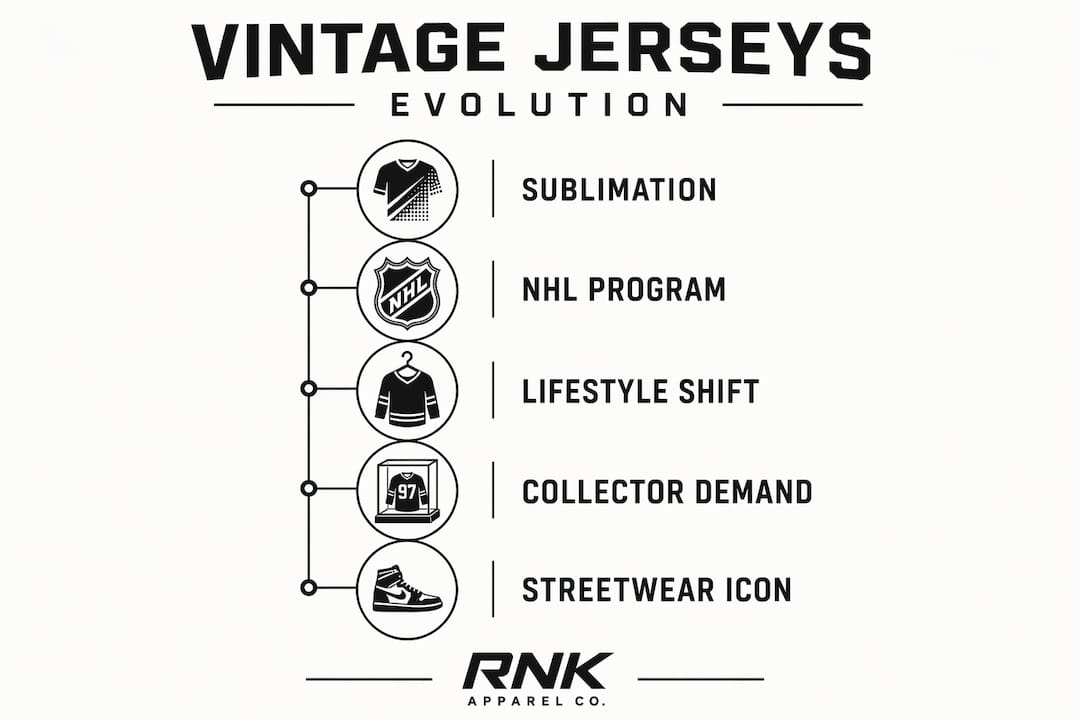
The NHL accelerated this shift with a deliberate program. The NHL’s third-jersey program, launched in 1995, gave franchises a platform to experiment with more playful designs. Teams used the program to introduce alternate crests, new color schemes, and graphic-heavy looks that felt closer to streetwear than traditional hockey uniforms. Fans responded immediately. Third jerseys often outsold primary jerseys in team stores.
The cultural crossover followed quickly. By the late 1990s and early 2000s, NHL jerseys appeared in rap music videos and casual streetwear. Artists and athletes outside hockey wore them as fashion pieces, not as team allegiance signals. That shift expanded the audience for hockey apparel far beyond the sport’s traditional fan base. It also created the foundation for the vintage hockey apparel market that exists today.
The institutionalization of vintage reproduction came in 2002. The NHL granted Mitchell & Ness exclusive rights to reproduce vintage hockey sweaters, bringing the same model that had worked for NBA and NFL throwbacks into the hockey market. That licensing agreement gave collectors and fans access to historically accurate reproductions for the first time. It also signaled that vintage hockey styles had real commercial value beyond casual nostalgia.
- Sublimation printing in the 1990s enabled bold, graphic-heavy jersey designs.
- The 1995 NHL third-jersey program made uniforms look like lifestyle apparel.
- Late 1990s hip hop culture adopted NHL jerseys as streetwear staples.
- Mitchell & Ness’s 2002 NHL licensing deal institutionalized vintage reproduction.
Why do vintage hockey jerseys work as streetwear?
The oversized silhouette of a hockey jersey was never designed for fashion. It was built to fit over shoulder pads, chest protectors, and elbow pads. That functional origin created an accidental streetwear advantage. The loose, hip-length cut and mesh texture contrast naturally with heavier casual fabrics like denim, fleece, and cotton. The result is a layered look that feels intentional without requiring much effort.

Vintage hockey jerseys work as streetwear centerpieces because they carry visual weight on their own. The bold crests, contrasting colors, and large numbers make the jersey the focal point of any outfit. Styling should reflect that. Pairing a vintage jersey with simple bottoms, clean sneakers, and minimal accessories lets the garment do the work. Overloading the look with competing graphics or loud accessories dilutes the impact.
Sizing is a practical issue that most fans overlook. Vintage cuts often run slimmer than modern streetwear sizing. Sizing up one or two steps achieves the relaxed, oversized fit that current fashion expects. A jersey that fits like a modern athletic top reads as athletic gear. A jersey with the right amount of drape reads as a deliberate style choice.
Pro Tip: When styling a vintage hockey jersey as a streetwear piece, treat it the way you would treat a statement coat. Build the rest of the outfit around it, not alongside it.
- The original oversized cut creates a natural streetwear silhouette.
- Mesh textures pair well with denim, fleece, and cotton for layered looks.
- Bold crests and numbers make the jersey the visual centerpiece of any outfit.
- Size up one or two steps to achieve the relaxed fit expected in current fashion.
What drives collector demand for vintage hockey gear?
Collector demand for vintage hockey apparel is driven by three factors: provenance, design quality, and scarcity. Game-worn and signed jerseys carry the highest value because they connect directly to a specific moment in hockey history. Wear, provenance, and authenticity are the key factors that affect investment value. A jersey worn during a playoff run or signed by a Hall of Fame player is both a historical artifact and a financial asset.
Design appreciation is a separate driver that often gets overlooked. Many fans and collectors buy vintage hockey apparel because the designs from the 1970s, 1980s, and 1990s are simply better looking than modern equivalents. The graphics are bolder, the color combinations are more distinctive, and the crests carry more visual personality. That design value exists independently of team allegiance or investment potential.
Authenticity verification is the most important skill a collector can develop. Many vintage jersey offerings on the market are counterfeits or incorrectly labeled. Collectors should inspect construction details, crest accuracy, and manufacturer labels carefully before purchasing. A jersey labeled as a 1980s CCM original that uses modern stitching techniques is not what it claims to be. Knowing the difference protects both your investment and the cultural integrity of the piece.
| Factor | Authentic vintage jersey | Reproduction or counterfeit |
|---|---|---|
| Construction | Era-accurate stitching and materials | Modern techniques, inconsistent with claimed era |
| Crest accuracy | Matches historical records exactly | Minor variations in color or design |
| Manufacturer label | CCM, Maska, or era-correct brand | Generic or incorrect branding |
| Provenance | Documented history or game-worn evidence | No documentation |
| Value | High and appreciating | Low and declining |
Key takeaways
Vintage hockey apparel functions as cultural identity, lifestyle fashion, and collector asset simultaneously, making it one of the most durable categories in sports merchandise.
| Point | Details |
|---|---|
| Cultural continuity | Classic crests and color palettes connect fans across generations more than any single player or era. |
| Technology as catalyst | Sublimation printing and the 1995 NHL third-jersey program transformed jerseys into lifestyle apparel. |
| Streetwear fit | The oversized, functional cut of hockey jerseys makes them natural streetwear centerpieces when sized correctly. |
| Collector value | Provenance, design quality, and authenticity verification determine the real value of vintage hockey gear. |
| Authenticity matters | Inspecting construction, crests, and manufacturer labels is the only reliable way to confirm a jersey’s era. |
Vintage hockey apparel has always been about more than the game
I have watched hockey apparel trends shift for years, and the one constant is that vintage styles never actually go away. They cycle back with more cultural weight each time. What strikes me most is how a Boston Bruins throwback or a Hartford Whalers tee communicates something that a modern jersey simply cannot. It signals that you know the history. You are not just a fan of the current roster. You understand where the franchise came from.
The deeper insight is that vintage hockey apparel connects generations of fans in a way that current merchandise rarely does. A grandfather and a teenager can both wear the same 1970s Flyers throwback and have completely different but equally valid reasons for doing so. That shared object creates a conversation. That is rare in sports merchandise.
My advice is to wear vintage hockey apparel with intention. Know what era the piece is from. Know what the crest represents. The fans who wear vintage gear as pure fashion without that knowledge are missing the point. The cultural weight of these garments comes from the history they carry. Wearing them thoughtfully is what separates a genuine expression of fandom from a costume.
— Eric
Vintage-inspired custom hockey apparel from Rnkapparel
Rnkapparel builds custom hockey apparel that takes the design principles behind classic styles and applies them to modern fits and fabrics. Whether you want bold graphics on a custom hockey tee or a retro-inspired look on a custom hockey hat, Rnkapparel lets you add your team logo, player name, and number to get exactly the piece you want.
The collection covers hoodies, long sleeve tees, accessories, and more, all built for players, fans, and teams across the United States and Canada. If you want the visual identity of vintage hockey with the comfort and quality of contemporary construction, Rnkapparel is the place to start.
FAQ
What is the role of vintage styles in hockey apparel?
Vintage styles in hockey apparel preserve franchise identity, serve as cultural symbols, and function as lifestyle fashion. They connect fans to the sport’s history while influencing modern streetwear trends.
Why did hockey jerseys become mainstream fashion in the 1990s?
Sublimation printing and the NHL’s 1995 third-jersey program transformed hockey jerseys into bold, graphic-heavy lifestyle apparel. NHL jerseys then crossed into hip hop culture and streetwear by the late 1990s.
How should I size a vintage hockey jersey for streetwear?
Vintage cuts run slimmer than modern streetwear sizing, so sizing up one or two steps achieves the relaxed, oversized fit that current fashion expects.
How do I verify if a vintage hockey jersey is authentic?
Inspect the construction, crest accuracy, and manufacturer label carefully. Era-correct manufacturers like CCM and Maska are key identifiers, and any mismatch between claimed era and actual materials signals a counterfeit.
Why do fans still buy apparel from defunct NHL teams?
Retro gear from defunct teams preserves local fan identity and keeps team memory alive when current merchandise no longer exists. These pieces also carry strong collector and design value.
Recommended
- How Hockey Traditions Influence Merchandise in 2026 – RNK Apparel Co.
- Hockey Slang Printed Apparel Examples for Fans and Players – RNK Apparel Co.
- Custom Hockey Hoodies USA & CANADA | Affordable Team Hoodies – RNK Apparel Co.
- Premium Hockey Cotton T-Shirt - premium hockey cotton t-shirt | Soft, lightweight, durable, modern fit. – RNK Apparel Co.
