

Screen printing is a stencil-based method where ink is forced through a mesh screen onto fabric to produce durable, vibrant designs. Each color in a design requires its own screen, and each layer is printed and cured separately. The result is apparel that holds up through hundreds of washes without fading or peeling. For sports teams, artists, and entrepreneurs ordering custom gear in bulk, understanding how screen printing works on apparel is the difference between a smart order and an expensive mistake.
What are the main steps in the screen printing process?
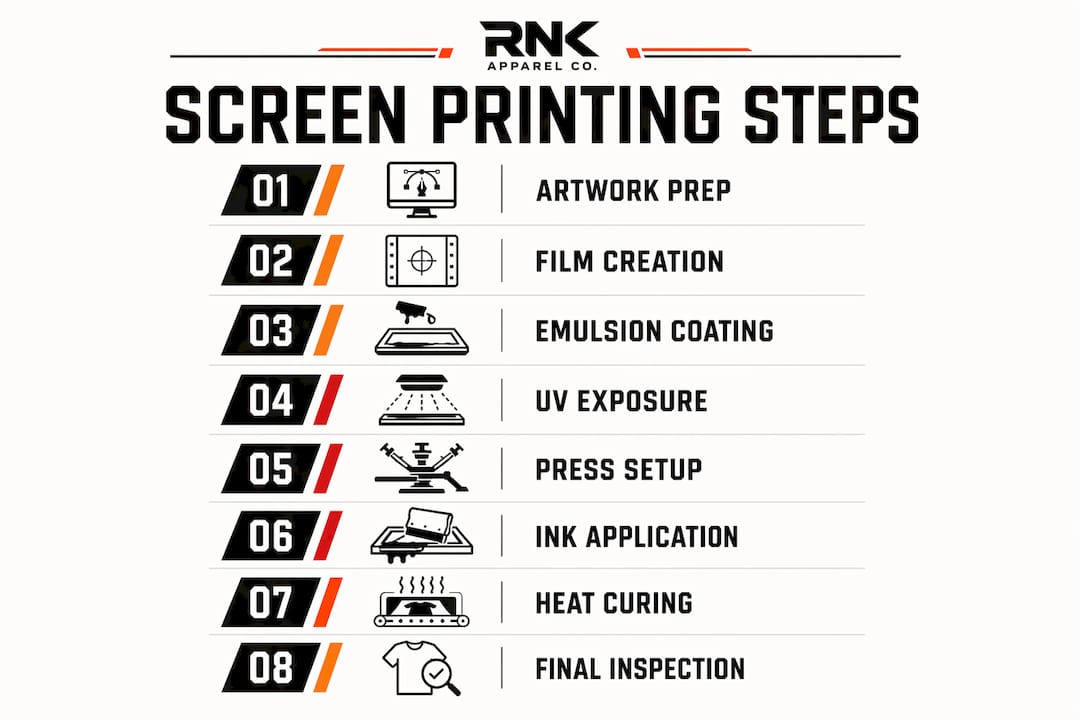
The screen printing process runs through eight distinct stages: artwork separation, film creation, emulsion coating, UV exposure, washout, registration, ink application, and heat curing. A single-color job can be completed in under one hour when the setup is dialed in. Multi-color designs take longer because each color requires its own screen and its own pass through the press.
Step 1: Artwork preparation and color separation
Every design starts as a digital file. A print technician separates the artwork into individual color layers, with each layer becoming its own film positive. Vector files work best here because they scale without losing sharpness. If you are preparing a team logo for the first time, submitting clean, high-resolution artwork saves significant setup time.
Step 2: Coating screens and UV exposure
A mesh screen stretched over an aluminum frame gets coated with photo emulsion, a light-sensitive liquid. The film positive is placed on top of the coated screen and exposed to UV light. Wherever the UV hits the emulsion, it hardens. The areas blocked by the film positive stay soft and wash away, leaving open mesh where ink will pass through.
Step 3: Press setup and registration
Each screen is mounted on the press and aligned so every color lands exactly where it should on the garment. This alignment step is called registration. Poor registration causes colors to overlap or shift, ruining the design. Multi-color prints require each screen to be registered independently, which is why multi-color designs exponentially increase setup time and the risk of misalignment.
Step 4: Ink application and heat curing
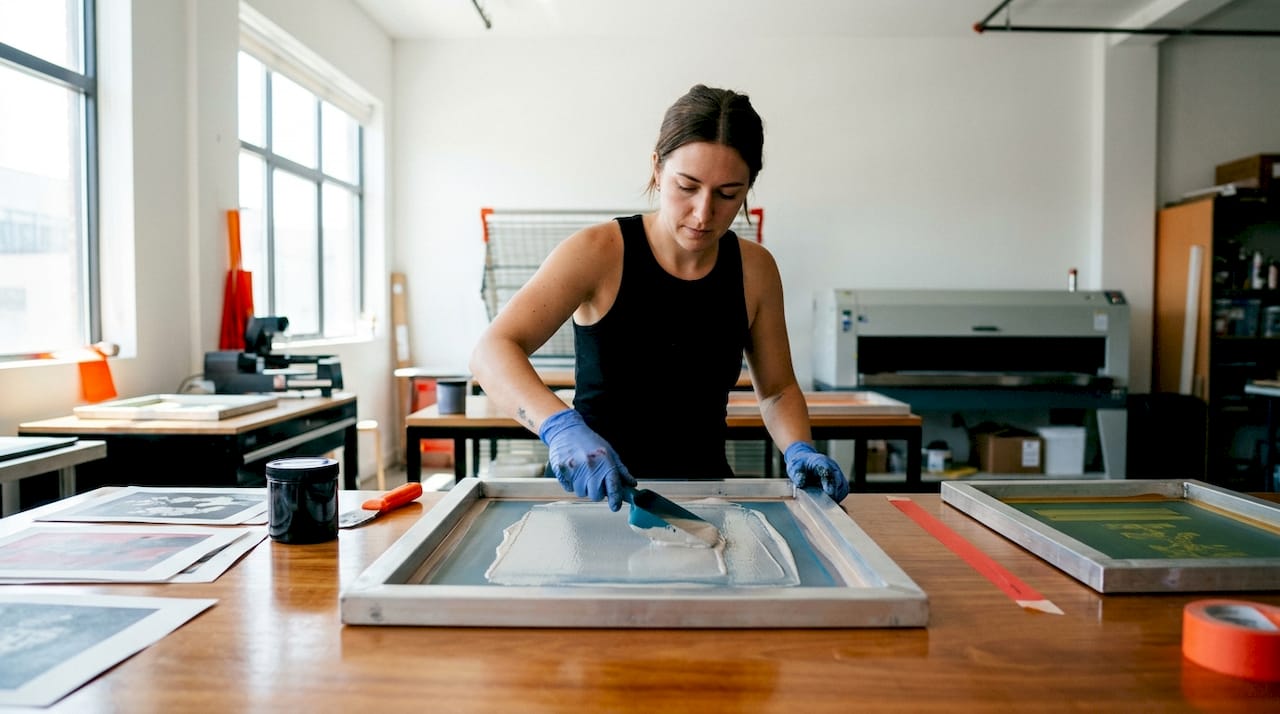
A squeegee pulls ink across the screen, forcing it through the open mesh and onto the fabric below. The garment then travels through a conveyor dryer set to approximately 320°F, where the ink bonds permanently to the fibers. Plastisol ink cures at this temperature and withstands repeated washing without peeling or cracking.
Pro Tip: Manual presses work well for small shops and hobbyists, but automatic presses deliver the speed and registration precision needed for hundreds or thousands of units. If your team order exceeds 100 pieces, an automatic press is the right tool.
What materials and inks are used in screen printing apparel?
The quality of a screen print depends heavily on the materials used at every stage. Screens, inks, and fabric all interact, and choosing the wrong combination produces prints that look dull, crack early, or bleed color.
Screen frames and mesh counts
Screen frames are typically made from aluminum because it holds tension well and resists warping. The mesh stretched across the frame is measured in threads per inch, called the mesh count. Lower mesh counts (around 110) allow more ink to pass through, making them ideal for bold graphics and thick ink deposits. Higher mesh counts (around 230 or above) hold finer detail and work better for halftone designs.
Ink types and their trade-offs
The three main ink types used in apparel screen printing are plastisol, water-based, and discharge.
- Plastisol sits on top of the fabric surface. It cures at roughly 320°F, delivers opaque, vibrant color, and is the most forgiving ink to work with on press. It is the industry standard for team apparel.
- Water-based inks penetrate the fabric fibers rather than sitting on top. They produce a softer feel and a more vintage look, but they can dry in the screen during a long run and require more careful handling.
- Discharge inks remove the dye from the fabric and replace it with a new color. They work only on 100% cotton and produce an extremely soft, breathable print with no hand feel at all.
Ink choice directly affects print opacity, feel, and production complexity. Plastisol is the right call for most team and bulk orders because it is consistent and durable.
Fabric compatibility
Fabric type determines which ink works and how well it performs. Cotton absorbs ink well and is compatible with all three ink types. Polyester presents a specific challenge called dye migration, where the fabric’s dye bleeds up into the ink layer during curing and muddies the color. Printing on polyester requires low-bleed inks or barrier layers to preserve crisp, accurate colors. For hockey training gear and performance apparel made from polyester blends, this is a non-negotiable consideration.
How do order size and design complexity affect cost?
Screen printing costs are driven by setup, not by the number of garments printed. That distinction matters a lot when you are budgeting for a team order.
Every color in a design requires a separate screen, and each screen costs money to produce and time to set up. A three-color logo costs three times as much to set up as a one-color design. Once the screens are made, however, the cost per garment drops as the order size grows.
Orders of 24 or more units are the standard threshold where screen printing becomes economically viable. Below that number, the setup cost per garment is too high compared to digital methods like direct-to-garment (DTG) or direct-to-film (DTF) printing.
Key cost factors to understand before placing an order:
- Number of colors: Each additional color adds a screen setup fee and increases press time.
- Order quantity: Larger orders spread the setup cost across more units, lowering the per-piece price.
- Design complexity: Gradients, fine details, and photographic images are difficult to reproduce accurately with screens and increase the risk of errors.
- Fabric type: Specialty fabrics like performance polyester may require specific inks that cost more per unit.
Screen printing excels for bold, simple graphics on large orders. For highly detailed or photographic designs, digital printing methods perform better and avoid the color-separation complexity that drives up screen printing costs.
What are the most common quality challenges in screen printing?
Print quality in screen printing depends more on technical precision than on the cost of the equipment. Setup parameters like mesh tension, squeegee angle, and garment fixation separate professional-grade prints from mediocre ones.
The squeegee angle should sit at approximately 75 degrees to the screen surface. A steeper angle deposits too much ink and causes bleeding. A shallower angle leaves the ink layer too thin and uneven. Mesh tension must be consistent across the entire screen. A loose screen produces blurry edges and inconsistent ink coverage.
Pro Tip: Always print a test garment before running the full order. A single test print catches registration errors, ink coverage issues, and curing problems before they affect hundreds of pieces.
The most common failure point is under-curing. Prints cured below 320°F crack and fade after just a few washes. The problem is subtle because the print looks fine when it comes off the press. The damage only appears after the first or second wash cycle. Conveyor belt speed and dryer temperature must both be calibrated correctly to prevent this.
Additional quality checkpoints for consistent results:
- Garment fixation: Use spray adhesive or pallet tape to hold the garment flat and prevent shifting during printing.
- Ink viscosity: Ink that is too thick or too thin affects coverage. Adjust with reducer or retarder as needed.
- Emulsion handling: Coat screens in a dark room and expose them promptly. Emulsion degraded by ambient light produces weak stencils that break down mid-run.
- Polyester dye migration: Use low-bleed inks on synthetic fabrics and keep curing temperatures as low as possible while still achieving full cure.
Screen prints deliver consistent ink coverage and long-lasting color vibrancy across large runs, which is why the method remains the standard for sport and team apparel. Getting there requires attention to every stage of the process, not just the final press run.
Key Takeaways
Screen printing is the most cost-effective apparel printing method for bulk orders of 24 or more units with bold, multi-color designs that require durable, wash-resistant results.
| Point | Details |
|---|---|
| Eight-stage workflow | The process runs from artwork separation through heat curing, with each stage affecting final print quality. |
| Ink type determines feel | Plastisol sits on fabric for opacity; water-based penetrates for softness; discharge removes dye for a no-feel print. |
| Order size drives cost | Setup costs per screen make screen printing economical only at 24+ units; smaller runs suit digital methods. |
| Curing temperature is critical | Prints cured below 320°F crack and fade after washing; conveyor speed and dryer heat must both be calibrated. |
| Polyester needs special ink | Dye migration on synthetic fabrics ruins color accuracy without low-bleed inks or barrier layers. |
Screen printing: what I’ve learned after years of watching teams order wrong
The biggest mistake I see teams and entrepreneurs make is choosing screen printing for the wrong job. They see the low per-unit price on a large quote and assume it applies to their 12-piece order with a six-color gradient logo. It does not. Screen printing rewards simplicity and volume. A two-color design on 48 hoodies is where this method shines. A photorealistic player portrait on 10 shirts is where it fails.
The second mistake is ignoring fabric. Hockey training gear is almost always a polyester blend, and polyester is genuinely difficult to print on without the right ink. I have seen teams receive gear where the colors look muddy or slightly off from what they approved. That is dye migration. It is preventable, but only if the printer uses the correct ink and knows what they are doing. Ask your printer directly how they handle polyester before you commit to an order.
The third thing I want teams to understand is that durability is not automatic. A screen print is only as durable as its cure. A properly cured plastisol print on a cotton-poly blend will outlast the garment itself. An under-cured print will start cracking by the third wash. The difference is invisible until it is too late. Work with printers who can tell you their exact curing temperature and conveyor settings. If they cannot answer that question, find someone who can.
Screen printing is still the best method for custom sports apparel when the job fits the method. Bold team logos, player numbers, and graphic tees in bulk quantities are exactly what it was built for.
— Eric
Custom hockey apparel from Rnkapparel, built to last
Rnkapparel applies the same production standards covered in this article to every custom hockey order. The result is apparel that holds its color and structure through a full season of wear, washing, and ice time.
The custom hockey t-shirts collection covers team graphics, player names, and numbers across a full range of sizes for youth and adult players. Rnkapparel also offers custom hockey hats and accessories for complete team kits. Every order includes customization support so your logo, colors, and layout print exactly as intended. If your team is ready to order, Rnkapparel handles the details from artwork to delivery.
FAQ
What is screen printing on apparel?
Screen printing is a method where ink is pushed through a mesh stencil onto fabric. Each color requires a separate screen, and the ink is heat-cured at approximately 320°F to bond permanently to the garment.
How many colors can a screen print design include?
There is no hard limit, but each color adds a screen setup fee and increases production time. Most team apparel orders use one to four colors to keep costs manageable and registration errors low.
Is screen printing durable on hockey gear?
Screen printing produces highly durable prints when properly cured. Plastisol ink on cotton or cotton-poly blends withstands repeated washing without peeling, making it well-suited for team apparel used throughout a hockey season.
What is the minimum order size for screen printing?
The standard economic threshold for screen printing is 24 or more units. Below that quantity, setup costs per garment make digital printing methods a more practical choice.
Can you screen print on polyester hockey apparel?
Yes, but it requires low-bleed inks or barrier layers to prevent dye migration. Without the correct ink, the fabric’s dye bleeds into the print during curing and distorts the colors.
