

Hockey apparel is defined as the full system of jerseys, protective gear, and team clothing worn by players and fans across competitive and recreational play. Understanding how hockey apparel evolved over decades reveals three interwoven threads: textile innovation, safety mandates, and branding culture. The sport began outdoors on frozen ponds, and the clothing reflected that. What players wear today shares almost nothing with those early wool layers except the basic silhouette. This article traces the full arc, from the original “sweater” to sublimation-printed jerseys carrying corporate logos.
What materials and fabrics shaped hockey jerseys from wool to synthetics?
Early hockey jerseys were called “sweaters” because players literally wore wool knit covers to stay warm during outdoor games in freezing temperatures. Wool was practical for that environment. It trapped heat, resisted wind, and held up to rough physical contact. The name “sweater” stuck in hockey vocabulary long after the material itself disappeared from the ice.
When hockey moved indoors to refrigerated arenas during the mid-20th century, the design problem shifted. Players no longer needed insulation. They needed breathability. Cotton replaced wool for a period, offering a lighter feel, but cotton absorbs sweat and stays wet. That created a new discomfort problem, especially during intense play.
Polyester solved it. Polyester mesh fabrics use an open weave structure that pulls moisture away from the skin, accelerates evaporation, and allows airflow across the body. Modern NHL jerseys are built almost entirely from polyester mesh. The fabric is lighter than cotton, dries faster, and holds color better under repeated washing and physical stress.
The most recent shift is toward sustainability. Recycled polyester made from PET bottles now appears in performance hockey jerseys. It delivers the same moisture-wicking and durability properties as virgin polyester while reducing plastic waste. Brands like Rnkapparel have responded to this trend by incorporating eco-conscious fabric options into their sustainability commitment.
Pro Tip: When choosing a hockey jersey for training, look for 100% polyester construction with a mesh weave. It will outperform cotton blends in every condition that matters on the ice.
Here is a quick comparison of how jersey fabrics have changed across eras:
| Era | Primary Fabric | Key Benefit | Main Limitation |
|---|---|---|---|
| Pre-1950s | Wool | Warmth outdoors | Heavy, itchy, slow-drying |
| 1950s–1980s | Cotton blends | Lighter feel | Absorbs sweat, stays wet |
| 1990s–2000s | Polyester | Breathable, durable | Early versions lacked stretch |
| 2010s–present | Polyester mesh / recycled polyester | Moisture-wicking, sustainable | Higher production cost |
How did protective gear change hockey apparel design?
Protective gear and jersey design are inseparable. The bulk and placement of pads directly determine how jerseys are cut, sized, and fitted. Early hockey players wore minimal protection. Shin guards and gloves existed, but helmets were entirely optional for most of the sport’s history.

That changed in the 1970s. Helmet adoption rose significantly after major injury incidents, most notably Bill Masterton’s fatal on-ice injury in 1968, which triggered serious discussion about mandatory head protection. By 1979, roughly 70% of NHL players wore helmets. The NHL eventually mandated helmets for all players entering the league after 1979, though veterans who had signed pre-mandate contracts were grandfathered in.
Safety-driven apparel changes can move faster than fan-style trends once a league enforces compliance through policy. Helmet adoption proved that point. Within a single generation, head protection went from rare to universal. The same pattern repeated with visors and neck guards in later decades.
Modern protective pads use high-density foam, hard plastics, and ergonomic shaping to absorb impact without restricting movement. Shoulder pads, elbow pads, and shin guards all became more anatomically fitted over time. That shift forced jersey designers to account for the added volume underneath. Jerseys grew longer in the torso, wider in the shoulders, and cut with more room through the arms.
Pro Tip: If you are designing team jerseys, always size up one level from the player’s base measurements to account for shoulder and elbow pad bulk underneath. A jersey that fits perfectly over a T-shirt will feel restrictive over full gear.
- Helmets: moved from optional to mandatory for new NHL players after 1979
- Shoulder pads: evolved from flat leather to molded plastic and foam composites
- Elbow pads: shifted from minimal felt padding to full hard-cap protection
- Shin guards: grew taller and wider, requiring longer jersey cuts
- Neck guards: added as a response to skate blade injuries, especially at youth levels
How did design, branding, and culture reshape the hockey jersey?
The hockey jersey became a cultural object in the 1990s. Before that decade, jerseys were functional and conservative. Teams used simple color blocks and basic lettering. The design vocabulary was limited by the printing technology available.
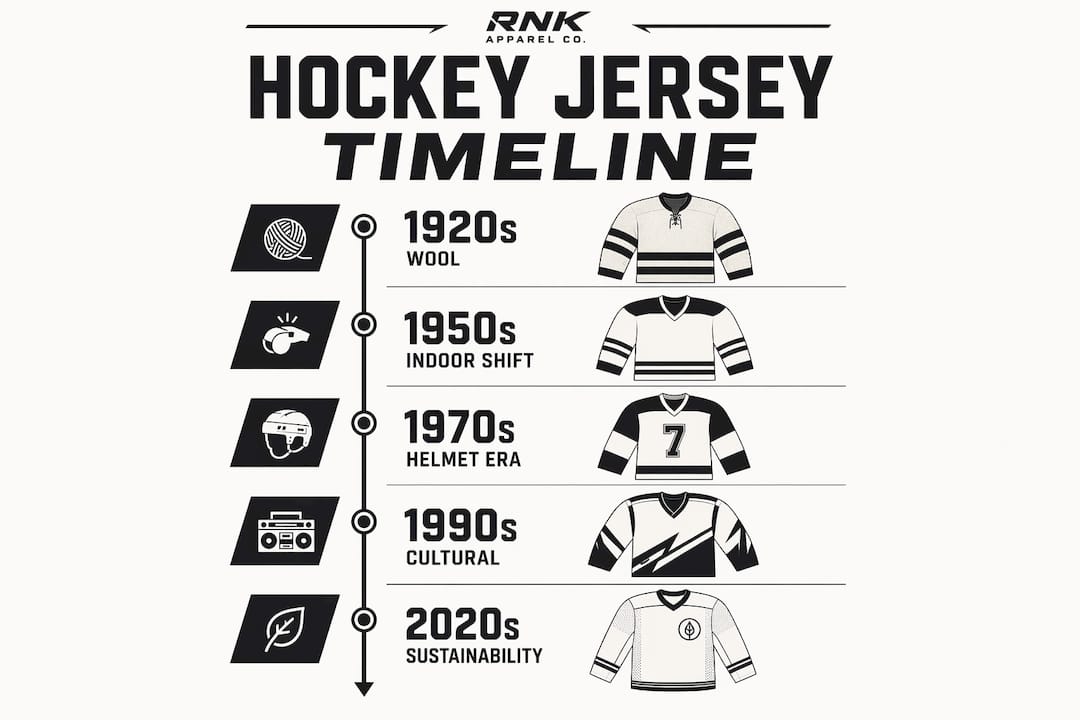
Sublimation printing changed everything. The process permanently fuses dye into fabric fibers rather than stitching or patching logos onto the surface. That meant designers could embed full-color graphics, gradients, and cartoon-like imagery directly into the jersey material. The result was a wave of bold, sometimes outrageous designs that defined the mid-1990s NHL aesthetic.
The NHL’s third-jersey program launched around 1995 and gave teams a vehicle to experiment with alternate looks. Third jerseys became marketing tools as much as uniforms. Teams could sell a new jersey to fans without abandoning their primary identity. The program accelerated design cycles and made jerseys feel closer to fashion releases than sports equipment.
- 1990s sublimation era: Bold graphics, cartoon logos, and fast design turnover define the decade.
- 2000s simplification: Many teams pulled back to cleaner looks after the visual excess of the 1990s.
- 2010s heritage revival: Retro and throwback jerseys became popular, connecting modern fans to team history.
- 2020s commercial integration: The NHL approved small front-jersey advertisements starting in the 2022–23 season.
- 2026 and beyond: Larger ads are projected for the 2026–27 season. The Buffalo Sabres announced a Stark Tech logo on their road jerseys beginning that season.
Cultural forces outside hockey also shaped jersey aesthetics. Hip-hop artists wore oversized NHL jerseys as streetwear in the late 1990s and early 2000s, pushing the garment into mainstream fashion. That crossover made hockey jerseys desirable to people who had never watched a game. Teams and the league noticed. Licensing revenue grew, and jersey design began factoring in off-ice appeal alongside on-ice function.
The Ontario Reign AHL team’s 2026 brand evolution illustrates how seriously teams now treat visual identity. The Reign rolled out a new primary logo, a revised color palette featuring Inland Blue, gold, and black, and updated jersey designs. The rebrand was not just cosmetic. It reflected a deliberate effort to build regional identity and fan loyalty through apparel. You can see how hockey traditions shape merchandise in the way teams connect visual history to current design choices.
How do modern hockey jerseys balance performance, safety, and branding?
Today’s hockey jersey carries three jobs at once. It must perform as an athletic garment, accommodate protective gear, and communicate team or commercial identity. Hockey apparel evolution is shaped equally by manufacturing technologies, safety policies, and cultural branding rather than any single factor. That three-way tension defines every design decision made at the professional level.
Performance fabrics now include thermoregulation properties beyond basic moisture-wicking. Some professional jerseys use zone-specific fabric weights, with lighter mesh panels under the arms and across the back where heat builds fastest. Stretch panels allow full range of motion without the jersey riding up during skating strides.
Safety compliance shapes the cut. Jerseys must fit over full protective gear without restricting movement or creating loose fabric that could catch on sticks or boards. That constraint pushes designers toward athletic fits with structured shoulders and tapered bodies.
Branding fills the remaining real estate. Team logos, sponsor patches, and now front-of-jersey advertisements compete for space on a garment that is also being asked to perform at elite athletic standards. The balance is difficult. Every square inch of a professional jersey serves a purpose.
- Moisture-wicking polyester mesh remains the standard fabric for professional and amateur jerseys
- Ergonomic cuts accommodate modern pad profiles without excess fabric
- Sublimation printing allows full-color branding without adding weight or stiffness
- Recycled polyester options address sustainability demands from teams and fans
- Commercial ad space on jerseys reflects the sport’s growing revenue model
Key takeaways
Hockey apparel evolved through three parallel forces: textile innovation, safety mandates, and branding culture, and no single thread explains the full transformation.
| Point | Details |
|---|---|
| Wool to polyester shift | Jersey fabrics moved from insulating wool to moisture-wicking polyester mesh as hockey moved indoors. |
| Safety drove design changes | Helmet mandates and pad evolution forced jersey cuts to grow wider and longer to fit protective gear. |
| Sublimation printing unlocked branding | Permanent dye embedding enabled bold graphics and faster design cycles starting in the 1990s. |
| Commercial ads are the new frontier | The NHL approved jersey advertisements in 2022–23, with larger placements projected for 2026–27. |
| Sustainability is now a design factor | Recycled polyester from PET bottles delivers performance benefits while reducing environmental impact. |
Why the three-thread view of hockey apparel history matters
Most hockey apparel histories focus on one thing: either the jerseys look cool, or the gear got safer, or the fabrics got better. That single-thread view misses the point. The real story is how all three forces pushed against each other at the same time.
The 1990s jersey explosion did not happen because designers suddenly got creative. It happened because sublimation printing made bold graphics technically possible and commercially viable at the same moment the NHL was looking for new revenue streams. Technology, business, and culture aligned. That is why the era produced such a distinct visual identity.
The helmet story is equally instructive. Bill Masterton’s death in 1968 did not immediately produce a helmet mandate. It took more than a decade of gradual adoption, cultural resistance from veteran players, and eventual policy enforcement to reach near-universal use. Safety changes in sport rarely happen fast unless a governing body forces them. The NHL’s 1979 rule proved that.
What I find most underappreciated is how protective gear bulk quietly shaped jersey aesthetics for decades without anyone talking about it. The reason modern jerseys look the way they do, with wide shoulders, long torsos, and structured cuts, is not fashion. It is geometry. The gear underneath dictates the silhouette above it. That connection between protection and style is the hidden thread in the whole history.
For anyone who studies hockey gear or designs team apparel, the lesson is the same. You cannot optimize a jersey by thinking about fabric alone, or safety alone, or branding alone. The best designs account for all three simultaneously.
— Eric
Custom hockey apparel built for today’s game
The history of hockey apparel points to one clear direction: performance fabrics, smart cuts, and strong visual identity all belong in the same garment.
Rnkapparel builds custom hockey shirts and team apparel using modern polyester construction, full-color customization, and fits designed for athletes who wear gear underneath. Whether you need team hoodies, graphic tees, or hockey accessories that carry your logo, Rnkapparel offers options for youth teams, adult leagues, and individual players across the USA and Canada. Upload your logo, choose your colors, and get apparel that reflects where the sport has arrived.
FAQ
What were the first hockey jerseys made from?
Early hockey jerseys were wool sweaters worn outdoors to retain body heat in cold weather. The term “sweater” persisted in hockey long after wool was replaced by synthetic fabrics.
When did NHL players start wearing helmets?
Helmet use rose to about 70% of NHL players by 1979, driven by injury incidents including Bill Masterton’s fatal injury in 1968. The NHL mandated helmets for all players entering the league after 1979.
What fabric do modern hockey jerseys use?
Modern professional jerseys use polyester mesh for moisture-wicking and airflow. Recycled polyester made from PET bottles is increasingly used for its sustainability benefits alongside identical performance properties.
How did sublimation printing change hockey jersey design?
Sublimation printing permanently fuses dye into fabric fibers, replacing stitched logos and enabling full-color graphics. This technology drove the bold, cartoon-style jersey designs that defined the 1990s NHL aesthetic.
Are there ads on NHL jerseys now?
The NHL approved small front-of-jersey advertisements starting in the 2022–23 season. Larger placements are projected for 2026–27, with the Buffalo Sabres announcing a Stark Tech logo on their road jerseys beginning that season.
