
The best hat for showing hockey team spirit is the one that matches where you’ll wear it, carries your logo in a method that holds up, and fits your whole team consistently. Start here: pick your style based on use case, confirm your color match and logo placement, then request a proof and a small sample run before committing to bulk production.
- Style first: Beanies for cold rinks and winter game-days; snapbacks, truckers, or dad hats for the arena concourse and travel; fitted or performance caps for players and coaches on the bench.
- Logo method second: High-contrast embroidery or a woven patch gives the sharpest visibility from the stands and holds up through a full season of wear.
- Proof before bulk: Never approve a full run without seeing a physical sample or at minimum a high-resolution digital mockup with accurate color codes.
Pro Tip: If your team needs both rink-side warmth and off-ice visibility, order a matching beanie and a branded snapback together. A consistent look across contexts signals a real program, not just a one-off purchase.
Key Takeaways
Choosing the right hat for hockey team spirit comes down to matching style to use case, picking the right customization method for your logo, and building enough lead time for proofs and samples before your deadline.
| Point | Details |
|---|---|
| Match style to context | Beanies for cold rinks; snapbacks and truckers for the concourse and travel; fitted caps for coaches and players. |
| Prioritize logo contrast | High-contrast embroidery or a woven patch reads clearly from 15–20 feet; always confirm with a physical proof. |
| Request a sample first | Order 5–10 units before bulk production to catch sizing, color, and embroidery issues early. |
| Build in timeline buffer | Allow design proof through bulk shipping to take 4–7 weeks; add two weeks for any hard game-day deadline. |
| Rnkapparel for team orders | Rnkapparel offers custom hockey hats with proof approval, bulk discounts, and USA/Canada shipping for teams and fans. |
Table of Contents
- Which hat style works best for hockey team spirit?
- What materials and features should you look for?
- How do you customize a hat with your team’s logo?
- How do you make your logo readable from the stands?
- How do you size hats correctly for a team order?
- What do custom team hats typically cost, and how long do they take?
- How do you keep custom hats looking good all season?
- What should you ask a vendor before placing a team hat order?
- Why do hats build hockey team spirit more than other accessories?
- A note from Rnkapparel on what actually works for hockey teams
- Rnkapparel makes custom hockey hats straightforward
- Sources
Which hat style works best for hockey team spirit?
Choosing the right hat style is the single fastest way to show team spirit, and the decision comes down to where the hat will actually be worn. Each style sends a slightly different visual signal and handles customization differently.
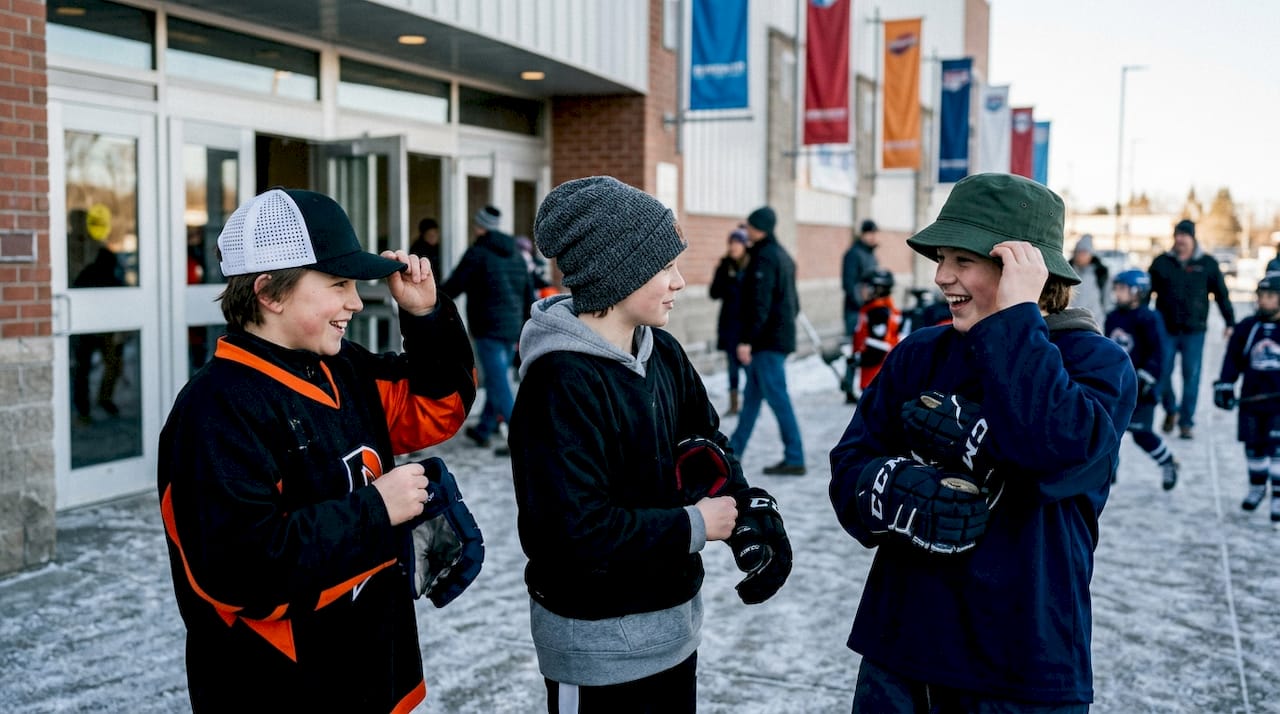
- Cuffed beanie: The go-to for cold rinks, outdoor games, and winter travel. The cuff is a natural canvas for a woven label or small embroidered logo. It reads as athletic and team-focused rather than casual.
- Snapback: Flat front panels are ideal for large, detailed embroidery. The adjustable back fits most adult heads, which simplifies bulk ordering. Snapbacks photograph well and show up clearly in the stands.
- Fitted cap: Cleaner silhouette, preferred by coaches and players who want a polished look. Requires accurate sizing, so it works best when you know your roster’s head measurements.
- Trucker hat: Mesh back panels keep it breathable for warmer arenas and travel days. The foam or structured front panel holds embroidery well, though the mesh limits rear customization.
- Dad hat / washed cotton cap: Relaxed and approachable, popular with fans and parents. Lower profile means less real estate for large logos, but it works well for a simplified alternate mark.
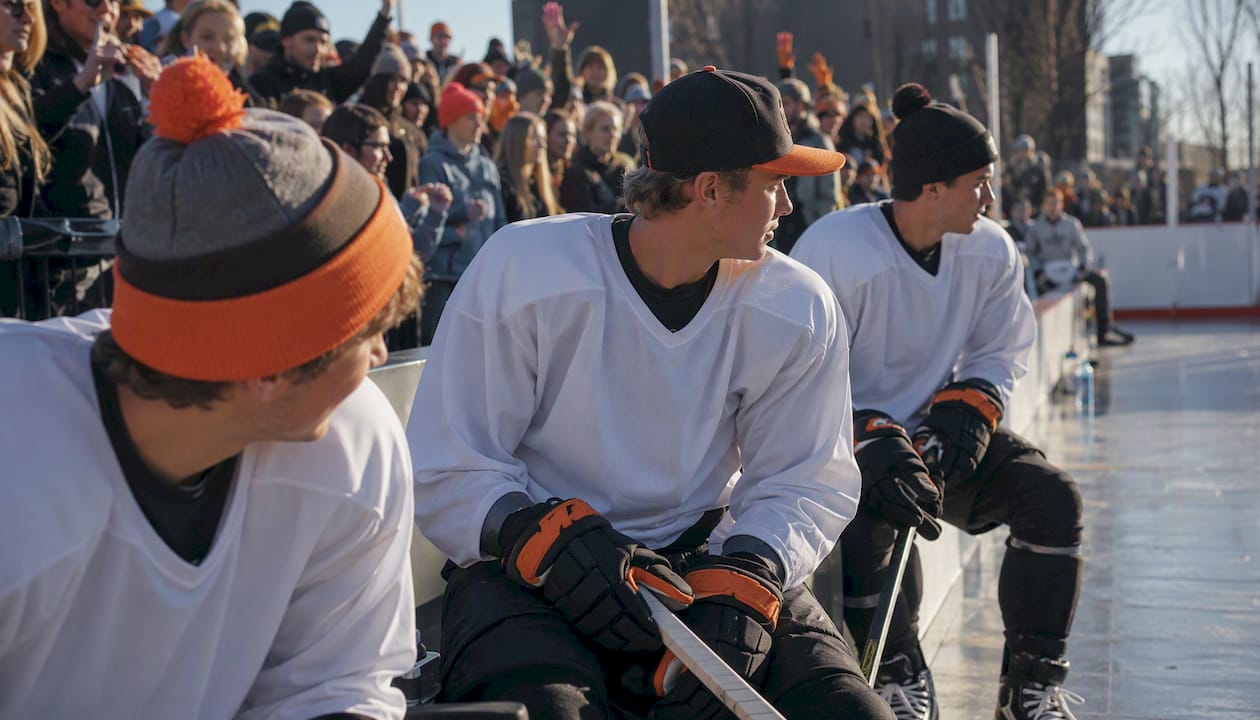
Wearing team colors and hats creates a visible wave of support that players notice during games, which is why style consistency across a group matters as much as the design itself. For fan nights and coordinated sections, snapbacks and beanies tend to photograph the best and create the strongest visual block of color from the ice.
Pro Tip: For youth teams, adjustable snapbacks and beanies eliminate the sizing headache entirely. Save fitted caps for adult rosters where you can collect accurate measurements.
What materials and features should you look for?
The fabric determines how long the hat looks good and how well it holds customization. Get this wrong and embroidery puckers, colors fade after a few washes, and the brim loses its shape mid-season.
- Acrylic/wool blends (beanies): Warm, stretchy, and durable. Acrylic-dominant blends are more affordable and machine-washable; wool-dominant blends are warmer but require more care. Both hold woven labels cleanly.
- Cotton/twill (snapbacks, dad hats): The standard for structured caps. Cotton twill is stiff enough to support embroidery without puckering and softens naturally over time without losing shape.
- Poly/cotton blends (truckers, performance caps): Lighter and more breathable. Moisture-wicking liners are worth requesting for players and coaches who wear caps during warm-ups or bench sessions.
- Performance polyester (training caps): Best for on-ice or practice use. Dries fast, resists odor, and pairs well with screen printing or heat-transfer logos when embroidery would add too much weight.
On the construction side, look for reinforced front panels on any cap you plan to embroider heavily. A soft, unstructured front will distort under a dense stitch count. Snapback closures are the most forgiving for bulk orders; adjustable straps (strapbacks) work similarly but can feel less secure on smaller heads. For fitted caps, stretch-fit materials like spandex-blend panels reduce sizing risk without sacrificing the clean look.
How do you customize a hat with your team’s logo?
Customization method is where most teams make their biggest mistake: they pick the wrong technique for the logo they have, and the result looks muddy or fades within a season.
The three main methods:
- Embroidery: Thread stitched directly into the fabric. Durable, tactile, and professional-looking. Best for bold logos with clean lines and limited color gradients. Ask your vendor for a stitch count estimate and confirm the minimum embroidery area they can work within.
- Woven patch: The logo is woven as a separate piece and then attached to the hat. Cleaner edges than embroidery for detailed artwork, and it sits slightly raised, which adds visual depth. Works especially well on beanies and structured caps.
- Screen printing / DTF (direct-to-film): Best for full-color graphics or photographic-style art on flat panels. Less durable than embroidery on fabric that flexes repeatedly, but the color range is unmatched.
Before you send your logo file, confirm these specs with your vendor:
- Stitch count estimate (for embroidery) or print resolution requirement (for DTF/screen print)
- Minimum embroidery area or minimum print size
- Pantone or hex color codes for every color in the logo
- Patch backing type (iron-on, sew-on, or heat-seal) if using woven patches
- Mockup format: request a high-resolution digital proof on the actual hat color before production starts
Color matching deserves its own attention. Ask for a physical swatch or a printed color proof before approving bulk production. Digital screens display colors differently than thread or ink on fabric, and a logo that looks sharp on your monitor can come back two shades off on a black cap.
Pro Tip: If your logo has fine lines or gradients, ask your vendor to create a simplified “cap mark” version specifically for embroidery. Most professional sports teams maintain alternate marks for exactly this reason.
How do you make your logo readable from the stands?
A hat that looks great up close but disappears at 20 feet defeats the purpose. Visibility from the stands is the real test for hockey team apparel, and a few design rules make a measurable difference.
- Contrast is non-negotiable: Light logo on a dark hat, or dark logo on a light hat. A navy logo on a dark green hat reads as a single dark mass from 15 feet away. When in doubt, add a thin outline in a contrasting color to separate the logo from the background.
- Front panel center is your primary placement: It’s the first place eyes land. Side embroidery and back logos are secondary accents, not the main identifier.
- Keep text short and large: A team name in a clean, bold font at 1.5 inches or taller reads clearly from the concourse. Script fonts and thin serifs collapse at distance.
- Simplify for small formats: Drop fine details, thin lines, and small secondary text when scaling a logo down to cap size. Use an alternate or simplified mark if your primary logo has intricate elements.
- Cuff placement on beanies: Center the logo on the cuff fold, not above it. A logo that sits above the cuff gets hidden when the hat is worn folded.
Pro Tip: Print your logo at actual cap size (roughly 2.5 inches wide for a front panel) and tape it to a dark piece of fabric. Walk 15 feet away. If you can’t read it clearly, simplify before sending to production.
How do you size hats correctly for a team order?
Sizing mistakes are the most common reason teams end up with a box of hats nobody wears. Getting it right before bulk production saves money and frustration.
Measuring head circumference:
- Wrap a soft tape measure around the head, about one inch above the eyebrows and ears.
- Note the measurement in inches or centimeters.
- Match to standard hat sizes: S/M typically fits 21.5–22.5 inches; L/XL fits 22.5–23.5 inches; fitted caps use numeric sizing (7, 7 1/8, 7 1/4, etc.).
For adjustable styles (snapbacks, strapbacks), one size covers most adult heads, which is why they dominate team orders. Fitted caps require individual measurements, so collect them from every player before ordering.
Youth sizing runs roughly 20–21 inches for most school-age players. If you’re ordering for a mixed youth/adult group, adjustable beanies and snapbacks are the safest choice. For more detail on sizing across the full apparel range, the common questions about team hockey apparel guide covers fit specifics by garment type.
- Always order a sample or small pre-production run (5–10 units) before committing to the full quantity.
- Include a size chart and a clear exchange policy in your vendor agreement.
- For youth orders, build in a 10% buffer of the most common size to cover late additions to the roster.
What do custom team hats typically cost, and how long do they take?
Budget and timeline planning is where orders go wrong most often. Teams underestimate lead time, skip the sample stage, and end up paying rush fees or receiving hats the week after the season opener.
Typical cost drivers:
- Stitch complexity and thread count for embroidery
- Patch manufacturing setup fees for woven patches
- Hat blank quality (budget cotton vs. premium structured twill)
- Special backings, custom labels, or hang tags
Per-unit costs generally decrease with volume, but the exact range depends on the vendor, customization method, and hat blank. Small runs (25–99 units) carry the highest per-unit cost because setup fees are spread across fewer pieces. Medium runs (100–499 units) typically unlock the first meaningful price break. Large runs (500+ units) bring the lowest per-unit cost but require more upfront capital and longer lead times.
Plan your timeline around these stages: design proof (3–5 business days) → sample or prototype (7–14 days) → bulk production (2–4 weeks) → shipping (3–10 business days depending on carrier and destination). Add a two-week buffer for any game-day or fundraising deadline.
Minimum order quantities vary by vendor. Some accept runs as small as 12–24 units; others require 48 or more for embroidered styles. Always confirm the minimum before finalizing your design, since switching vendors mid-process resets the proof and sample timeline.
How do you keep custom hats looking good all season?
A well-made hat with quality embroidery can last years with basic care. Most teams ruin theirs in the first month by machine-washing on hot and tossing them in the dryer.
- Embroidered caps: Hand wash in cold water or use a gentle machine cycle in a mesh laundry bag. Reshape the brim while damp and air dry on a hat form or inverted bowl. Never put a structured cap in the dryer.
- Beanies with woven labels: Machine wash cold on gentle, lay flat to dry. High heat shrinks acrylic fibers and can cause woven patches to peel at the edges.
- Spot cleaning: For minor dirt or sweat stains, a damp cloth and mild soap handles most issues without a full wash. This is the right approach for woven patches.
- Storage: Keep caps in a cool, dry place away from direct sunlight. UV exposure fades both fabric and thread color faster than washing does. Stack beanies loosely; store structured caps upright or on a shelf, not crushed in a bag.
- Loose threads: Clip, never pull. A loose embroidery thread pulled from the wrong end can unravel a section of the logo.
Pro Tip: For team giveaways or fundraiser stock, rotate inventory so older units go out first. Hats stored in a warm, humid equipment room for months arrive to recipients already faded and misshapen.
What should you ask a vendor before placing a team hat order?
The difference between a smooth order and a costly mistake usually comes down to the questions you ask before signing off. Use this checklist before committing.
Must-ask vendor questions:
- Can you provide a material/spec sheet for the hat blank?
- What file format do you need for the logo, and what’s the minimum resolution?
- Will I receive a high-resolution digital mockup before production starts?
- What is your stitch count estimate for this logo, and is there a minimum embroidery area?
- What are your minimum order quantities and lead times for this style?
- Do you offer a sample or pre-production prototype, and what does it cost?
- What is your return or refund policy if the bulk order doesn’t match the approved proof?
- Do I retain full rights to my logo artwork, and how do you handle IP/right-to-use?
Trust signals worth requesting:
- Photos of past team orders in a similar style and color
- Customer reviews or team case studies from comparable programs
- A clear sizing chart specific to the hat blank being used
- Documentation of how color matching is guaranteed (Pantone references, physical swatches)
Negotiation tips:
- Ask about volume discounts at specific quantity thresholds, not just a general “bulk pricing” claim.
- Confirm rush fee amounts upfront so you know the real cost of a late design approval.
- Ask whether staggered delivery is available if you need hats shipped to multiple locations.
Pro Tip: Request the vendor’s production timeline in writing, with milestone dates for proof approval, sample delivery, and bulk ship date. A verbal “about three weeks” becomes a problem when your season starts in four.
Why do hats build hockey team spirit more than other accessories?
A hat is one of the few pieces of apparel that works equally well on the ice, in the locker room, and in the stands. That cross-context visibility is what makes it a stronger identity tool than, say, a jersey that only comes out on game day.
Research on team dynamics frames this clearly: team spirit depends on a “line of sight” connecting individual actions to collective outcomes. When a player, coach, and fan all wear the same hat, that visible alignment reinforces a shared identity without anyone saying a word. The hat becomes a signal, not just an accessory.
Practical rituals amplify this effect. According to Psyche Guides’ research on team cohesion, structured rituals and short, regular celebrations are among the most effective tactics for building and sustaining team spirit. A pre-game hat handout, a coordinated “hat night” for fans, or a limited-edition run to mark a championship run all tap into this.
- Pre-game hat handout: Distribute matching hats to the starting lineup before warm-ups. The physical act of receiving and putting on the hat together functions as a ritual that signals “we’re in this together.”
- Fan hat nights: Coordinate a section of fans in matching hats for a home game. The visual block of color is something players actually notice from the ice.
- Milestone hats: Limited-edition runs for a playoff berth, a championship, or a team anniversary create a tangible record of shared achievement.
The hat-trick tradition itself grew from promotional hat giveaways in the 1940s before evolving into the fan-throwing ritual of the 1950s, which shows how deeply hats are woven into hockey’s collective identity. When fans throw hats onto the ice after a player scores three goals in a single game, they’re participating in one of the sport’s most recognizable rituals. Arenas stage staff and collection containers ahead of time for likely hat-trick moments, and teams often donate the collected hats to local charities, turning fan noise into community action.
Pro Tip: If you’re planning a fan hat night, coordinate with arena operations in advance. Arenas with experience handling hat-trick events already have cleanup and donation pipelines in place that you can model your own event logistics on.
A note from Rnkapparel on what actually works for hockey teams
Most teams come to us having already made one of two mistakes: they ordered a style that looked great in a mockup but didn’t hold up through a season, or they skipped the sample stage and ended up with 200 hats in the wrong shade of blue.
What works most consistently is a simple combination: a structured snapback or cuffed beanie in the team’s primary color, with a woven patch or flat embroidery of the main logo in a high-contrast thread. That combination photographs well, survives a full season of use, and works for players, coaches, and fans simultaneously.
On the cost-versus-quality question: woven patches carry a higher setup cost than flat embroidery, but they’re worth it for logos with fine detail or multiple colors. For a simpler mark, a clean flat embroidery at a solid stitch count is the better value. The mistake is choosing the cheaper method for a logo that needs the more precise one.
Rnkapparel makes custom hockey hats straightforward
Skip the back-and-forth with vendors who don’t specialize in hockey. Rnkapparel builds custom hockey accessories specifically for teams and fans across the USA and Canada, with a process designed to eliminate the common ordering mistakes: upload your logo, receive a high-resolution proof, approve a sample, then move to bulk production with confirmed color codes and a documented lead time.
The hats collection covers the styles that work for hockey programs: structured snapbacks, cuffed beanies, and performance caps, all available with embroidery and woven patch options. Bulk discounts apply at standard quantity thresholds, and the team at Rnkapparel can coordinate matching hockey hoodies and shirts so your whole spirit-wear package ships together.
Start by uploading your logo at Rnkapparel and requesting a proof. The sample stage is built into the process, not an add-on.
Sources
These references cover the practical and historical ground behind team hat decisions.
- Smells like team spirit — Kellogg Insight
- How to build team spirit — Psyche Guides
- Nhl
- If the hat fits, throw it: what happens with the headwear post-hat trick — The Hockey News
- What happens to all the hats after a hat trick? — The News & Observer
- How to show your team spirit at a WBS Penguins game — WBS Penguins blog
- Hat-trick — Wikipedia
