

Imagine it's a freezing Tuesday morning, and you're watching your young athlete struggle to drag a massive, fraying bag through the slush while the scent of damp pads lingers in the air. Every parent knows the frustration of a youth hockey gear bag that fails mid-season, leaving you to deal with broken zippers, ripped seams, and disorganized equipment. At RNK, we believe that confidence is part of the uniform, and that mindset starts the moment you arrive at the rink.
You deserve a gear solution that lasts longer than a single season and helps your player feel like a pro before they even hit the ice. We promise to help you choose a durable, organized, and confidence-boosting bag that grows with your player and fosters independence in the locker room. This guide explores the 2026 trends in smart ventilation and rugged materials, while showing you how the RNK Gear Haulers collection can help your athlete stay organized and build team pride. Work hard, play hard, and keep your gear ready for the next shift.
Key Takeaways
- Understand why high-denier fabrics and reinforced bottoms are essential for a bag that survives the rigors of the season and protects your investment.
- Learn how to evaluate carry, wheeled, and backpack styles to find the perfect youth hockey gear bag for your player's age and physical strength.
- Master the "bottom-up" packing method to improve weight distribution and help your athlete navigate the locker room with ease.
- Discover how a well-organized gear system fosters player independence and establishes a professional pre-game ritual that builds on-ice confidence.
- Explore how personalized Gear Haulers and custom team identification can eliminate equipment confusion while strengthening your squad's collective identity.
Beyond the Rink: Why the Right Youth Hockey Gear Bag Matters
Game day doesn't start with the puck drop. It starts in the driveway. A high-quality youth hockey gear bag is more than a storage solution; it's the foundation of a player's pre-game ritual. When an athlete zips up their bag, they're zipping into a competitive mindset. This ritual builds a bridge between home and the locker room, helping young players focus on the task ahead. At RNK, we believe that preparation is the first step toward peak performance.
For many families, the early years of hockey involve parents lugging heavy equipment through snowy parking lots. However, the transition to player independence is a vital milestone in an athlete's development. Carrying their own bag teaches accountability and respect for their ice hockey equipment. An organized bag ensures that skates, pads, and jerseys have a dedicated home, which significantly reduces pre-game stress. You won't have to deal with frantic searches for a missing neck guard or a single sock five minutes before warmups. When the gear is organized, the player stays calm and ready to play.
The Psychology of the Gear Hauler
Looking the part is a powerful psychological tool. At RNK, we believe confidence is part of the uniform. When a player walks into the rink with a sleek, professional-looking setup, their self-assurance spikes. This isn't about vanity; it's about identity. A well-maintained gear hauler signals to teammates and opponents alike that the player is prepared. This organization leads to mental clarity. When the gear is ready, the mind is ready. It's the physical manifestation of a "work hard, play hard" mentality that carries over into every drill and every shift.
Durability vs. Convenience: The Parent’s Dilemma
Every parent faces the choice between a budget-friendly option and a premium investment. While a cheap bag might seem attractive in September, it often leads to mid-season disasters. Ripped handles and broken zippers create unnecessary hurdles for a young player. A durable youth hockey gear bag built from high-denier materials stands up to the rigors of the locker room and the trunk of the car. It's an investment in your player's daily experience. To complete that professional look and boost team unity, check out our Custom Hockey Hoodies Guide. Pairing high-performance apparel with a reliable bag creates a unified look that makes every player feel like they belong to something bigger.
Essential Features of a Durable Youth Hockey Gear Bag
Hockey gear is heavy, sharp, and often soaking wet. Your youth hockey gear bag shouldn't be the weak link in your player's equipment. To survive the grit of a full season, a bag needs to be built like a fortress. Choosing the right features ensures the gear stays protected, the car stays dry, and the bag stays out of the landfill. At RNK, we know that performance starts with the right tools. High-quality materials provide the foundation for a player's success.
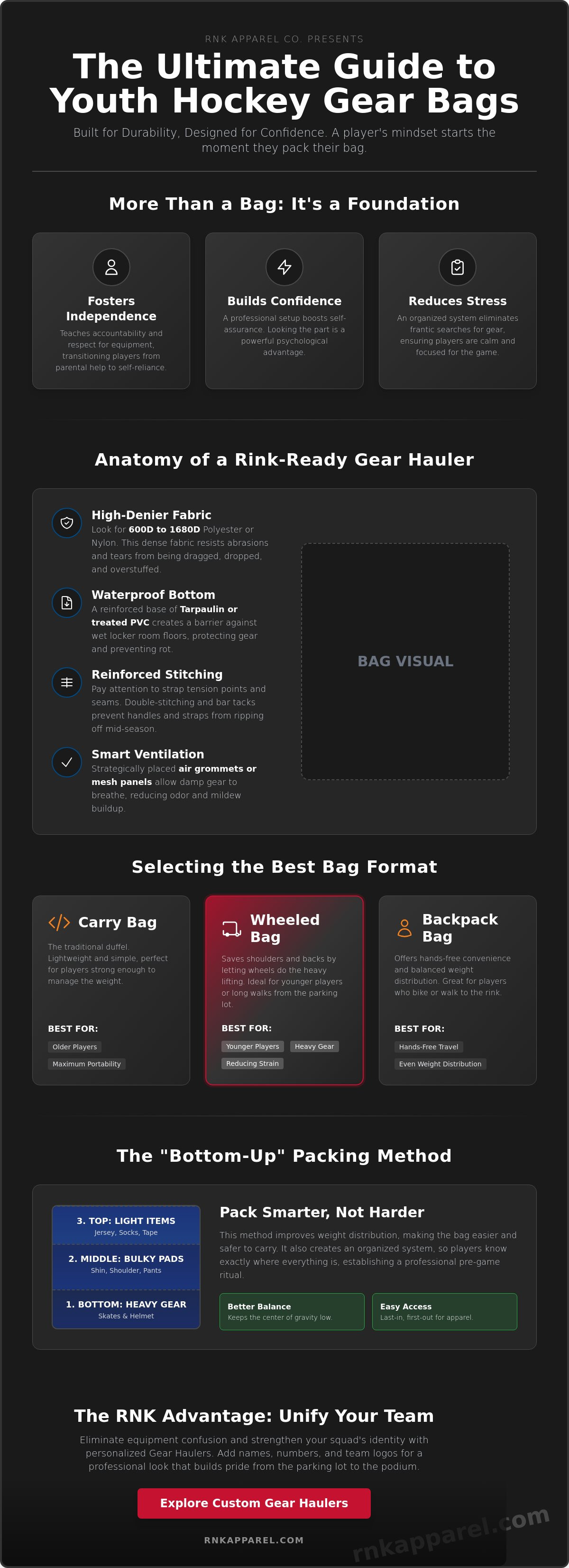
The primary failure point for most bags is the fabric. You need high-denier materials to withstand being dragged across asphalt or shoved into tight locker room stalls. For context, denier count is a measure of fabric density and durability. Look for bags utilizing 600D to 1680D polyester or nylon. These fabrics resist abrasions and tears, even when packed to the brim with heavy pads. Combined with heavy-duty zippers, these materials ensure the bag won't burst at the seams during a mid-season tournament. If you want to keep your player's off-ice look as sharp as their bag, consider browsing our Gear Haulers: Tote and Bag Collection for supplementary storage that matches their drive.
Locker room floors are notoriously wet and dirty. A bag with a reinforced, waterproof bottom is essential. Materials like tarpaulin or treated PVC create a barrier between the damp floor and the dry gear inside. This protection is vital for maintaining the lifespan of the equipment. Properly storing and drying equipment helps maintain its structural integrity, which aligns with standard Hockey Safety Tips for preventing gear-related injuries. When the bag keeps the gear in top shape, the player stays safe on the ice.
Material Science for Rink Life
Water-resistant coatings are a must for families living in snow-heavy climates. These treatments prevent moisture from seeping through the fabric during the walk from the parking lot. Pay close attention to reinforced stitching at strap tension points. Double-stitched handles and padded shoulder straps distribute weight effectively, preventing the "ripped strap" syndrome that plagues cheaper alternatives. Durability is a choice. Choose gear that works as hard as the athlete.
Internal Organization and Pockets
Smart organization fosters player independence. Dedicated skate pockets are non-negotiable; they keep blades from slicing through jerseys or scratching helmets. Internal mesh compartments provide a home for small essentials like tape, mouthguards, and extra laces. For post-game management, separate laundry bags or wet-pockets isolate sweaty base layers from the rest of the kit. This separation improves airflow and makes the "hockey smell" much easier to manage. Find your style, organize your gear, and play at your peak.
Carry, Wheeled, or Backpack: Selecting the Best Format
Choosing the right format for a youth hockey gear bag is about more than just storage. It is a decision that balances physical development with rink-side practicality. Every choice you make for your player impacts their experience before they even step onto the ice. Whether they are lugging gear through a snow-covered parking lot or navigating a cramped locker room, the bag's format determines their level of independence and confidence.
The traditional carry bag remains a staple for a reason. It is the "old school" choice that builds functional strength and carries a certain locker room "cred." Many coaches prefer carry bags because they force players to be accountable for their own weight. However, for the youngest "Mite" players, wheeled bags are often a necessity. These bags allow smaller athletes to transport heavy equipment without straining their backs. The downside? Wheels often fail in the slush and snow of mid-winter tournaments. There is also a growing "wheeled bag stigma" as players move into older, more competitive tiers where carry bags are seen as a badge of maturity.
Mobility is the ultimate factor. Narrow locker room doors and steep arena stairs are the enemies of the oversized wheeled bag. If your player is constantly battling their bag just to get to the bench, it creates unnecessary pre-game frustration. A bag should support the athlete, not hinder them. Ensuring you have space for all necessary youth hockey safety equipment while maintaining mobility is a delicate balance that elite players are now solving with new designs.
The Rise of the Hybrid Backpack
In 2026, we are seeing a massive shift toward backpack-style bags among elite junior players. This trend is driven by ergonomics. Backpack straps distribute the weight of a youth hockey gear bag across both shoulders, protecting growing spines from the uneven load of a traditional carry strap. This hands-free design is a game changer. It allows players to carry their sticks and water bottles with ease. Junior players are moving away from wheels because backpacks offer superior mobility in tight spaces and snowy conditions.
Locker Room Etiquette and Bag Size
Space is a premium in the locker room. Oversized bags are the enemy of a focused team environment. When a bag takes up two stalls, it disrupts the flow of the pre-game ritual. Match your bag dimensions to your player's actual equipment size. A 30-inch bag is often plenty for youth kits. Teach your kid to pack "tight" by placing heavier items at the bottom. This saves space and makes the bag easier to carry. At RNK, we believe that respect for the game starts with respect for the locker room space.
Sizing and Organizing Your Gear Hauler for Efficiency
Finding the right youth hockey gear bag size is a balancing act. If the bag is too large, your player will struggle to maintain balance in the parking lot. If it's too small, you'll spend twenty minutes playing equipment Tetris after every game. For most youth players, a 30-inch bag provides the perfect footprint for standard pads and skates. As they transition into older age brackets or take on the goalie role, a 34-inch bag becomes necessary to accommodate the increased volume of protective gear. Efficiency starts with the right fit.
Organization is the secret to a fast locker room exit. We recommend the "Bottom-Up" packing method for better weight distribution. Start by placing the heaviest, bulkiest items like shin guards and pants at the bottom of the bag. This lowers the center of gravity, making the bag feel lighter and more stable during transport. Placing your jersey and socks on top keeps them crisp and ready for the pre-game ritual. A well-packed bag isn't just about space; it's about being ready to perform the moment you arrive.
Packing Like a Pro
Skate placement is critical for the longevity of your gear. Always use dedicated side pockets or blade guards to prevent the steel from slicing through your other equipment. Keep your "Core" essentials, such as your helmet, gloves, and shins, centrally located for easy access. Teaching your player to use their bag as a portable changing station keeps their gear off the damp locker room floor. This habit fosters independence and ensures nothing gets left behind in the post-game rush. If you need a secondary solution for extra layers or snacks, explore our RNK Gear Haulers: Tote and Bag Collection to stay organized in style.
Extending the Life of Your Gear Bag
A youth hockey gear bag is an investment that requires consistent maintenance. The most important rule is simple: air it out after every single practice. Leaving damp gear in a zipped bag is a recipe for mold and the dreaded "hockey smell." Use a damp cloth to wipe away salt and winter grime from the bag’s exterior to prevent fabric degradation. If zippers become sticky, a small amount of wax or specialized lubricant can prevent a mid-season break. When the seams begin to pull or the bottom reinforcement thins, it's time to consider a replacement. Regular care ensures your gear stays professional and your player stays confident. Work hard, play hard, and keep your kit in top condition.
The RNK Advantage: Custom Gear Haulers and Team Identity
A bag is more than just a place to store pads. It's a statement of intent. At RNK, we recognize that the right youth hockey gear bag can be a catalyst for team culture and individual confidence. While most manufacturers focus solely on the box, we focus on the player who carries it. Our made-to-order model prioritizes quality over mass production. This ensures that every piece of gear serves a specific purpose in the athlete's journey. We don't believe in one-size-fits-all solutions because every player has a unique story.
Personalization is at the heart of our mission. Adding a player's name and number isn't just about easy identification in a crowded hallway; it's about ownership. When a young athlete sees their name on their youth hockey gear bag, they feel a deep sense of accountability to their performance. This level of customization was once reserved for professional organizations with massive budgets. Our "No Minimum Orders" policy changes that reality. Whether you have a full roster or a small development squad, high-quality custom gear is now accessible to everyone. It's a democratic approach to elite-level branding.
Confidence is Part of the Uniform
We often say that confidence is part of the uniform. This philosophy extends to every piece of equipment a player uses. Personalized gear impacts a young player's sense of belonging. It makes them feel like a valued part of the team before they even lace up. On a practical level, custom bags are essential during high-stakes tournaments. They prevent gear mix-ups in busy locker rooms where dozens of identical bags often end up in a single pile. You can easily integrate these bags into your Custom Team Apparel Store. This creates a unified look that starts the moment the team arrives at the arena.
Streamlined Ordering for Coaches and Managers
Managing a youth team involves enough logistics without worrying about equipment orders. We've simplified the process. Coaches and managers can set up a dedicated team portal where parents order their gear individually. This made-to-order fulfillment model eliminates the inventory headaches and financial risks of bulk buying. You don't have to collect checks, guess sizes, or store extra bags in your garage. Our RNK Gear Haulers combine "Core Comfort" with rugged performance. It's a seamless way to build team identity while staying focused on the game. Work hard, play hard, and let us handle the gear.
Build Your Legacy One Shift at a Time
Selecting the right youth hockey gear bag is about more than just finding a place for your pads. It's about investing in a system that supports your player's growth, organization, and pre-game focus. From choosing rugged fabrics to mastering the bottom-up packing method, every detail helps your athlete arrive at the rink ready to perform. You've seen how the right format and consistent maintenance can extend the life of your equipment while building essential locker room independence.
At RNK, we believe that looking the part is the first step toward playing the part. We provide made-to-order quality for every player, ensuring your gear stands up to the grit of the season. Because we offer no minimum orders for custom team gear, we're a flexible partner for small teams and individual families alike. It's why we're trusted by hockey families across the U.S. who know that confidence is part of the uniform. Explore Custom Gear Haulers and Team Bags at RNK Apparel and give your player the professional edge they deserve. Work hard, play hard, and own every moment on the ice.
Frequently Asked Questions
What size hockey bag does a youth player need?
Most youth players require a bag between 30 and 34 inches in length to accommodate their full equipment kit. A 30-inch bag is usually the sweet spot for younger athletes because it provides enough room for pads without becoming too heavy to carry. Choosing the right size ensures the gear stays snug and protected during transport to the rink.
Are wheeled hockey bags better for kids?
Wheeled bags are often better for the youngest players, such as Mites, who don't yet have the physical strength to carry heavy equipment. These bags reduce the strain on growing backs and make the trek from the parking lot much easier. However, keep in mind that wheels can struggle in deep snow or on stairs, so consider your typical rink environment.
How do I stop my youth hockey gear bag from smelling?
The best way to prevent odors is to unzip your youth hockey gear bag and air it out immediately after every practice. Removing damp base layers and jerseys for washing allows the internal compartments to dry completely. You can also use specialized gear sprays or moisture-absorbing inserts to neutralize bacteria before it has a chance to settle into the fabric.
Can I wash a hockey gear bag in the washing machine?
You shouldn't put a structured gear bag in the washing machine because the agitation can destroy the internal liners and waterproof coatings. Instead, use a soft brush with mild soap and warm water to scrub the interior and exterior surfaces by hand. Always allow the bag to air dry fully in a well-ventilated space to maintain its structural integrity.
What is the best material for a durable youth hockey bag?
High-denier polyester or ballistic nylon, specifically in the 600D to 1680D range, is the gold standard for a durable youth hockey gear bag. These fabrics are engineered to resist tears from skate blades and withstand the friction of being dragged across rough surfaces. Look for materials with a water-resistant finish to keep your gear dry in snowy climates.
How do I personalize a hockey bag for my child?
You can personalize a bag by adding custom heat-pressed names, player numbers, or team logos through a specialized provider like RNK. Our made-to-order model allows you to create a unique look that helps your player identify their gear instantly in a crowded locker room. Personalization builds a sense of ownership and reminds the athlete that confidence is part of the uniform.
Why are backpack hockey bags becoming more popular?
Backpack bags are gaining popularity because they distribute weight evenly across both shoulders to protect a young player's developing spine. This ergonomic design leaves the player's hands free to carry their sticks and water bottles safely. They are also much easier to maneuver through narrow arena hallways and crowded lobby spaces than traditional wide carry bags.
Is a 30-inch bag big enough for full youth hockey gear?
A 30-inch bag is typically large enough to hold a complete set of standard youth equipment for field players. It offers a compact and manageable size that most kids can handle independently without feeling overwhelmed by the bag's bulk. If your player is transitioning into junior sizes or carries extra goalie equipment, you may eventually need to upgrade to a 34-inch model.
Disclaimer
Some content published on this website may be developed with the assistance of AI-powered research and writing tools to help streamline research, organization, and content creation. All articles are reviewed, edited, and approved by RNK Apparel Co. to ensure they align with our perspectives, experience, and intended messaging.
While we strive to provide accurate and up-to-date information, blog content is intended for informational and educational purposes only and should not be considered legal, financial, or professional advice. Readers should independently verify information and consult qualified professionals when appropriate.
